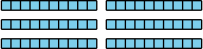
The purpose of this How Many Do You See? is for students to use grouping strategies to describe the images they see.
When students use grouping to find the total in a multiple of tens, they look for and make use of structure (MP7).
Launch
Groups of 2
“How many do you see? How do you see them?”
Flash the image.
30 seconds: quiet think time
Teacher Instructions
Display the image.
“Discuss your thinking with your partner.”
1 minute: partner discussion
Record responses.
Student Task
How many do you see? How do you see them?
Solution Steps (3)
1
Look at base ten diagram
→See 6 tens arranged in pattern
2
Identify groupings
→6 groups of 10, or 2 per row × 3 rows, or 3 per column × 2 columns
3
Calculate total
→6 × 10 = 60
Sample Response
60. Sample responses:
I see 6 groups of 10.
I see 2 tens in each row and there’s 3 rows, so there are 6 tens.
I see 2 tens in each group and there are 3 groups, so there are 6 tens.
I see 2 groups of 3 tens, so there’s 6 tens.
Activity Synthesis (Teacher Notes)
“What expressions could we record for the different ways that students saw the tens?” (6×10, because some students saw 6 groups of 10. 3×(10×2), because some students saw 2 rows of 10, then multiplied by 3. (3×10)×2, because some students multiplied 3 times 10 for each column, then multiplied by 2.)
Consider asking:
“Who can restate in different words the way _____ saw the tens?”
“Did anyone see the tens the same way but would explain it differently?”
“Does anyone want to add an observation to the way _____ saw the tens?”
Standards
Addressing
3.NBT.3·Multiply one-digit whole numbers by multiples of 10 in the range 10—90 (e.g., 9 × 80, 5 × 60) using strategies based on place value and properties of operations.
3.NBT.A.3·Multiply one-digit whole numbers by multiples of 10 in the range 10–90 (e.g., <span class="math">\(9 \times 80\)</span>, <span class="math">\(5 \times 60\)</span>) using strategies based on place value and properties of operations.
Press enter or space to select a node. You can then use the arrow keys to move the node around. Press delete to remove it and escape to cancel.
Press enter or space to select an edge. You can then press delete to remove it or escape to cancel.
Relate Multiplication and Division
10 min
Narrative
The purpose of this How Many Do You See? is for students to use grouping strategies to describe the images they see.
When students use grouping to find the total in a multiple of tens, they look for and make use of structure (MP7).
Launch
Groups of 2
“How many do you see? How do you see them?”
Flash the image.
30 seconds: quiet think time
Teacher Instructions
Display the image.
“Discuss your thinking with your partner.”
1 minute: partner discussion
Record responses.
Student Task
How many do you see? How do you see them?
Solution Steps (3)
1
Look at base ten diagram
→See 6 tens arranged in pattern
2
Identify groupings
→6 groups of 10, or 2 per row × 3 rows, or 3 per column × 2 columns
3
Calculate total
→6 × 10 = 60
Sample Response
60. Sample responses:
I see 6 groups of 10.
I see 2 tens in each row and there’s 3 rows, so there are 6 tens.
I see 2 tens in each group and there are 3 groups, so there are 6 tens.
I see 2 groups of 3 tens, so there’s 6 tens.
Activity Synthesis (Teacher Notes)
“What expressions could we record for the different ways that students saw the tens?” (6×10, because some students saw 6 groups of 10. 3×(10×2), because some students saw 2 rows of 10, then multiplied by 3. (3×10)×2, because some students multiplied 3 times 10 for each column, then multiplied by 2.)
Consider asking:
“Who can restate in different words the way _____ saw the tens?”
“Did anyone see the tens the same way but would explain it differently?”
“Does anyone want to add an observation to the way _____ saw the tens?”
Standards
Addressing
3.NBT.3·Multiply one-digit whole numbers by multiples of 10 in the range 10—90 (e.g., 9 × 80, 5 × 60) using strategies based on place value and properties of operations.
3.NBT.A.3·Multiply one-digit whole numbers by multiples of 10 in the range 10–90 (e.g., <span class="math">\(9 \times 80\)</span>, <span class="math">\(5 \times 60\)</span>) using strategies based on place value and properties of operations.