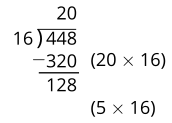
The purpose of this Warm-up is for students to analyze the structure of a partial-quotients algorithm, which will be useful when students use this method to divide multi-digit numbers in a later activity. Students have seen partial-quotients algorithms in grade 4. The new aspect to these calculations in grade 5 is that the dividend is now a two-digit number. While students may notice and wonder many things about this image, the purpose of subtraction and the relationship between multiplication and division are the important discussion points.
Launch
Groups of 2
Display the image.
“What do you notice? What do you wonder?”
1 minute: quiet think time
Teacher Instructions
“Discuss your thinking with your partner.”
1 minute: partner discussion
Share and record responses.
Student Task
What do you notice? What do you wonder?
Divide. four hundred forty eight divided by 16, 5 rows. First row: 20. Second row: 16, long division symbol with four hundred forty eight inside. Third row: minus three hundred twenty. In parentheses, 20 times 16. Horizontal line. Fourth row: one hundred twenty eight. Fifth row: blank. In parentheses, 5 times 16.
Sample Response
Students may notice:
There are multiplication expressions on the side.
5×16 doesn’t have anything written next to it.
They multiplied 16 by 20 and then wrote the 20 above the 448.
This looks like how we divided in grade 4.
Students may wonder:
Are they finished solving the problem?
What will they do next?
Activity Synthesis (Teacher Notes)
“This is an algorithm used to divide whole numbers. The algorithm is not complete. What might you do next?” (Find 5×16, and then subtract it from 128.)
Standards
Addressing
5.NBT.6·Find whole-number quotients of whole numbers with up to four-digit dividends and two-digit divisors, using strategies based on place value, the properties of operations, and/or the relationship between multiplication and division. Illustrate and explain the calculation by using equations, rectangular arrays, and/or area models.
5.NBT.B.6·Find whole-number quotients of whole numbers with up to four-digit dividends and two-digit divisors, using strategies based on place value, the properties of operations, and/or the relationship between multiplication and division. Illustrate and explain the calculation by using equations, rectangular arrays, and/or area models.
20 min
15 min
Knowledge Components
All skills for this lesson
No KCs tagged for this lesson
A Partial-Quotients Algorithm
10 min
Narrative
The purpose of this Warm-up is for students to analyze the structure of a partial-quotients algorithm, which will be useful when students use this method to divide multi-digit numbers in a later activity. Students have seen partial-quotients algorithms in grade 4. The new aspect to these calculations in grade 5 is that the dividend is now a two-digit number. While students may notice and wonder many things about this image, the purpose of subtraction and the relationship between multiplication and division are the important discussion points.
Launch
Groups of 2
Display the image.
“What do you notice? What do you wonder?”
1 minute: quiet think time
Teacher Instructions
“Discuss your thinking with your partner.”
1 minute: partner discussion
Share and record responses.
Student Task
What do you notice? What do you wonder?
Divide. four hundred forty eight divided by 16, 5 rows. First row: 20. Second row: 16, long division symbol with four hundred forty eight inside. Third row: minus three hundred twenty. In parentheses, 20 times 16. Horizontal line. Fourth row: one hundred twenty eight. Fifth row: blank. In parentheses, 5 times 16.
Sample Response
Students may notice:
There are multiplication expressions on the side.
5×16 doesn’t have anything written next to it.
They multiplied 16 by 20 and then wrote the 20 above the 448.
This looks like how we divided in grade 4.
Students may wonder:
Are they finished solving the problem?
What will they do next?
Activity Synthesis (Teacher Notes)
“This is an algorithm used to divide whole numbers. The algorithm is not complete. What might you do next?” (Find 5×16, and then subtract it from 128.)
Standards
Addressing
5.NBT.6·Find whole-number quotients of whole numbers with up to four-digit dividends and two-digit divisors, using strategies based on place value, the properties of operations, and/or the relationship between multiplication and division. Illustrate and explain the calculation by using equations, rectangular arrays, and/or area models.
5.NBT.B.6·Find whole-number quotients of whole numbers with up to four-digit dividends and two-digit divisors, using strategies based on place value, the properties of operations, and/or the relationship between multiplication and division. Illustrate and explain the calculation by using equations, rectangular arrays, and/or area models.