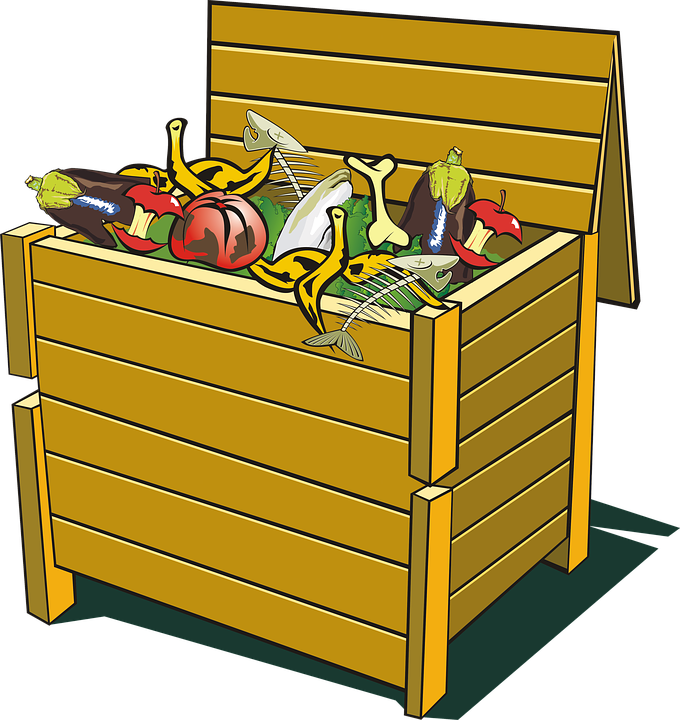
The purpose of this Warm-up is to elicit ideas about the context of food waste, which will be useful when students keep a journal of food waste in a later activity. While students may notice and wonder many things about this illustration, what students consider to be food waste in their neighborhood or community is the important discussion point.
Launch
Groups of 2
Display the image.
“What do you notice? What do you wonder?”
1 minute: quiet think time
Teacher Instructions
“Discuss your thinking with your partner.”
1 minute: partner discussion
Share and record responses.
Student Task
What do you notice? What do you wonder?
Sample Response
Students may notice:
There is a trash dumpster filled with food.
There are bones and fish skeletons.
Some food is eaten, but other food looks uneaten.
There are two whole eggplants.
Students may wonder:
How much more food is in the dumpster?
How much does this all weigh?
Why was the food thrown out?
Activity Synthesis (Teacher Notes)
"What kinds of things do we throw out when we cook or eat at home or outside?” (food scraps, leftover food, spoiled ingredients or food, packaging for food)
“What are some reasons we throw out food?” (It’s spoiled. It smells or looks bad. We don't want it anymore. It’s too old. It fell on the floor.)
Record responses on a chart, and keep it displayed.
Standards
Building Toward
5.NBT.5·Fluently multiply multi-digit whole numbers using the standard algorithm.
5.NBT.B.5·Fluently multiply multi-digit whole numbers using the standard algorithm.
20 min
20 min
Knowledge Components
All skills for this lesson
No KCs tagged for this lesson
Food-Waste Journal
10 min
Narrative
The purpose of this Warm-up is to elicit ideas about the context of food waste, which will be useful when students keep a journal of food waste in a later activity. While students may notice and wonder many things about this illustration, what students consider to be food waste in their neighborhood or community is the important discussion point.
Launch
Groups of 2
Display the image.
“What do you notice? What do you wonder?”
1 minute: quiet think time
Teacher Instructions
“Discuss your thinking with your partner.”
1 minute: partner discussion
Share and record responses.
Student Task
What do you notice? What do you wonder?
Sample Response
Students may notice:
There is a trash dumpster filled with food.
There are bones and fish skeletons.
Some food is eaten, but other food looks uneaten.
There are two whole eggplants.
Students may wonder:
How much more food is in the dumpster?
How much does this all weigh?
Why was the food thrown out?
Activity Synthesis (Teacher Notes)
"What kinds of things do we throw out when we cook or eat at home or outside?” (food scraps, leftover food, spoiled ingredients or food, packaging for food)
“What are some reasons we throw out food?” (It’s spoiled. It smells or looks bad. We don't want it anymore. It’s too old. It fell on the floor.)
Record responses on a chart, and keep it displayed.
Standards
Building Toward
5.NBT.5·Fluently multiply multi-digit whole numbers using the standard algorithm.
5.NBT.B.5·Fluently multiply multi-digit whole numbers using the standard algorithm.