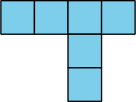
Select all of the nets that can be folded and assembled into a cube.
A.
B.
C.
D.
E.
Answer:A, B
2.
Polyhedron P is a cube with a corner removed and relocated to the top of P. Polyhedron Q is a cube with the same size base as Polyhedron P. How do their surface areas compare?
P
Q
A.
Q’s surface area is less than P’s surface area.
B.
Q’s surface area is equal to P’s surface area.
C.
Q’s surface area is greater than P’s surface area.
D.
There is not enough information given to compare their surface areas.
Answer:
Q’s surface area is less than P’s surface area.
Teaching Notes
Students who select Choice B are correct that the large cube has the same surface area before and after the small cube is removed, but they may be forgetting that putting the small cube back on top also contributes to the surface area. Or, students who select Choice B may be confusing surface area with volume. Students who select Choice D may not believe that the problem can be solved without specific measurements, such as a side length.
3.
For a cube whose side length is 4 inches, the expression 43 could represent . . .
A.
The length of 3 cubes lined up, in inches
B.
The cube’s surface area in square inches
C.
The cube’s volume in cubic inches
D.
The total volume of 3 cubes, in cubic inches
Answer:
The cube’s volume in cubic inches
Teaching Notes
Students who select Choice A may be confusing 43 with 3⋅4. Students who select Choice B may be confusing surface area with volume. Students who select Choice D may think that 4 could represent the volume of a single cube.
4.
A square has an area of 16 cm2. What is the length of each of its sides?
A square has a side length of 8 cm. What is its area?
Answer:
4 cm
64 cm2
Teaching Notes
This problem has students find the side length when the area of square is given, and then find the area of a square when its side length is given.
5.
Here is a list of expressions. Order them from least to greatest.
402
83
103
7⋅82
104
Answer:
7⋅82,83,103,402,104
Teaching Notes
Students will evaluate the expressions involving exponents. Students who fail to correctly rearrange these expressions may not have a clear understanding of the definition of bases and exponents.
6.
A rectangular prism measures 3 cm by 2 cm by 2 cm. What is its surface area? Explain or show your reasoning.
A rectangular prism with three faces showing. Two faces are rectangles, each with a height of 2 centimeters and a length of 3 centimeters. The third face is a square, with side length of 2 centimeters.
Answer:
The surface area is 32 cm2. Sample reasoning: The left and right faces each have an area of 4 cm2. The top, bottom, front, and back faces each have an area of 6cm2. (2⋅4)+(4⋅6)=32
Minimal Tier 1 response:
Work is complete and correct.
Sample: 2⋅2+2⋅2+3⋅2+3⋅2+3⋅2+3⋅2=32, so 32 cm2.
Tier 2 response:
Work shows general conceptual understanding and mastery, with some errors.
Sample errors: Work shows the correct surface area but does not include reasoning or units. Work contains arithmetic mistakes but still indicates an intent to add up the areas of the six faces. Response (with work shown) is the sum of the areas of the three visible faces only.
Tier 3 response:
Significant errors in work demonstrate lack of conceptual understanding or mastery.
Sample errors: Student calculates a different quantity, such as volume or the area of only one face. Incorrect answer with no work is shown.
Teaching Notes
Students use an understanding of area in rectangles to find the surface area of a rectangular prism.
7.
Here is a net made of a square and four identical triangles. All measurements are given in centimeters.
If the net were folded and assembled, what type of polyhedron would it make?
What is the surface area of the polyhedron? Explain your reasoning.
Answer:
Square pyramid
The surface area is 72 cm2. Sample reasoning: The net is made of four triangles, each with a base of 4 cm and a height of 7 cm, as well as a square with side lengths of 4 cm. The four triangles each have an area of 14 cm2. The square has an area of 16 cm2. 4⋅14+16=72.
Minimal Tier 1 response:
Work is complete and correct, with complete explanation or justification.
Sample: A. Square pyramid B. (0.5)(4)(7)=14×4=56 , which is the total area of the 4 triangles, and the base has an area of 4 x 4 = 16. Because 56+16=7 , the surface area is 72cm2.
Tier 2 response:
Work shows good conceptual understanding and mastery, with either minor errors or correct work with insufficient explanation or justification.
Sample errors: Arithmetic errors accompany otherwise correct work. The area of one face is missing or incorrect. Units are omitted. Surface area is correct and well-justified but the polyhedron is incorrect yet somewhat reasonable, such as a triangular pyramid or rectangular prism.
Tier 3 response:
Work shows a developing but incomplete conceptual understanding, with significant errors.
Sample errors: The shape is correctly identified as a square pyramid but work shows little progress on finding the surface area. No reasonable attempt is made at identifying the polyhedron (or an answer like “squares and triangles”). Surface area calculations involve serious mistakes such as incorrect processes for calculating the area of a triangle. Work includes a significant error in one part but a correct answer in the other part.
Tier 4 response:
Work includes major errors or omissions that demonstrate a lack of conceptual understanding and mastery.
Sample errors: Omissions or Tier 3 errors across both problem parts.
Teaching Notes
Students identify the polyhedron associated with a net and calculate its surface area.