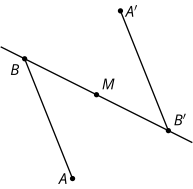
Line segment A’B’ is the image of AB after a 180∘ rotation around point M. Select all of the true statements about the figure.
A.
Angle ABM and angle A’B’M are vertical angles.
B.
AB is the same length as A’B’.
C.
AB is the same length as BB’.
D.
AB is parallel to A’B’.
E.
Angle ABM is the same measure as angle A’B’M.
Answer:B, D, E
Teaching Notes
Students who select choice A may identify that the angles are the same measure but do not recall that vertical angles share a vertex. Students who select choice C identify parts of the figure that are not corresponding parts as having the same length.
2.
Select all the pairs where Figure H is the image of Figure G after a reflection, rotation, or translation.
A
B
C
D
E
F
A.
Pair A
B.
Pair B
C.
Pair C
D.
Pair D
E.
Pair E
F.
Pair F
Answer:
A, B, E, F
Teaching Notes
Segment lengths and angle measures are preserved by translations, reflections, and rotations. If two shapes do not have the same side lengths or angles, then one of them cannot be obtained from the other by a rigid transformation.
3.
Which sequence of transformations would return a shape to its original position?
A.
Translate 5 units right, then 5 units down
B.
Translate 3 units down, then 2 units up, and then 1 unit down
C.
Rotate 120∘ counterclockwise around center C, then rotate 240∘ clockwise around C again
D.
Reflect over line ℓ, then reflect over line ℓ again
Answer:
D
Teaching Notes
Students who select choice A or choice B may be struggling with understanding a sequence of translations. Students who select choice C may incorrectly add the angle measures of the rotation or not consider the direction of the rotations. Students who do not select choice D may have trouble visualizing a reflection over a line which is not drawn for them.
4.
Point A is located at coordinates (1,-3).
What are the coordinates of each point?
Point B is the image of A after a reflection using the y-axis, then a translation 3 units to the left.
Point C is the image of A after a reflection using the x-axis, then a translation 4 units to the right.
Point D is the image of A after a rotation of 180∘ using (0,0) as center.
Answer:
Point B:(-4,-3)
Point C:(5,3)
Point D:(-1,3)
Teaching Notes
In order to apply rigid transformations to polygons and other shapes, students practice applying them to single points. Lines of reflection are restricted to the x- and y-axes, while rotations are about the origin and are multiples of 90∘.
5.
Here are three pairs of figures:
Pair 1
Pair 2
Pair 3
In Pair 1, which transformation takes Figure A to Figure B:
a translation, rotation, or reflection?
In Pair 2, which transformation takes Figure A to Figure B:
a translation, rotation, or reflection?
In Pair 3, which transformation takes Figure A to Figure B:
a translation, rotation, or reflection?
Answer:
Reflection
Translation
Rotation
Teaching Notes
Students are presented with a shape and an image that is a translation, rotation, or reflection of the given shape. Students then identify the translation, rotation, or reflection. For this task, the shapes are on a grid.
6.
Describe a sequence of transformations that takes Figure Q to Figure P.
Answer:
Sample response: Translate Figure Q down 1 unit, and then reflect this image across the vertical line that goes through (1,0).
Minimal Tier 1 response:
Work is complete and correct.
Sample: Translate Figure Q down 1 unit, then reflect this image across the vertical line that goes through (1,0).
Tier 2 response:
Work shows general conceptual understanding and mastery, with some errors.
Sample errors: Students describe a correct sequence of transformations but may fail to identify the line of reflection or give the wrong direction for a translation.
Tier 3 response:
Significant errors in work demonstrate lack of conceptual understanding or mastery.
Two or more minor errors that result in an incorrect answer.
Sample errors: Omitted explanations; stating that Figure P is the image of Figure Q.
Teaching Notes
There are many possible sequences of transformations that take Figure Q to Figure P. Any valid sequence must include a reflection.
7.
Draw the image of this figure after a reflection using line ℓ.
The figure on the left is rotated 90∘ clockwise around point P to form the image on the right. Use the information in the original figure to label the corresponding side lengths and angle measures of the image.
Answer:
2.
Minimal Tier 1 response:
Work is complete and correct, with complete explanation or justification.
Sample: See diagram. The image is drawn correctly, with all vertices in correct locations, and all edges drawn.
Tier 2 response:
Work shows good conceptual understanding and mastery, with either minor errors or correct work with insufficient explanation or justification.
Sample errors: One point in the image for part a is incorrectly located; one angle or length in part b is incorrect.
Tier 3 response:
Work shows a developing but incomplete conceptual understanding, with significant errors.
Sample errors: More than one point in part a is incorrectly located; the image in part a is drawn a translation rather than a reflection or students used a different line of reflection; more than one angle or length in part b is incorrect, including the case where all angles and lengths have been drawn in as if the image were a translation of the original shape.
Tier 4 response:
Work includes major errors or omissions that demonstrate a lack of conceptual understanding and mastery.
Sample errors: Major errors or omissions in one problem part along with errors in the other; two or more error types from Tier 3 response.
Teaching Notes
A figure is given on a grid. Students apply a rigid transformation to the shape, drawing the final result. Students also identify and label corresponding parts in an image given information on the original figure.