1.
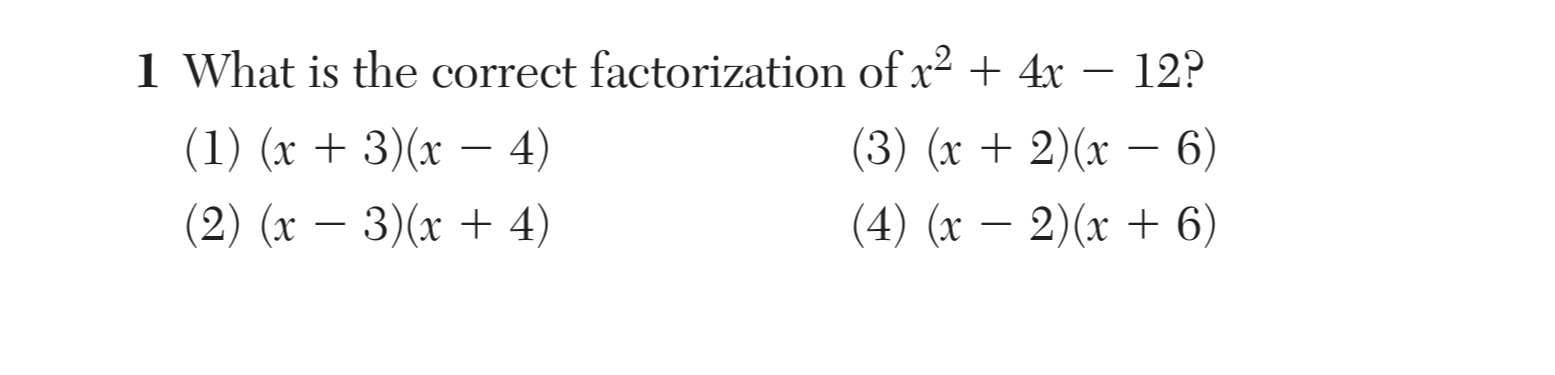
When factored, the expression is equivalent to
(1)
(2)
(3)
(4)
Task Image
Standard
NGLS.Math.Content.AI.A-SSE.A
Domain
Algebra
When factored, the expression is equivalent to
(1)
(2)
(3)
(4)
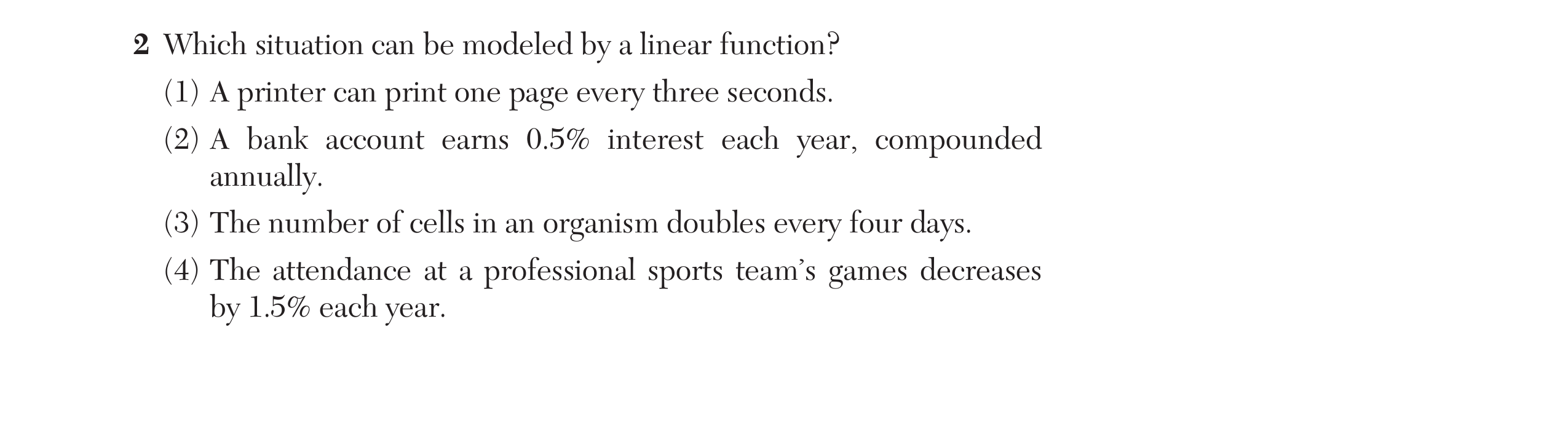
Which situation can be modeled by a linear function?
(1) A printer can print one page every three seconds.
(2) A bank account earns 0.5% interest each year, compounded annually.
(3) The number of cells in an organism doubles every four days.
(4) The attendance at a professional sports team's games decreases by 1.5% each year.
Which expression is equivalent to ?
(1)
(2)
(3)
(4)

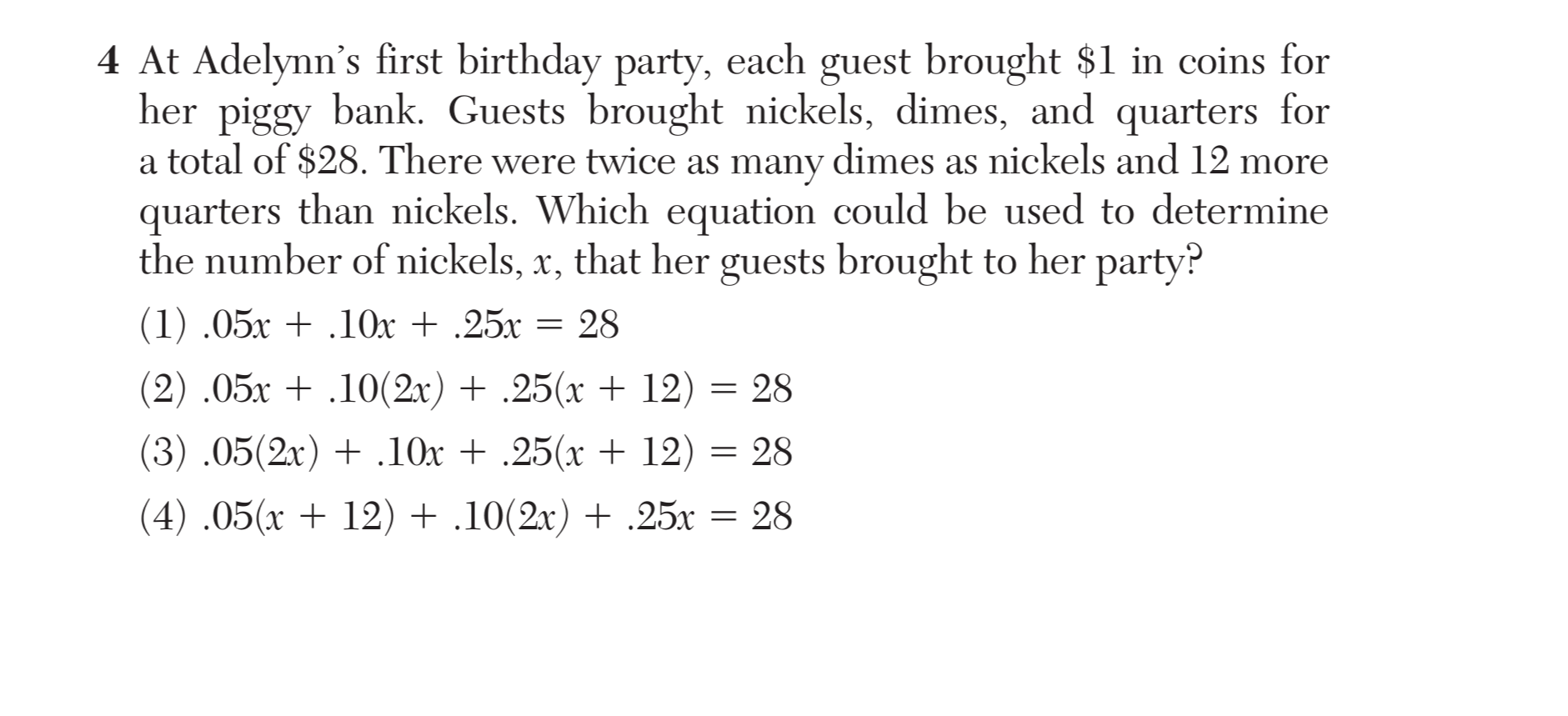
At Adelynn's first birthday party, each guest brought $1 in coins for her piggy bank. Guests brought nickels, dimes, and quarters for a total of $28. There were twice as many dimes as nickels and 12 more quarters than nickels. Which equation could be used to determine the number of nickels, , that her guests brought to her party?
(1)
(2)
(3)
(4)
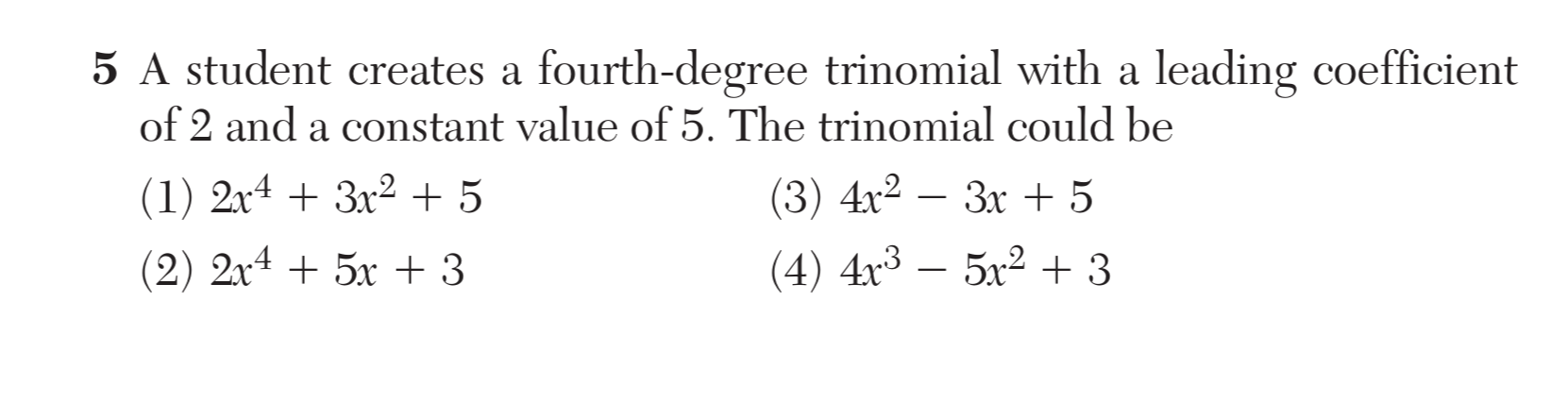
A student creates a fourth-degree trinomial with a leading coefficient of 2 and a constant value of 5. The trinomial could be
(1)
(2)
(3)
(4)
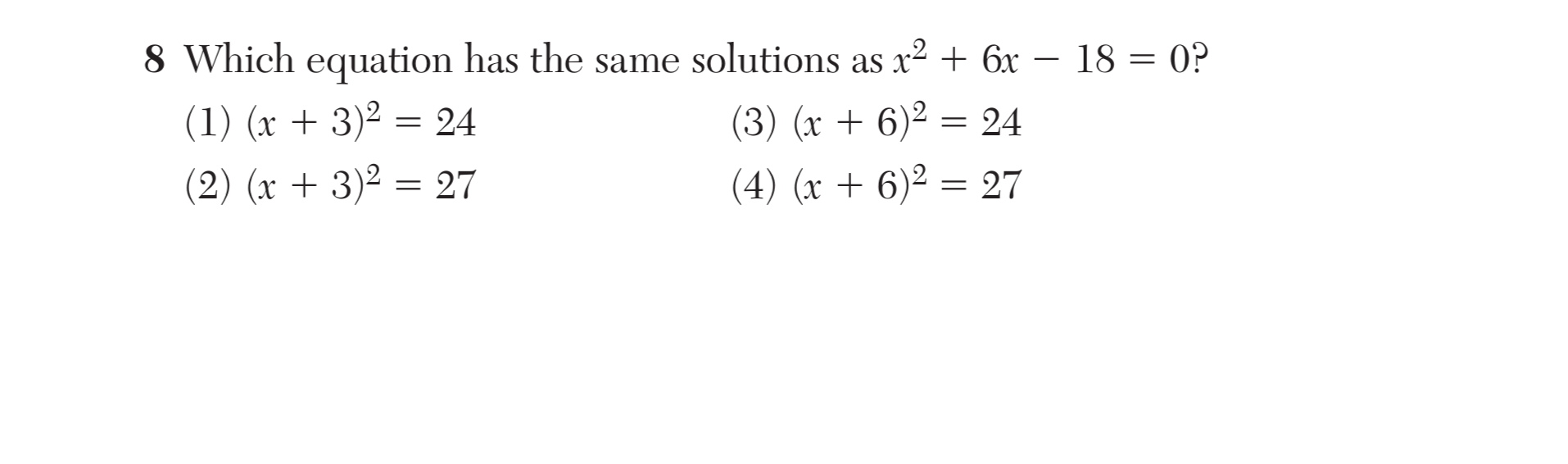
When solving the equation , Laura wrote as her first step. Which property justifies Laura's first step?
(1) distributive property of multiplication over addition
(2) multiplication property of equality
(3) commutative property of addition
(4) addition property of equality
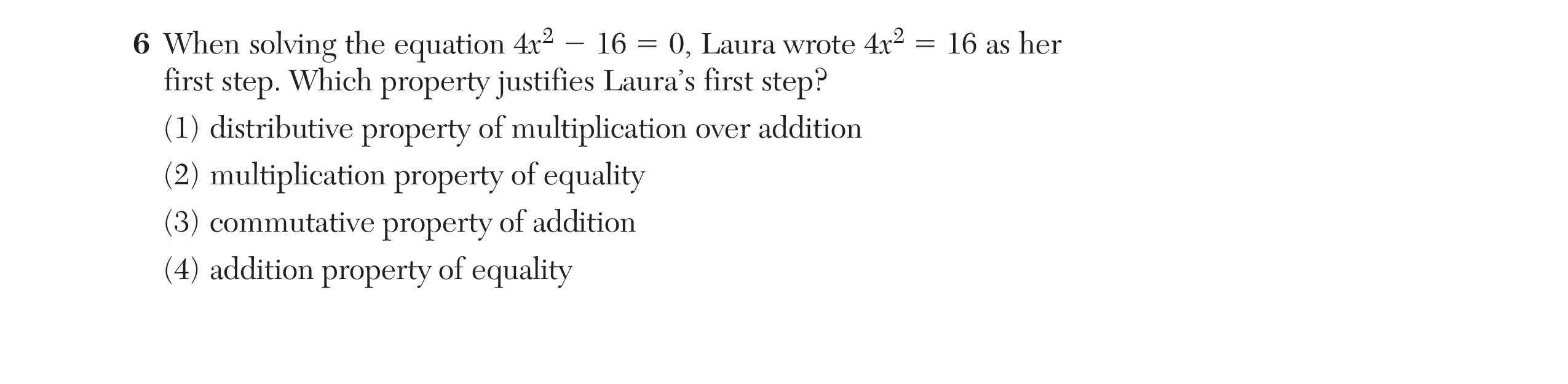
Which expression results in an irrational number?
(1)
(2)
(3)
(4)
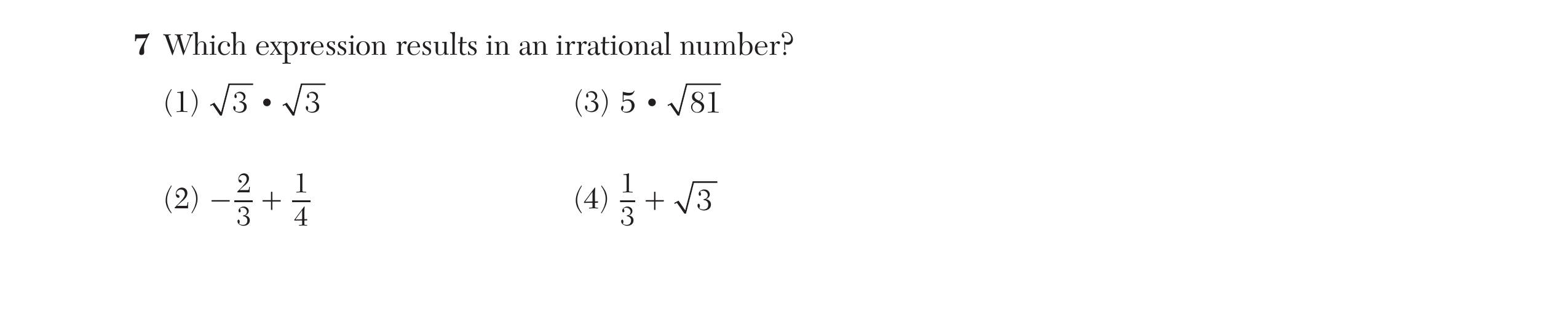
Which equation has the same solutions as ?
(1)
(2)
(3)
(4)
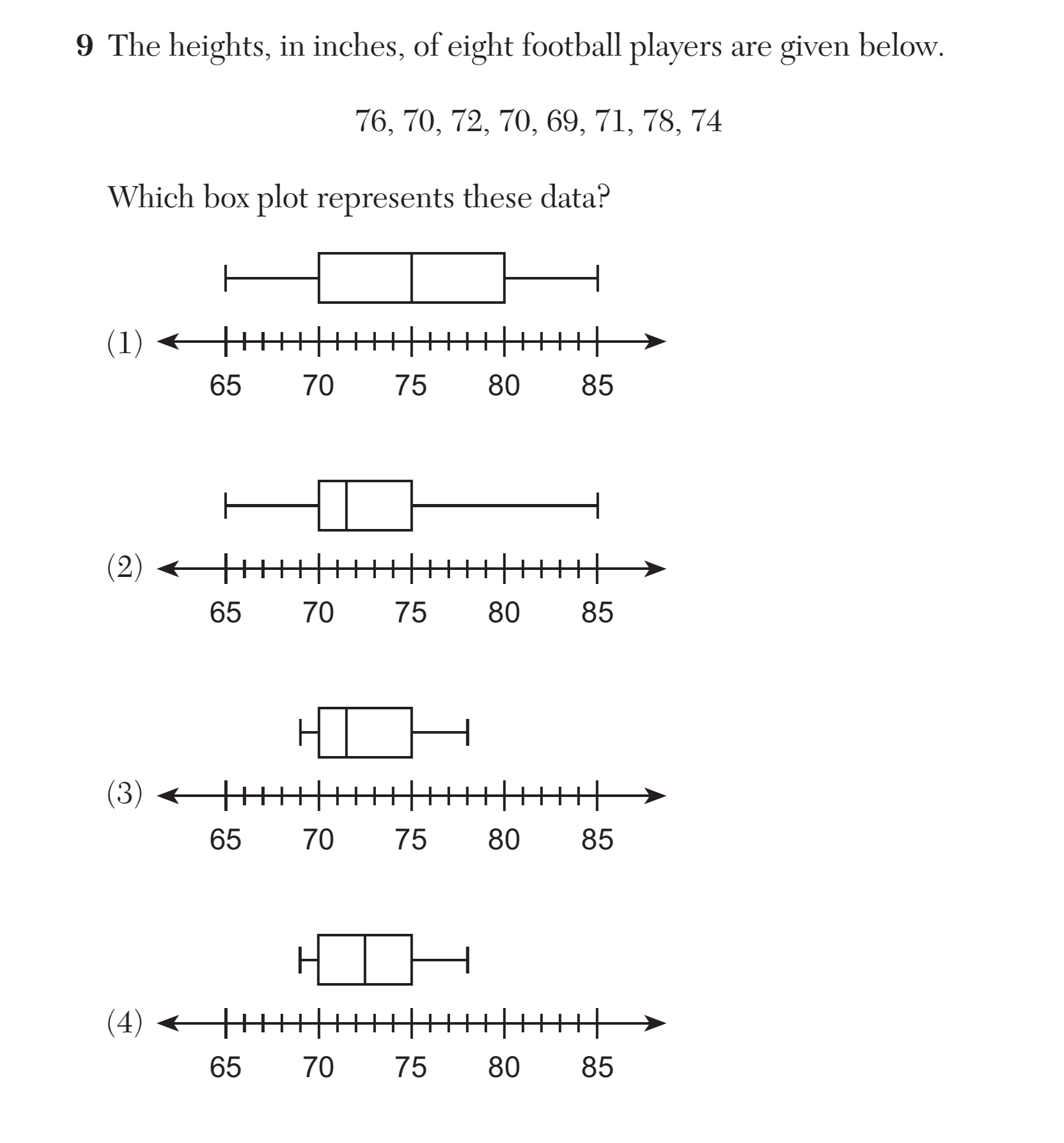
The heights, in inches, of eight football players are given below.
76, 70, 72, 70, 69, 71, 78, 74
Which box plot represents these data?
Image Description: Four box-and-whisker plots are shown on number lines ranging from 65 to 85.
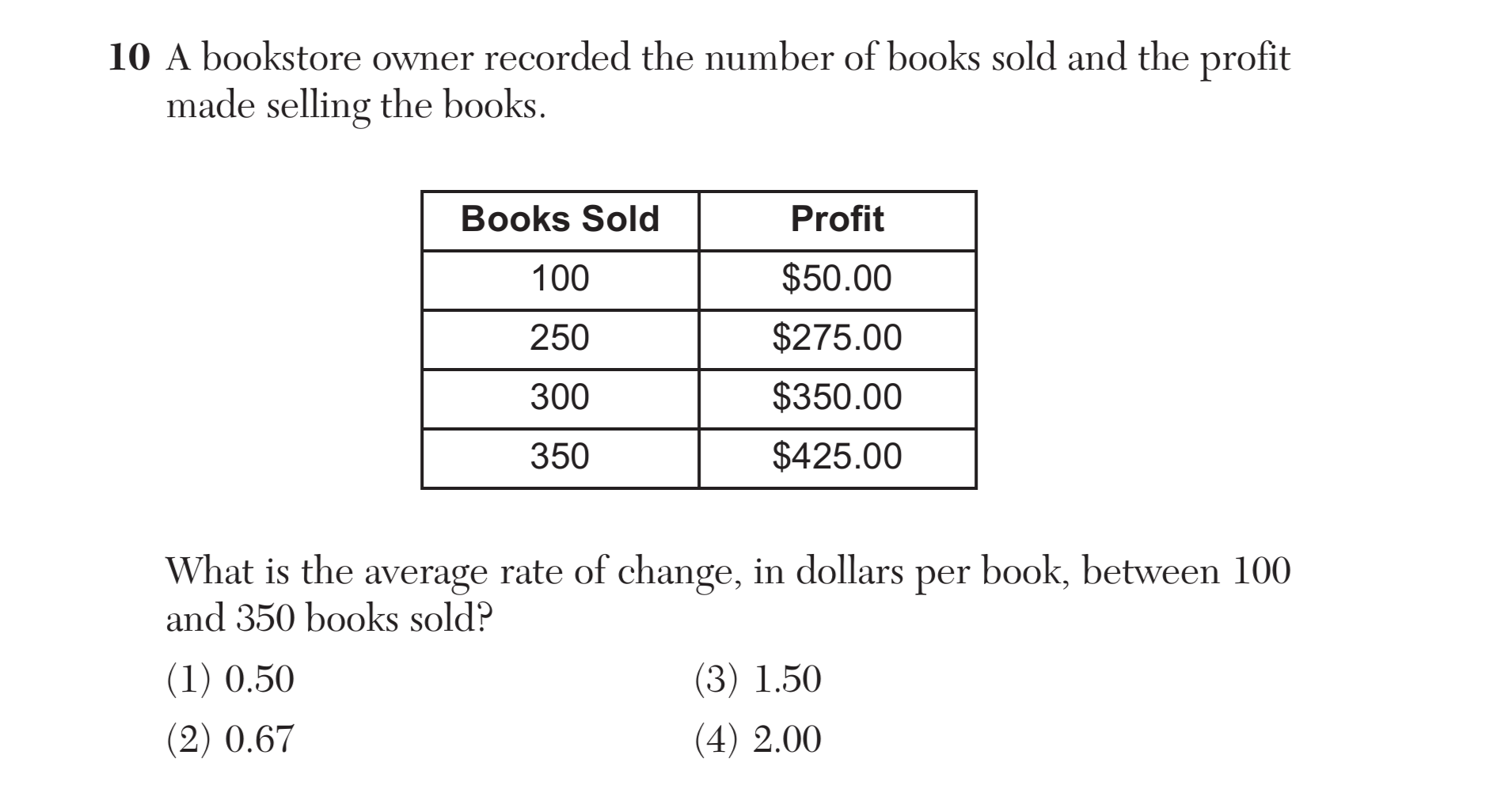
A bookstore owner recorded the number of books sold and the profit made selling the books.
| Books Sold | Profit |
|---|---|
| 100 | $50.00 |
| 250 | $275.00 |
| 300 | $350.00 |
| 350 | $425.00 |
What is the average rate of change, in dollars per book, between 100 and 350 books sold?
(1) 0.50
(2) 0.67
(3) 1.50
(4) 2.00
Nancy has just been hired for her first job. Her company gives her four choices for how she can collect her annual salary over the first eight years of employment.
Each function below represents the four choices she has for her annual salary in thousands of dollars, where represents the number of years after she is hired.
Which pay plan should Nancy choose in order to have the highest salary in her eighth year?
(1)
(2)
(3)
(4)
The third term in a sequence is 25 and the fifth term is 625. Which number could be the common ratio of the sequence?
(1)
(2)
(3)
(4)
The box plot below summarizes the data for the amount of snowfall, in inches, during the winter of 2021 for 12 locations in western New York.
Image Description: A box-and-whisker plot is shown on a number line labeled "Winter of 2021 Snowfall (inches)" with tick marks at 0, 20, 40, 60, 80, 100, 120, and 140. The left whisker extends from approximately 50 to 60. The box extends from approximately 60 (Q1) to 110 (Q3), with a median line at approximately 80. The right whisker ends at approximately 110, coinciding with Q3.
What is the interquartile range?
(1) 30
(2) 50
(3) 80
(4) 110

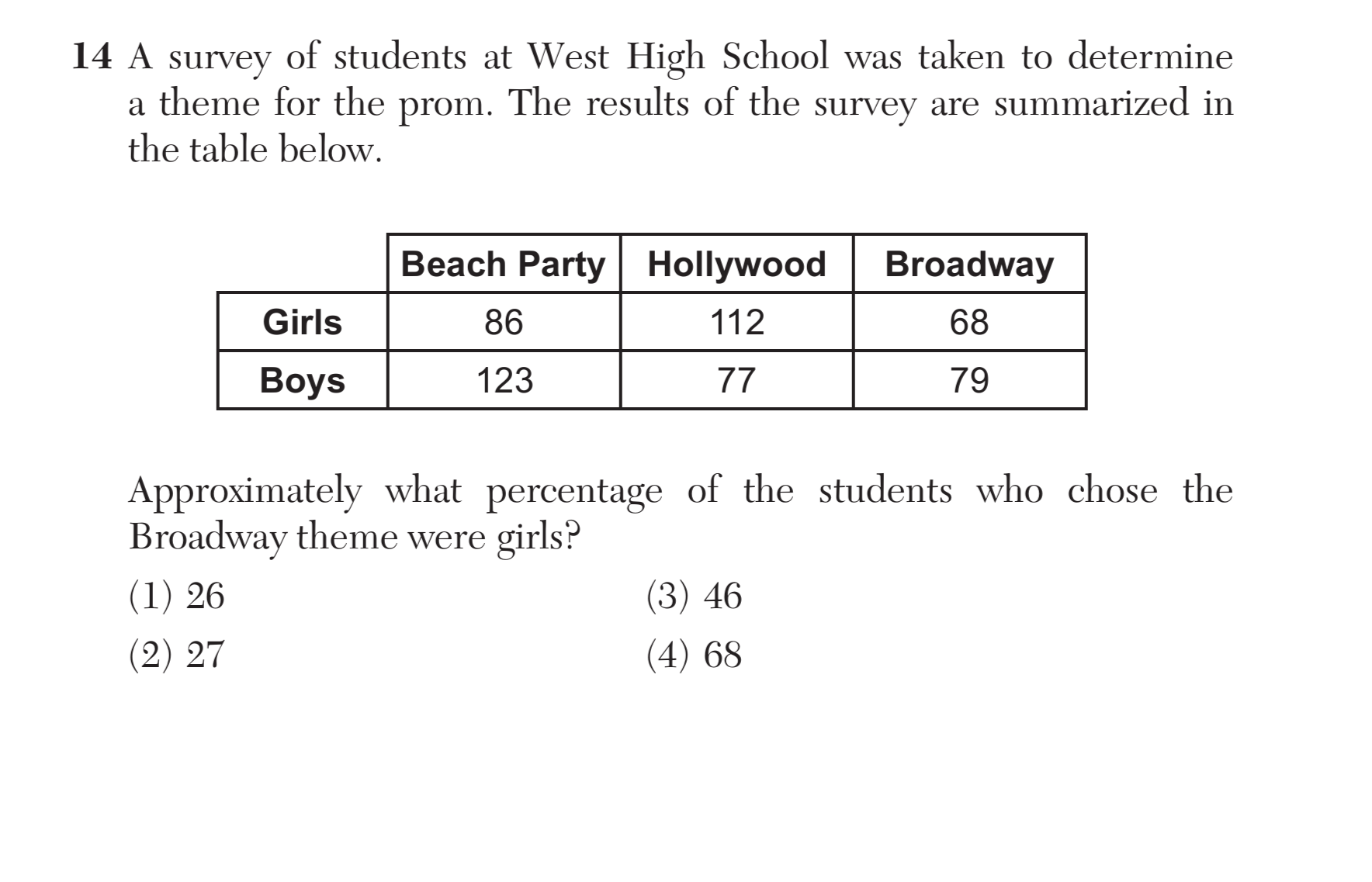
A survey of students at West High School was taken to determine a theme for the prom. The results of the survey are summarized in the table below.
| Beach Party | Hollywood | Broadway | |
|---|---|---|---|
| Girls | 86 | 112 | 68 |
| Boys | 123 | 77 | 79 |
Approximately what percentage of the students who chose the Broadway theme were girls?
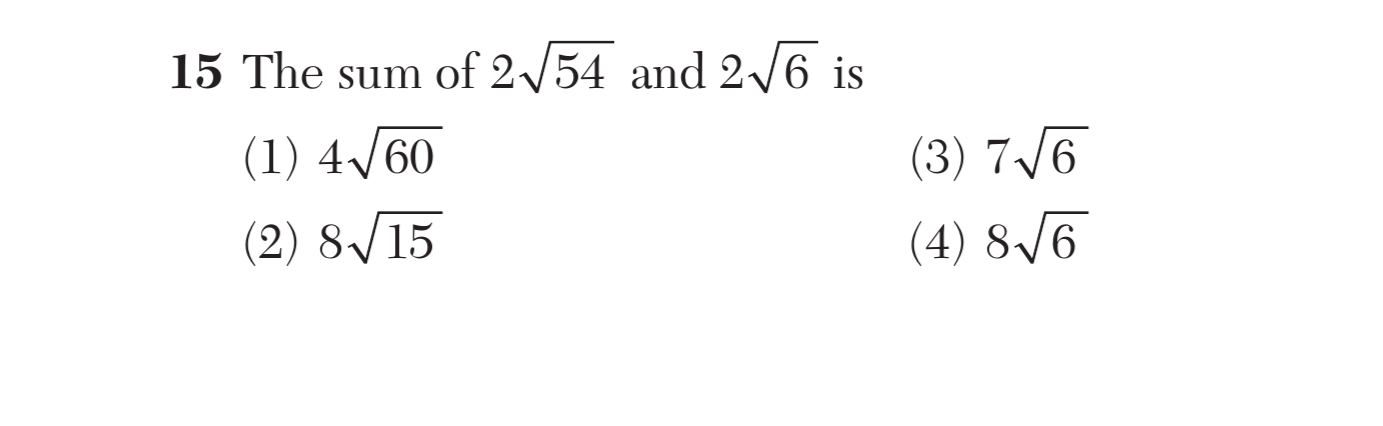
The sum of and is
The functions and are graphed on the same set of axes. What are the solutions to the equation ?

If and , then which polynomial is equivalent to the product of and ?

What is an equation of the line that passes through and has a slope of 2?

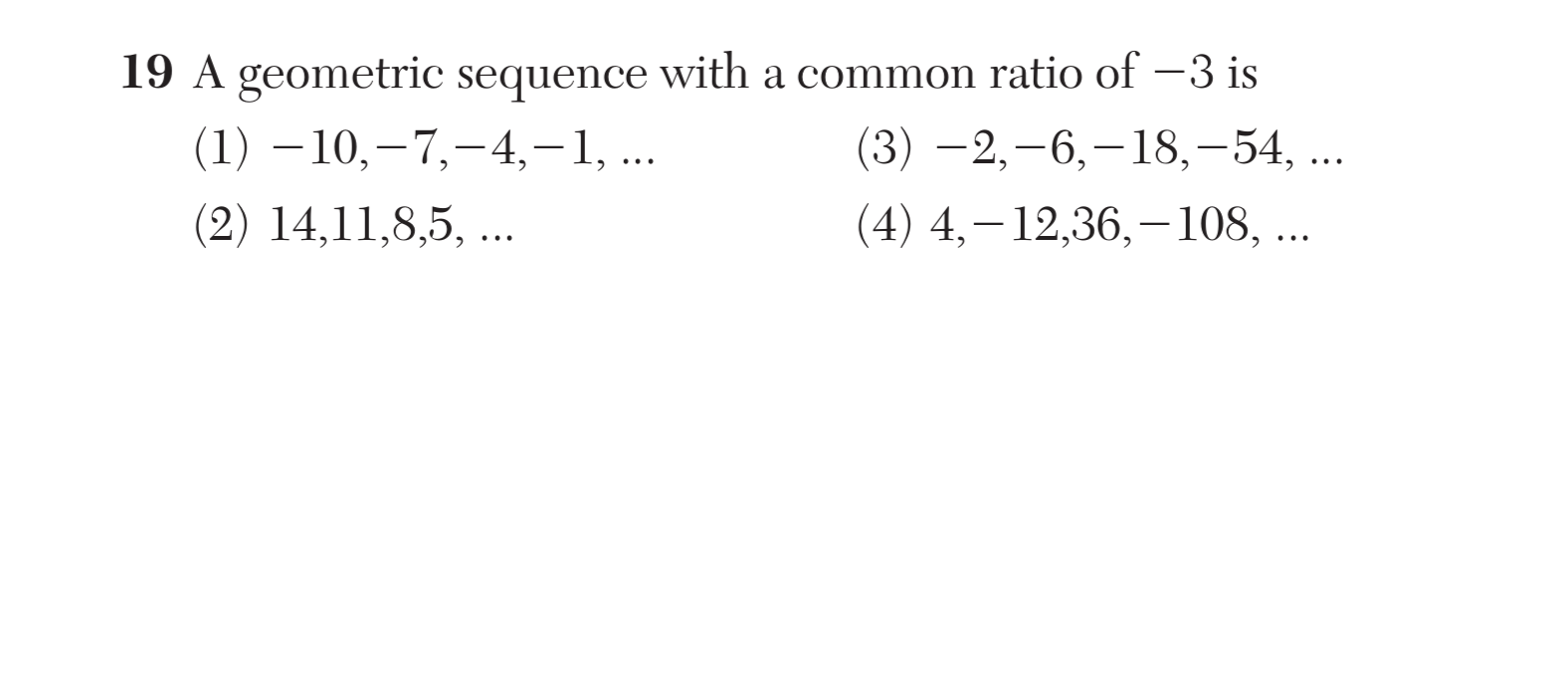
A geometric sequence with a common ratio of is
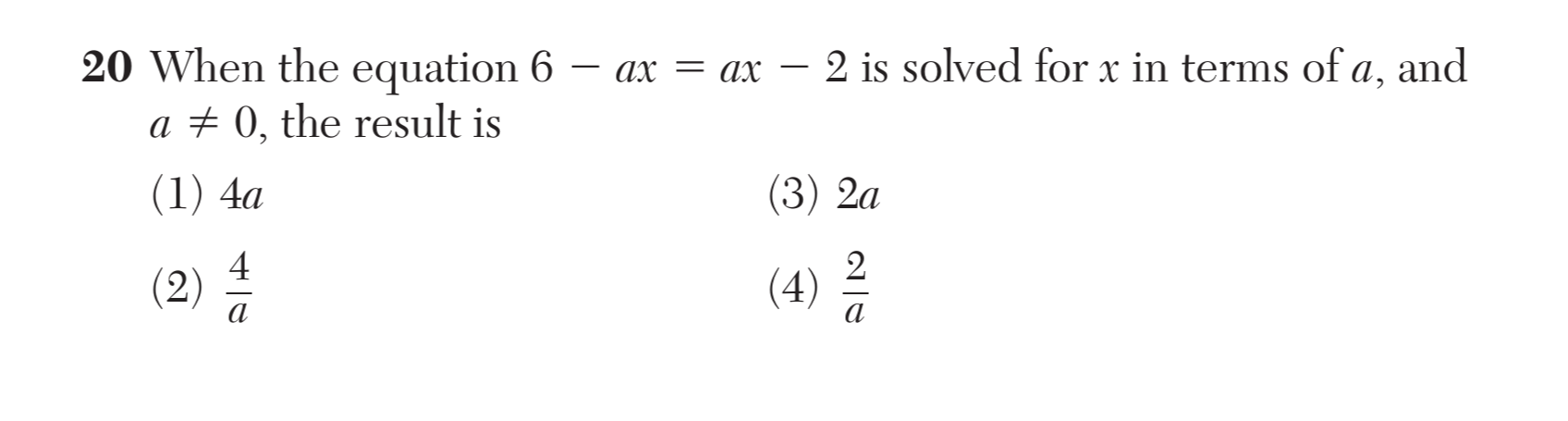
When the equation is solved for in terms of , and , the result is
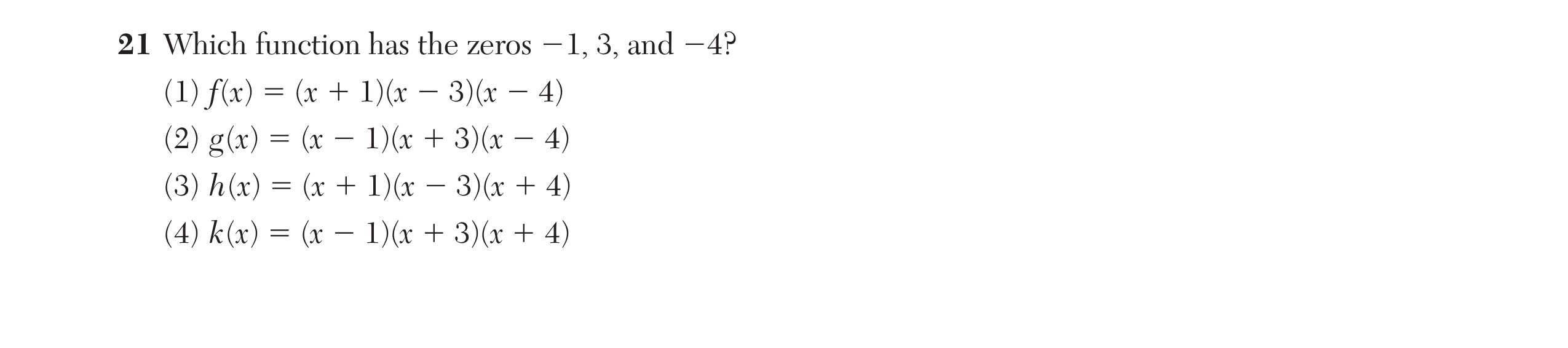
Which function has the zeros , , and ?
The expression is equivalent to

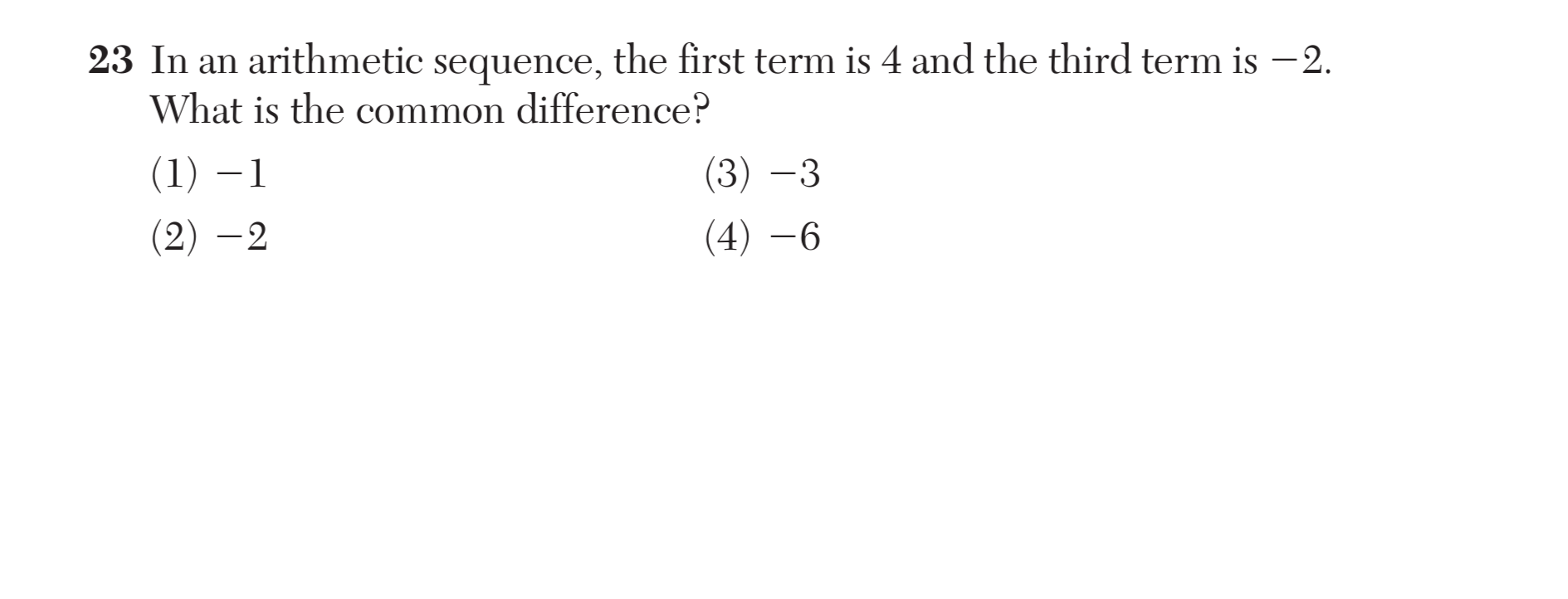
In an arithmetic sequence, the first term is 4 and the third term is . What is the common difference?
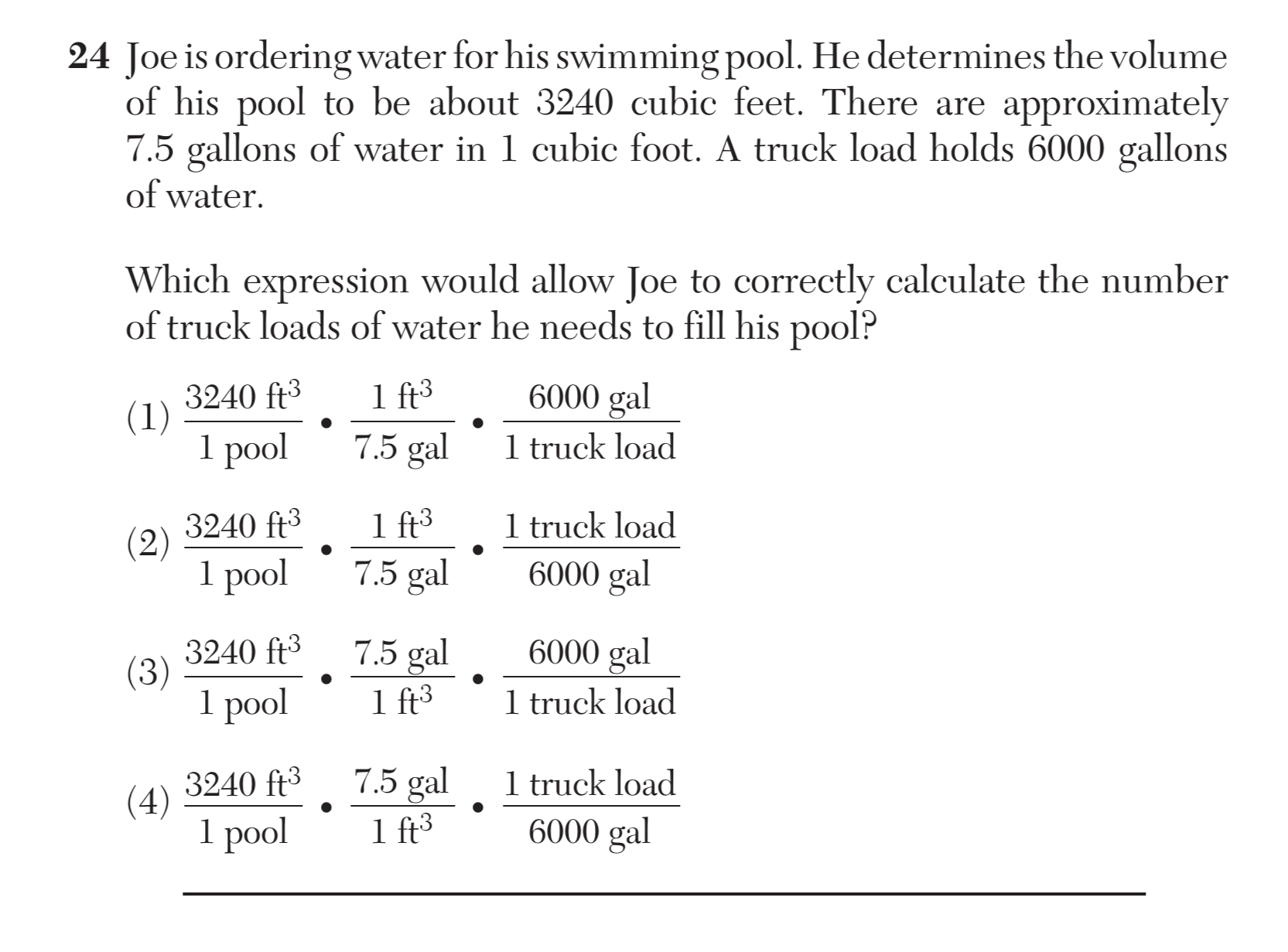
Joe is ordering water for his swimming pool. He determines the volume of his pool to be about 3240 cubic feet. There are approximately 7.5 gallons of water in 1 cubic foot. A truck load holds 6000 gallons of water.
Which expression would allow Joe to correctly calculate the number of truck loads of water he needs to fill his pool?
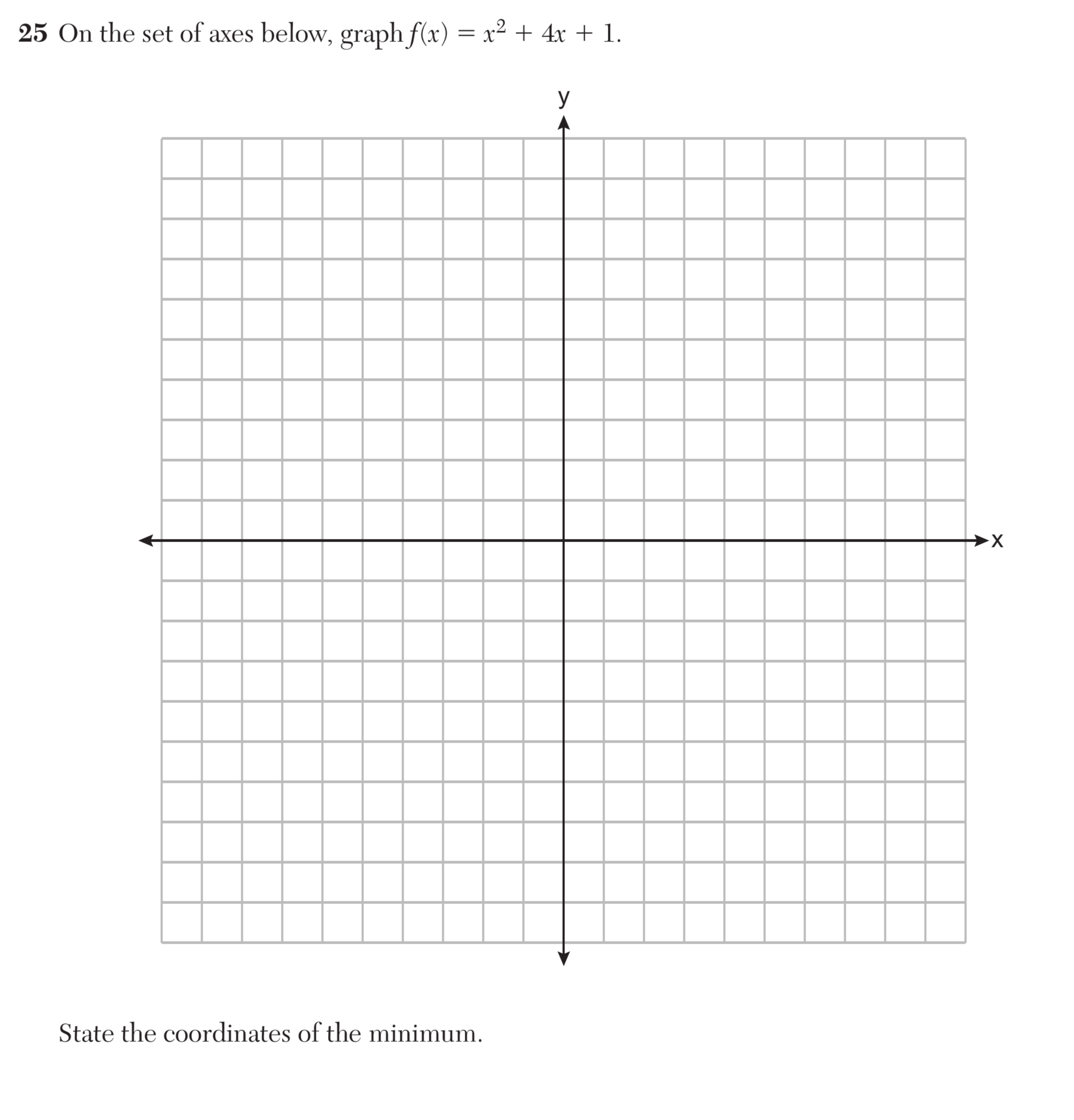
On the set of axes below, graph .
Image Description: A coordinate plane with x-axis and y-axis, with gridlines. The axes are labeled x and y.
State the coordinates of the minimum.
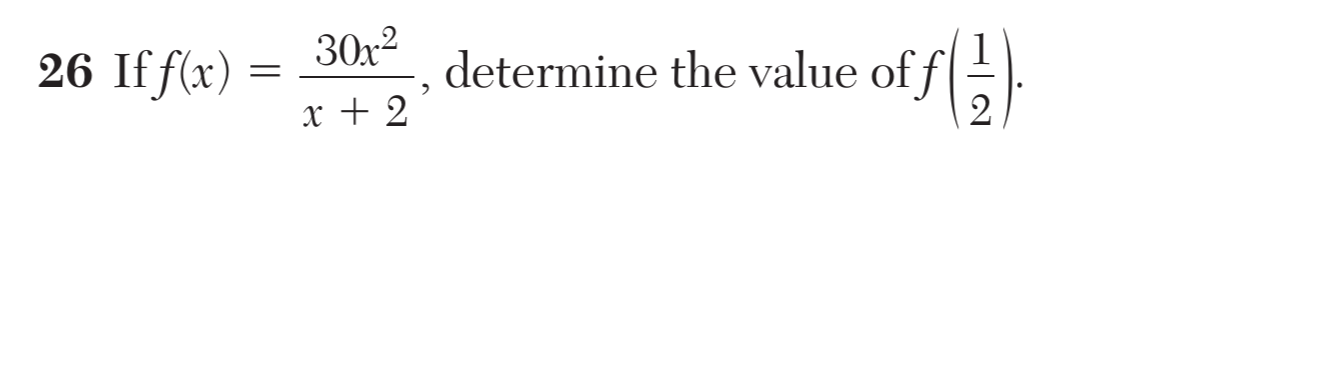
If , determine the value of .
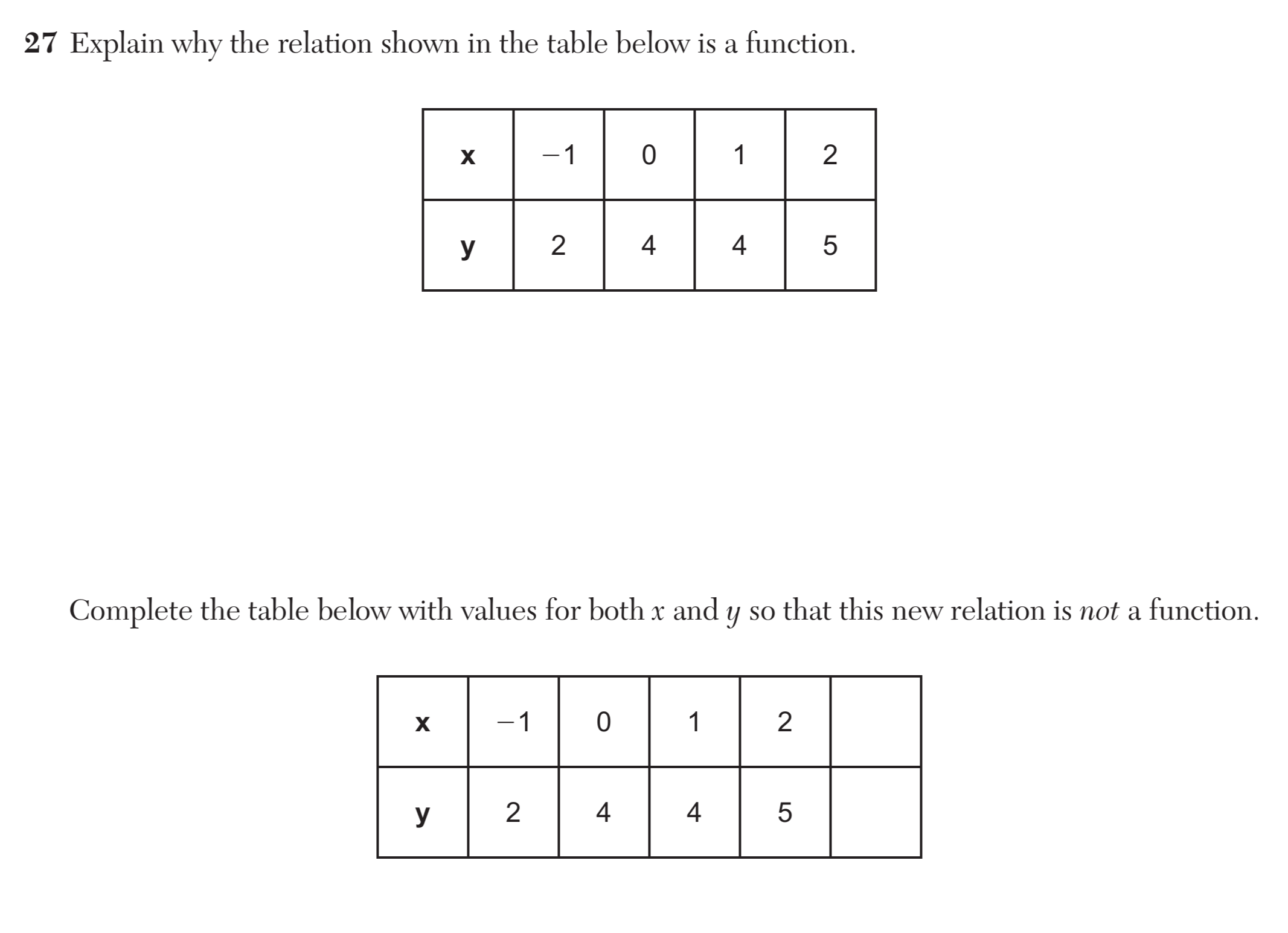
Explain why the relation shown in the table below is a function.
Complete the table below with values for both and so that this new relation is not a function.
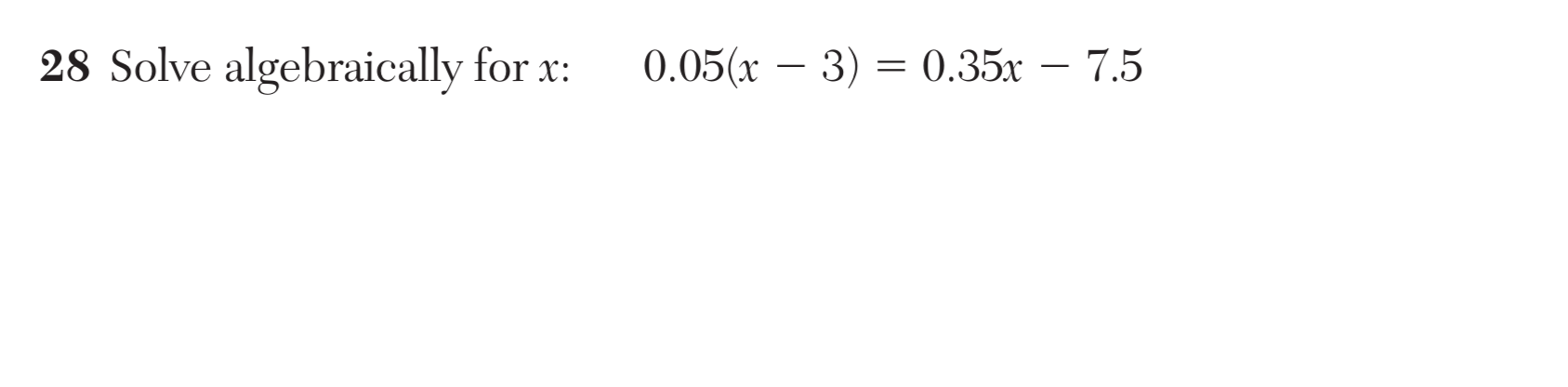
Solve algebraically for :
Use the quadratic formula to determine the exact roots of the equation .

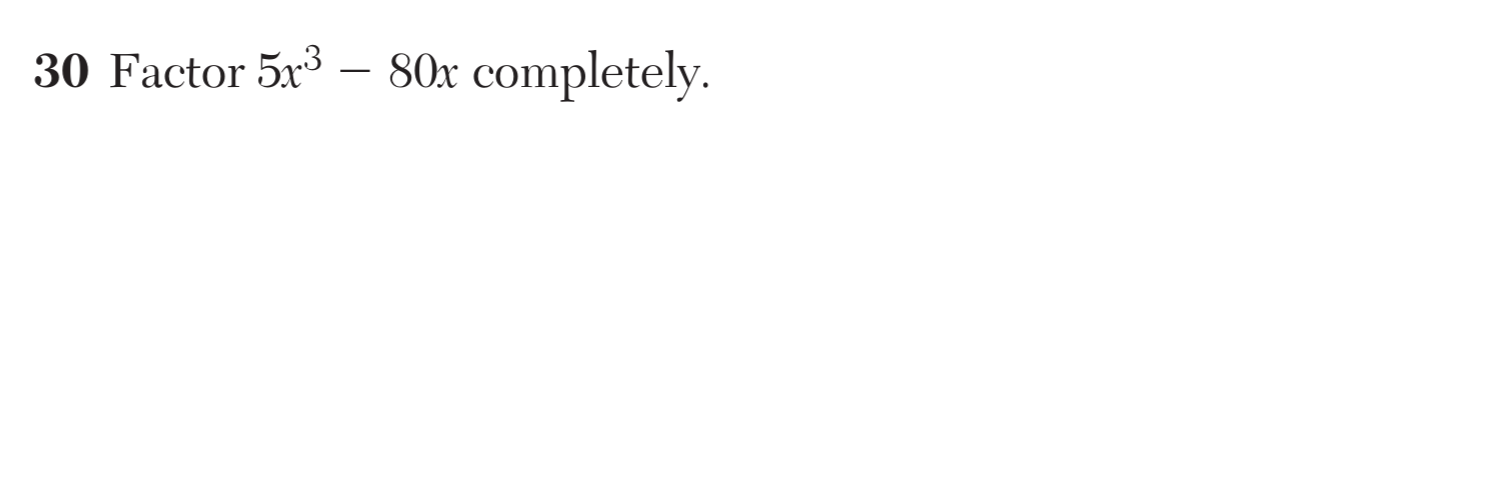
Factor completely.
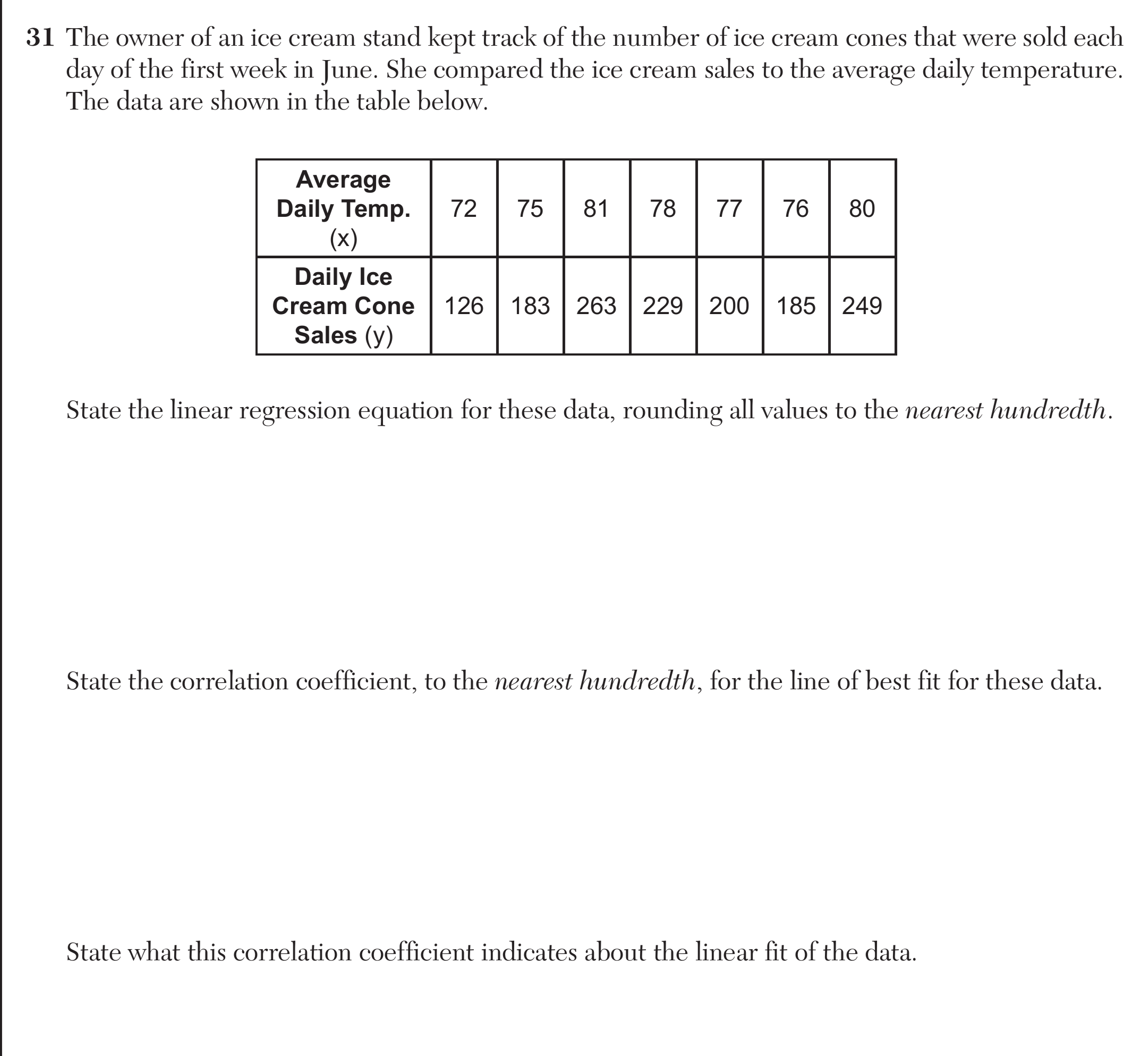
The owner of an ice cream stand kept track of the number of ice cream cones that were sold each day of the first week in June. She compared the ice cream sales to the average daily temperature. The data are shown in the table below.
| Average Daily Temp. | 72 | 75 | 81 | 78 | 77 | 76 | 80 |
|---|---|---|---|---|---|---|---|
| Daily Ice Cream Cone Sales | 126 | 183 | 263 | 229 | 200 | 185 | 249 |
State the linear regression equation for these data, rounding all values to the nearest hundredth.
State the correlation coefficient, to the nearest hundredth, for the line of best fit for these data.
State what this correlation coefficient indicates about the linear fit of the data.
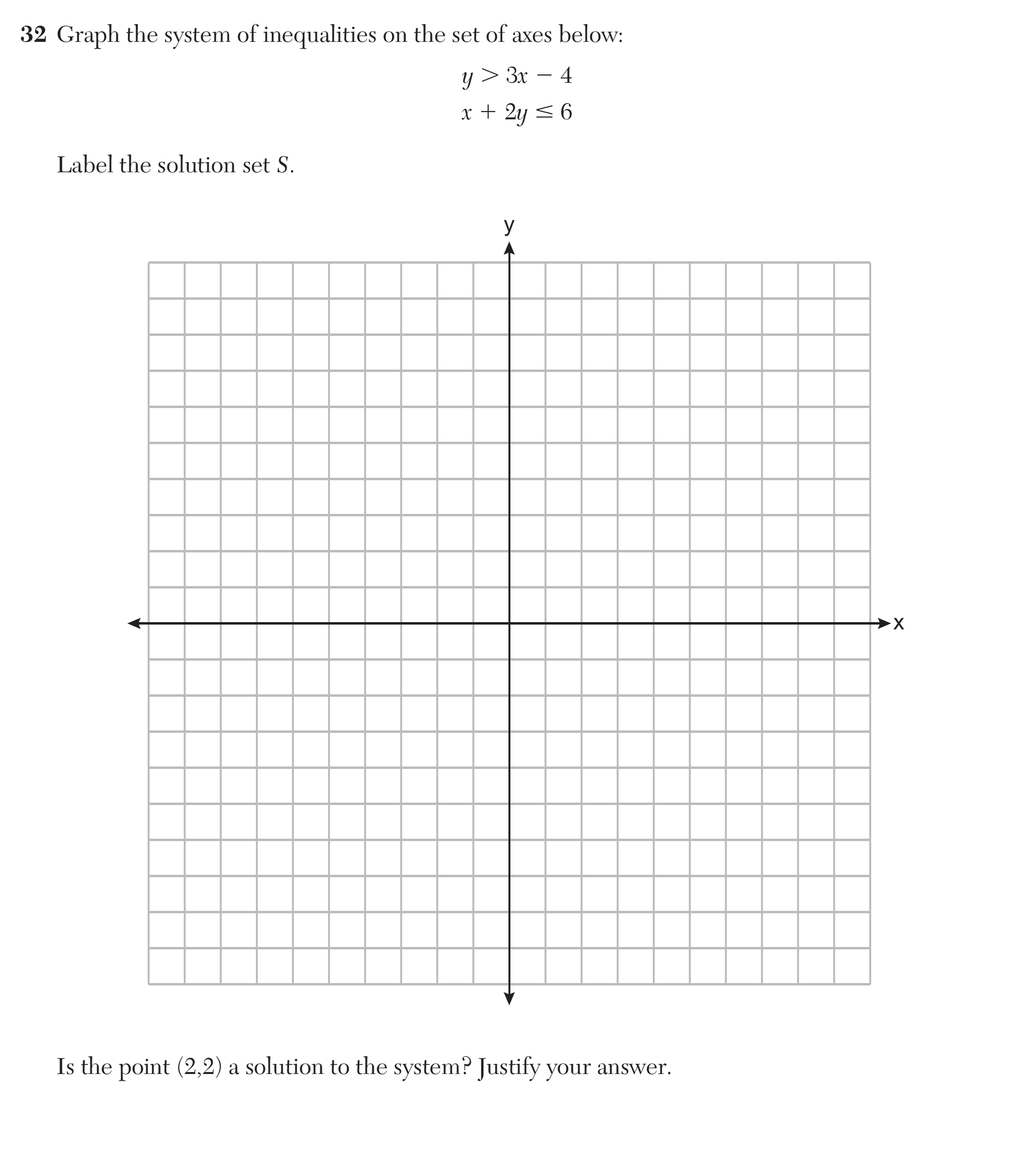
Graph the system of inequalities on the set of axes below:
Label the solution set S.
Image Description: A coordinate plane with x-axis and y-axis, with gridlines. The axes are labeled x and y.
Is the point a solution to the system? Justify your answer.
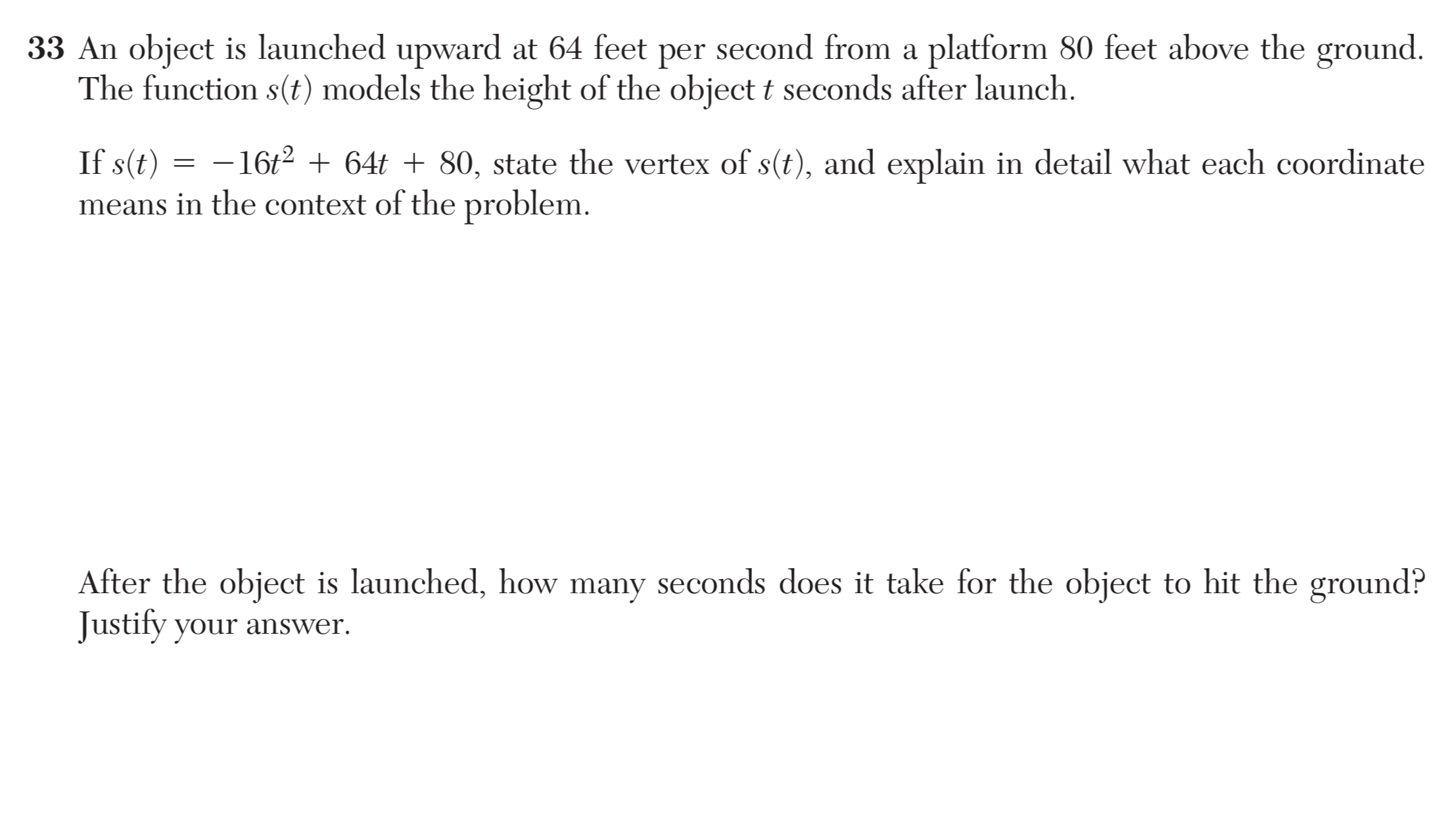
An object is launched upward at 64 feet per second from a platform 80 feet above the ground. The function models the height of the object seconds after launch.
If , state the vertex of , and explain in detail what each coordinate means in the context of the problem.
After the object is launched, how many seconds does it take for the object to hit the ground? Justify your answer.
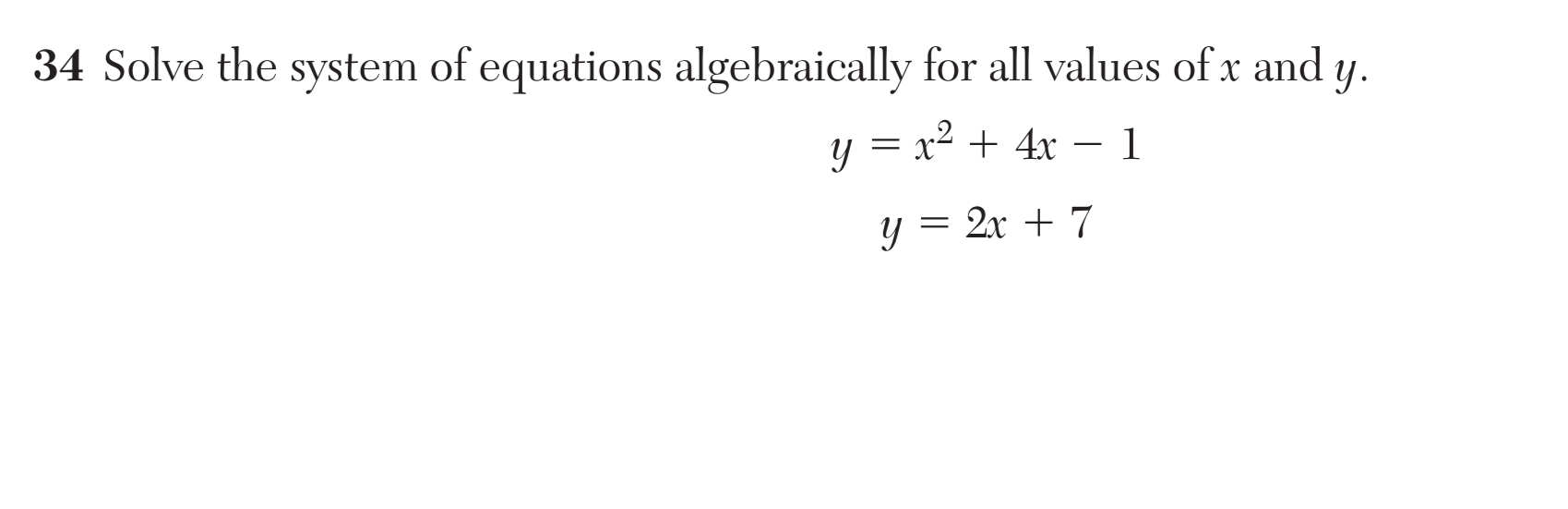
Solve the system of equations algebraically for all values of and .
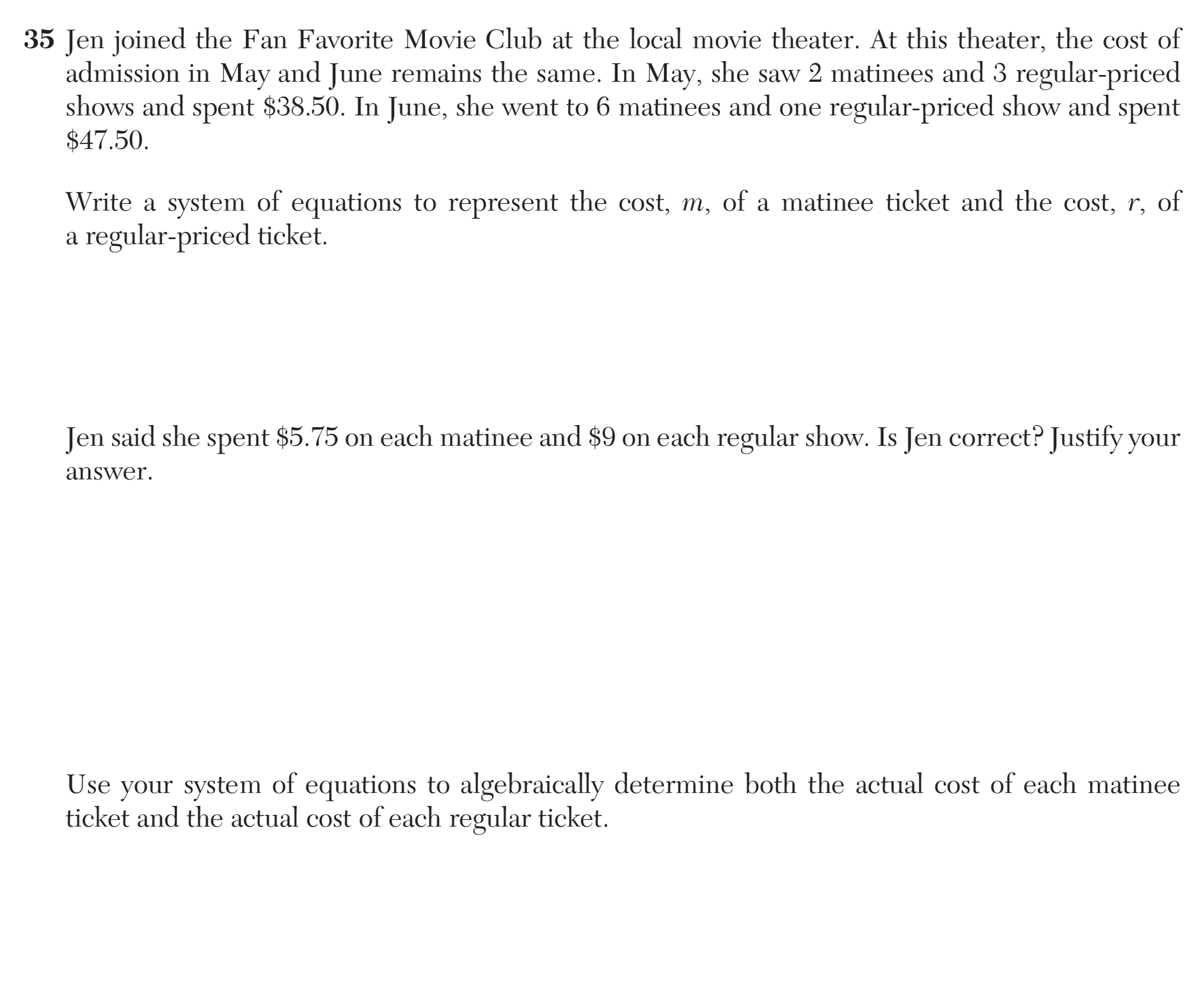
Jen joined the Fan Favorite Movie Club at the local movie theater. At this theater, the cost of admission in May and June remains the same. In May, she saw 2 matinees and 3 regular-priced shows and spent $38.50. In June, she went to 6 matinees and one regular-priced show and spent $47.50.
Write a system of equations to represent the cost, , of a matinee ticket and the cost, , of a regular-priced ticket.
Jen said she spent $5.75 on each matinee and $9 on each regular show. Is Jen correct? Justify your answer.
Use your system of equations to algebraically determine both the actual cost of each matinee ticket and the actual cost of each regular ticket.
(3)
(1)
(4)
(2)
(1)
(4)
(4)
(2)
(3)
(3)
(1)
(2)
(2)
(3)
(4)
(3)
(4)
(1)
(4)
(2)
(3)
(2)
(3)
(4)
To graph , first find the vertex. The x-coordinate of the vertex is .
The y-coordinate is .
So the vertex (minimum) is at .
Create a table of values:
Plot these points and draw a smooth parabola opening upward through them.
The coordinates of the minimum are .
Substitute into :
The relation is a function because each -value is paired with exactly one -value. To make the new relation not a function, add , in the fifth column (any repeated -value with a different -value is acceptable).
The relation shown in the first table is a function because each -value () is paired with exactly one -value. No -value is repeated, so the relation passes the definition of a function.
Note: Even though the -value appears twice (for and ), this does not violate the definition of a function. A function only requires that each input has one output, not that each output has one input.
To make the second relation not a function, the fifth column must repeat an -value that already appears in the table but assign it a different -value. For example, using and in the fifth column creates two ordered pairs with : and . Since the input now maps to two different outputs, the relation is not a function.
Distribute on the left side:
Subtract from both sides:
Add to both sides:
Divide both sides by :
and
Identify , , .
Apply the quadratic formula:
The exact roots are and .
First, factor out the greatest common factor (GCF). The GCF of and is :
Next, recognize that is a difference of two perfect squares, since :
Using the data points , enter the values into a graphing calculator and perform a linear regression (LinReg).
The calculator gives and .
Rounding to the nearest hundredth: and .
The linear regression equation is .
Graph showing a dashed line for with shading above, a solid line for (or ) with shading below, and the overlapping region labeled S.
For : Draw a dashed line through and with slope 3. Shade above the line since is greater.
For : Rewrite as . Draw a solid line through and with slope . Shade below the line since is less than or equal to.
The solution set S is the region where the two shadings overlap.
The vertex is .
The vertex of a quadratic has a -coordinate of .
The vertex is .
The -coordinate, 2, means that the object reaches its maximum height 2 seconds after launch.
The -coordinate, 144, means that the maximum height of the object is 144 feet above the ground.
and
Since both equations are equal to , set them equal to each other:
Subtract from both sides:
Factor:
or
Substitute each value of into to find the corresponding -values:
When :
When :
The solutions are and .
In May, Jen saw 2 matinees and 3 regular-priced shows and spent $38.50:
In June, she went to 6 matinees and 1 regular-priced show and spent $47.50: