1.
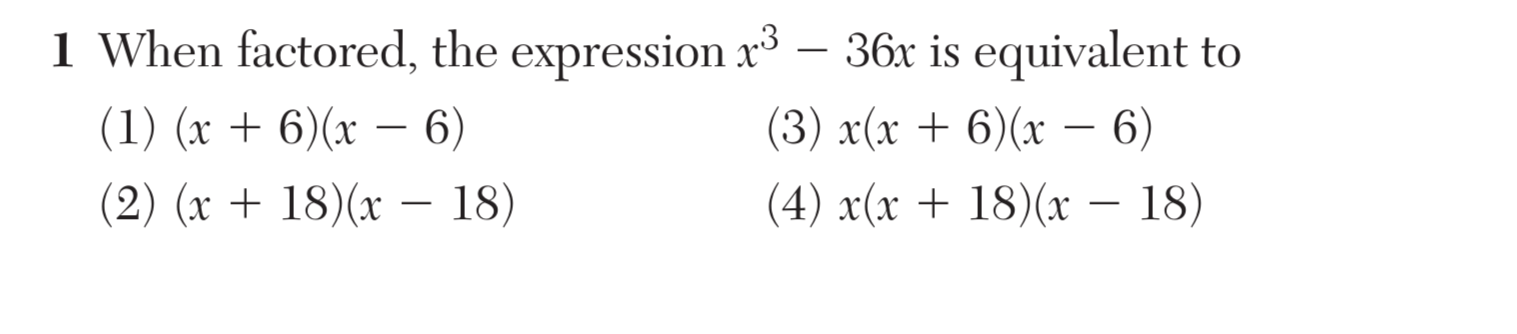
When factored, the expression is equivalent to
(1)
(2)
(3)
(4)
Task Image
Standard
NGLS.Math.Content.AI.A-SSE.A
Domain
Algebra
When factored, the expression is equivalent to
(1)
(2)
(3)
(4)
Which equation represents the line that passes through the points and ?
(1)
(2)
(3)
(4)

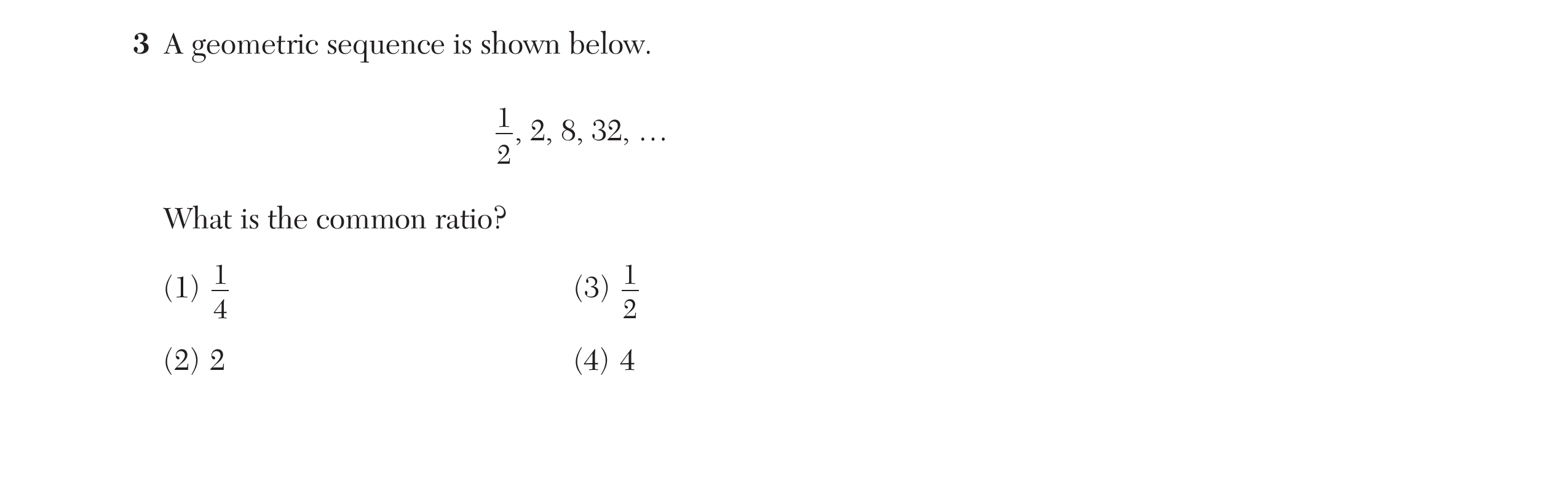
A geometric sequence is shown below.
What is the common ratio?
(1)
(2)
(3)
(4)
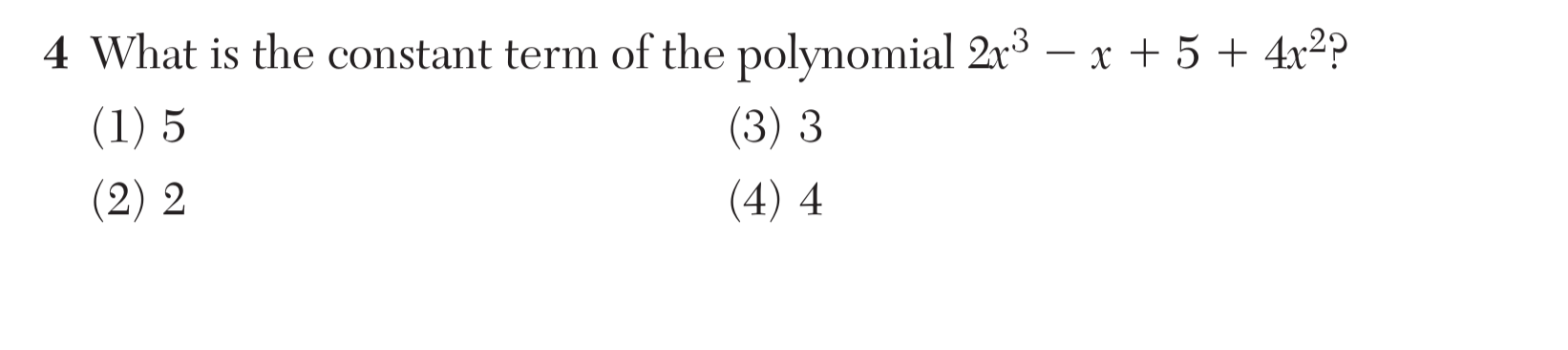
What is the constant term of the polynomial ?
(1)
(2)
(3)
(4)
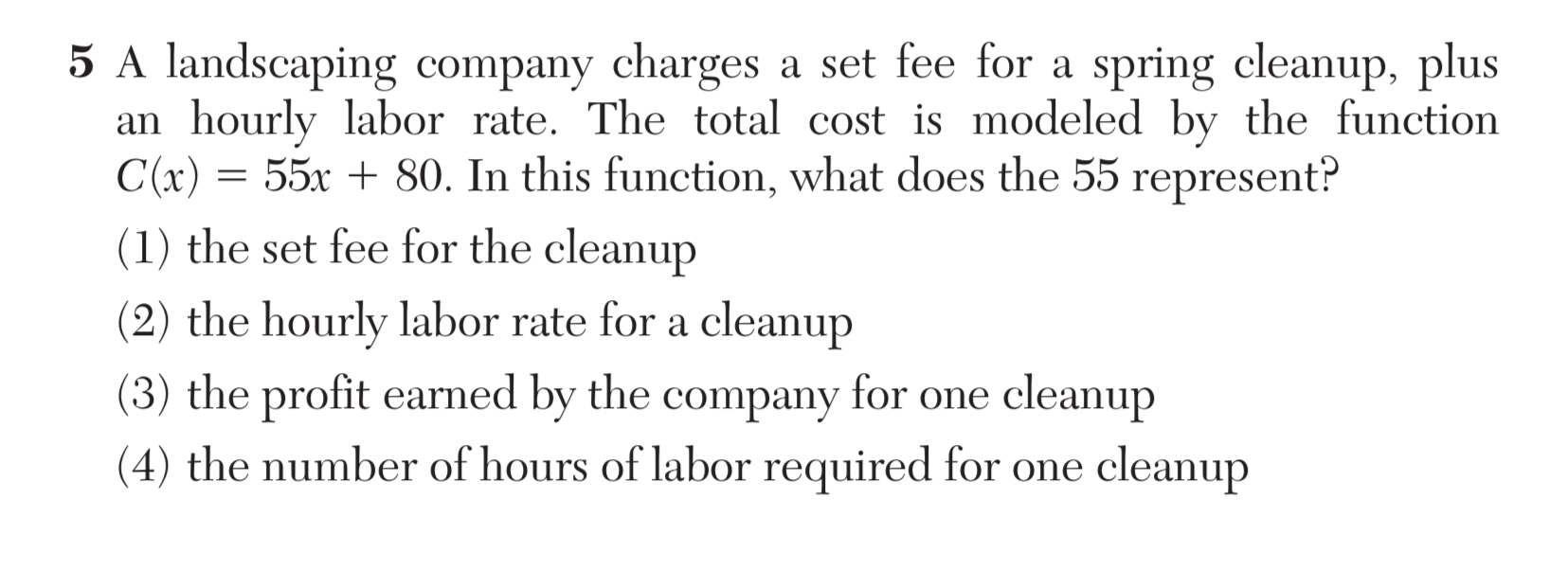
A landscaping company charges a set fee for a spring cleanup, plus an hourly labor rate. The total cost is modeled by the function . In this function, what does the 55 represent?
(1) the set fee for the cleanup
(2) the hourly labor rate for a cleanup
(3) the profit earned by the company for one cleanup
(4) the number of hours of labor required for one cleanup
Which expression is equivalent to ?
(1)
(2)
(3)
(4)

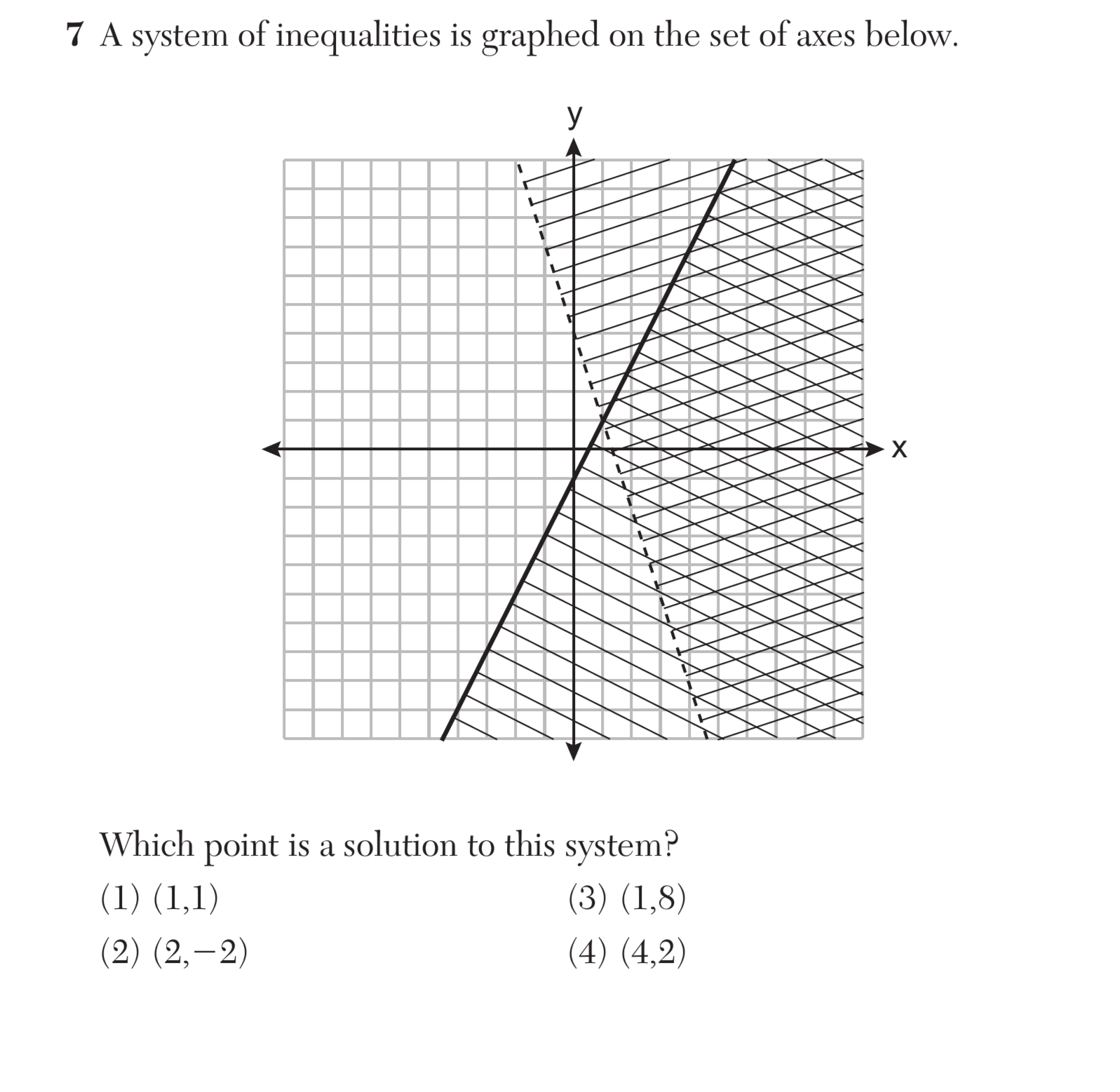
A system of inequalities is graphed on the set of axes below.
Image Description: A coordinate plane shows two dashed lines with shaded regions. One line has a negative slope with a y-intercept at and a slope of , with shading below. The other line has a positive slope with a y-intercept at and a slope of , with shading above. The two lines intersect at . The solution region (double-shaded area) is between the two lines.
Which point is a solution to this system?
(1)
(2)
(3)
(4)
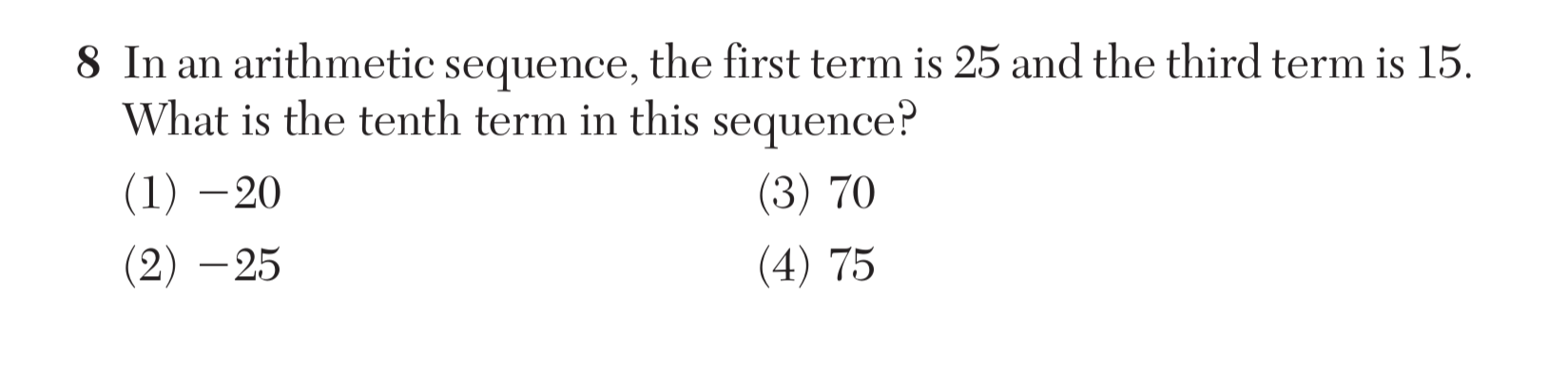
In an arithmetic sequence, the first term is 25 and the third term is 15. What is the tenth term in this sequence?
(1)
(2)
(3)
(4)
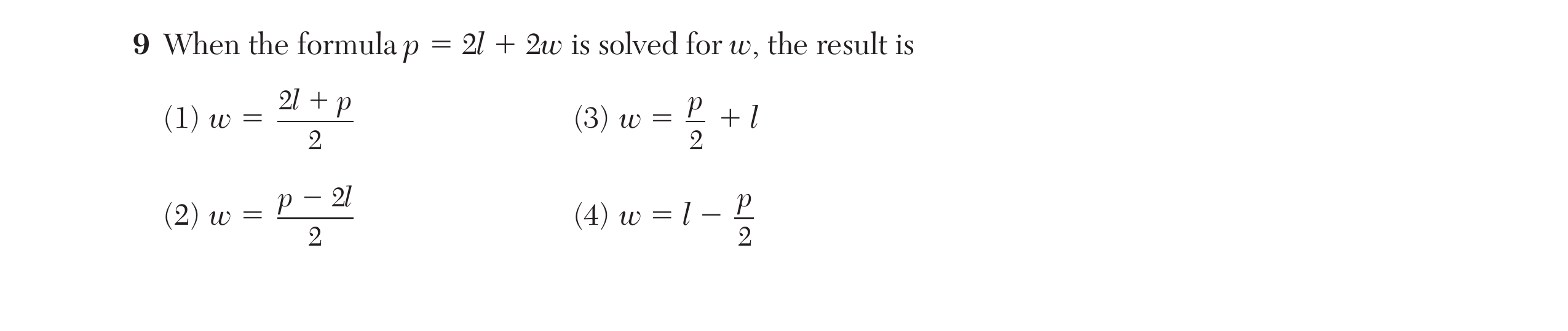
When the formula is solved for , the result is
(1)
(2)
(3)
(4)
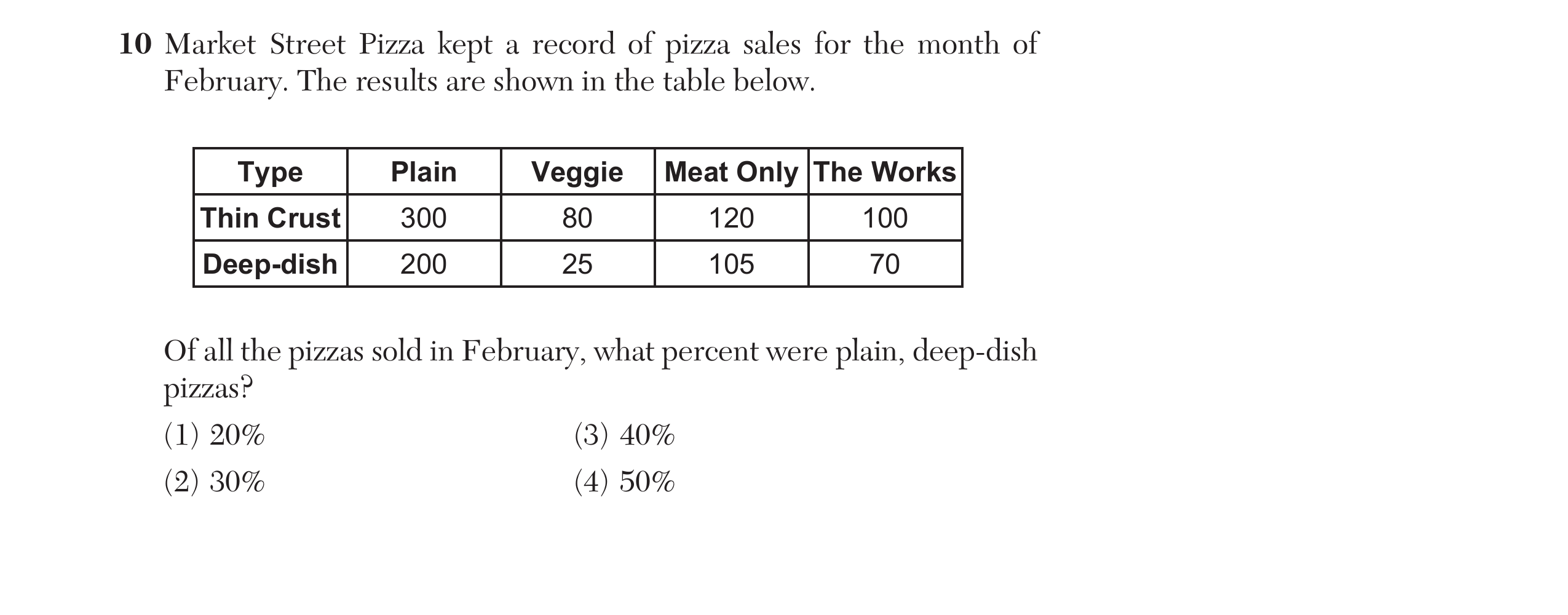
Market Street Pizza kept a record of pizza sales for the month of February. The results are shown in the table below.
| Type | Plain | Veggie | Meat Only | The Works |
|---|---|---|---|---|
| Thin Crust | 300 | 80 | 120 | 100 |
| Deep-dish | 200 | 25 | 105 | 70 |
Of all the pizzas sold in February, what percent were plain, deep-dish pizzas?
(1) 20%
(2) 30%
(3) 40%
(4) 50%
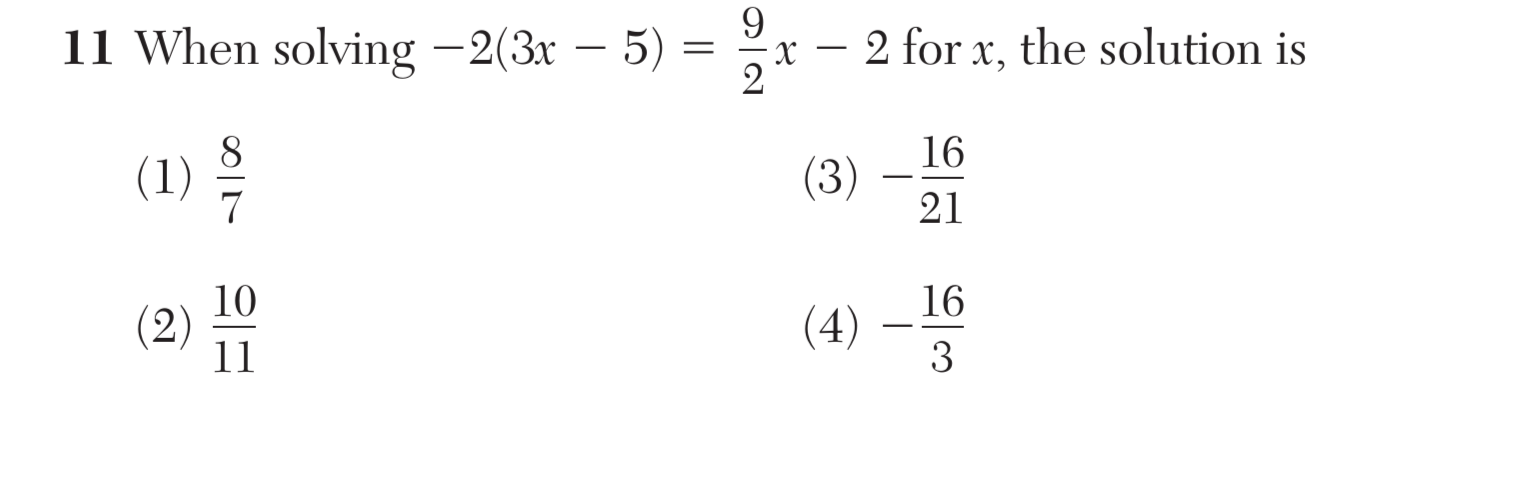
When solving for , the solution is
(1)
(2)
(3)
(4)
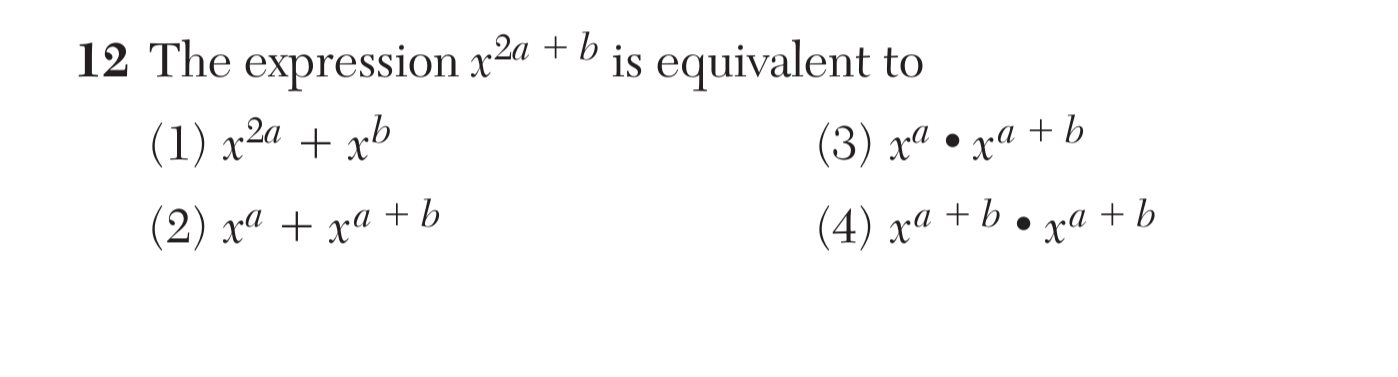
The expression is equivalent to
(1)
(2)
(3)
(4)
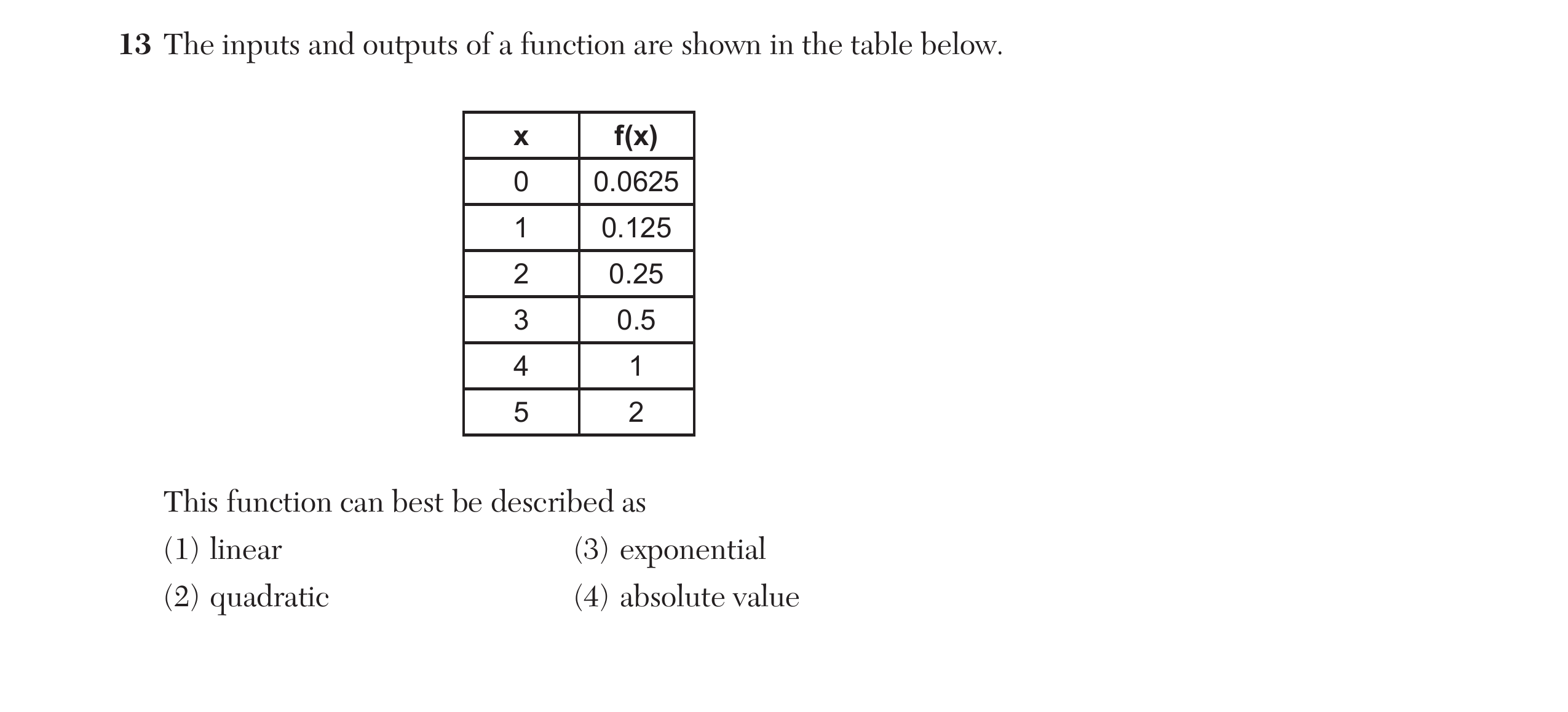
The inputs and outputs of a function are shown in the table below.
| 0 | 0.0625 |
| 1 | 0.125 |
| 2 | 0.25 |
| 3 | 0.5 |
| 4 | 1 |
| 5 | 2 |
This function can best be described as
(1) linear
(2) quadratic
(3) exponential
(4) absolute value
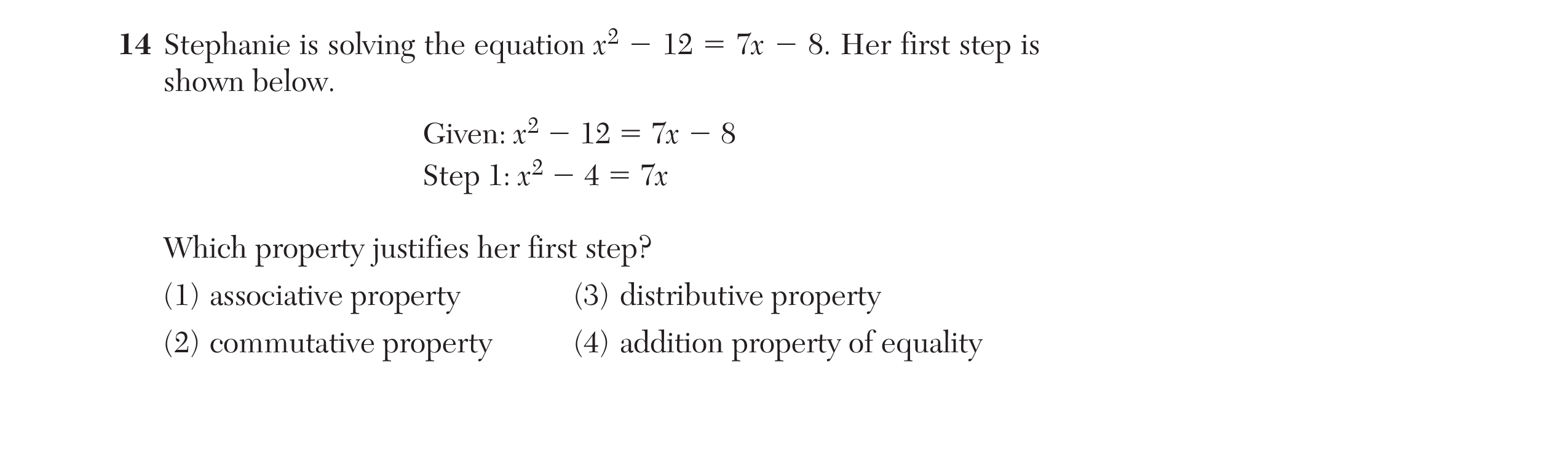
Stephanie is solving the equation . Her first step is shown below.
Given:
Step 1:
Which property justifies her first step?
(1) associative property
(2) commutative property
(3) distributive property
(4) addition property of equality
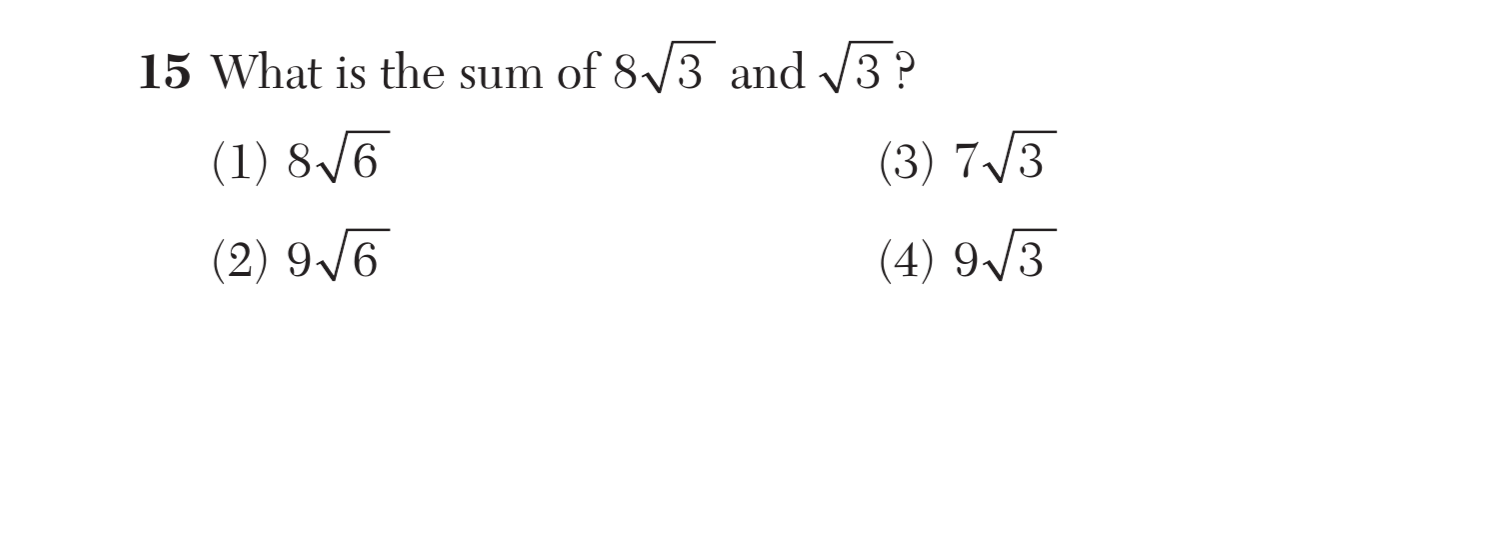
What is the sum of and ?
(1)
(2)
(3)
(4)
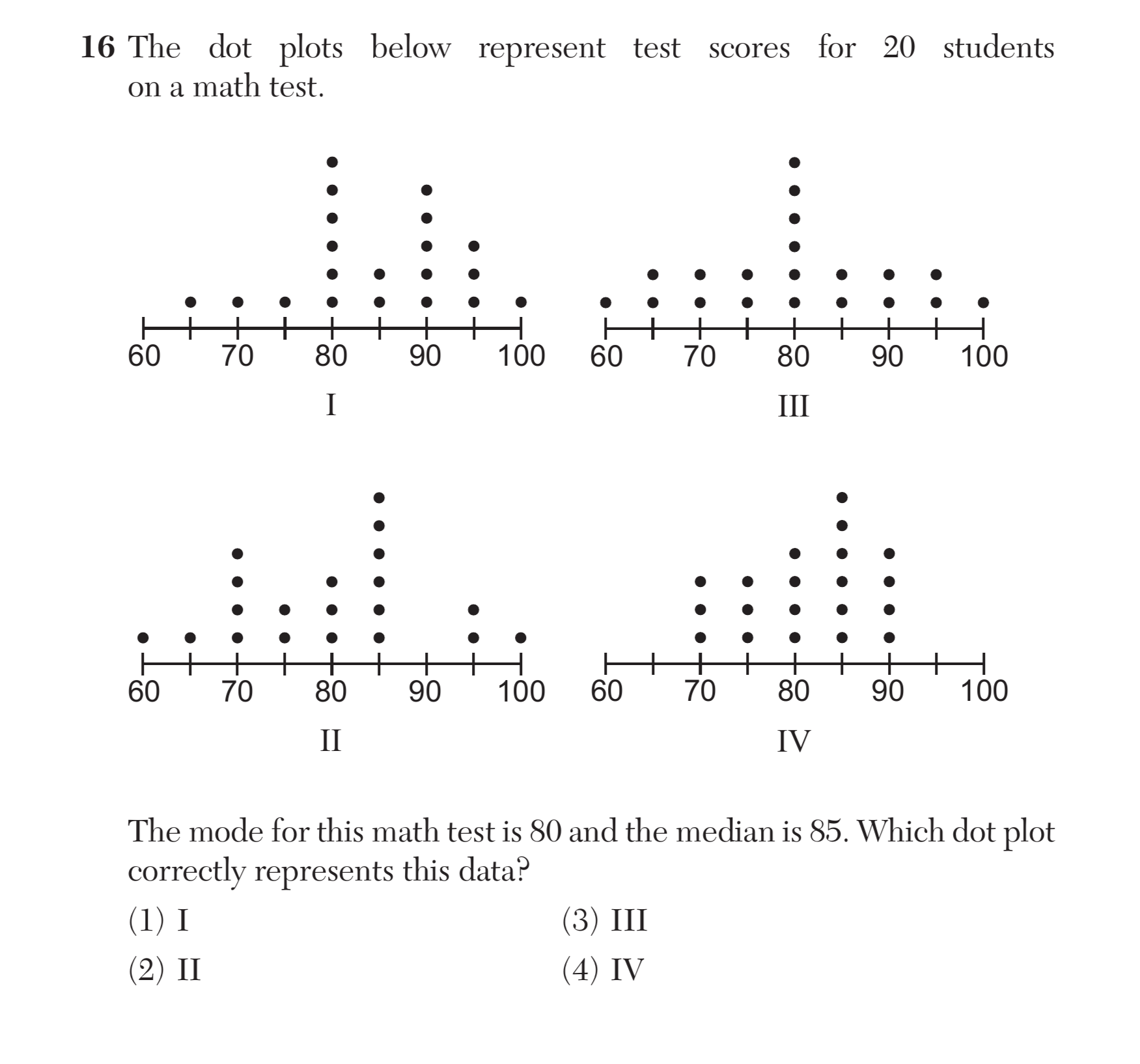
The dot plots below represent test scores for 20 students on a math test.
Image Description: Four dot plots labeled I, II, III, and IV are shown. Each dot plot has a horizontal axis ranging from 60 to 100 in increments of 5, representing test scores. Each dot represents one student's score.
Dot Plot I: 65(1), 70(1), 75(1), 80(6), 85(2), 90(5), 95(3), 100(1)
Dot Plot II: 60(1), 65(1), 70(4), 75(2), 80(3), 85(6), 95(2), 100(1)
Dot Plot III: 60(1), 65(2), 70(2), 75(2), 80(6), 85(2), 90(2), 95(2), 100(1)
Dot Plot IV: 70(3), 75(3), 80(4), 85(6), 90(4)
The mode for this math test is 80 and the median is 85. Which dot plot correctly represents this data?
(1) I
(2) II
(3) III
(4) IV
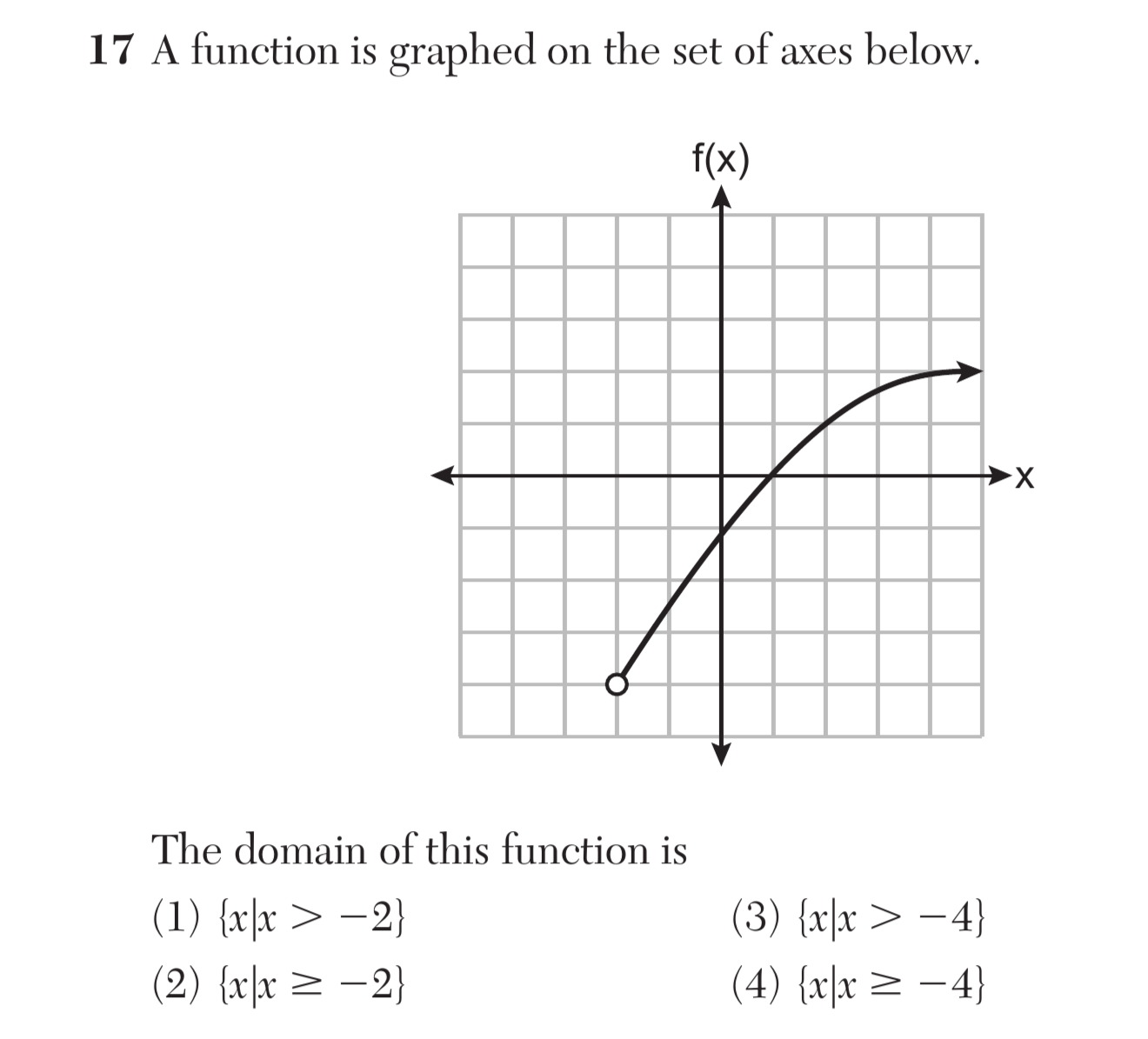
A function is graphed on the set of axes below.
Image Description: A coordinate plane is shown with the x-axis and f(x)-axis. A curve begins at an open circle at approximately and increases, passing through the origin area and continuing to the right. The curve resembles a square root function that has been shifted. The open circle indicates the point is not included in the function.
The domain of this function is
(1)
(2)
(3)
(4)
Which ordered pair is a solution to the equation ?
(1)
(2)
(3)
(4)

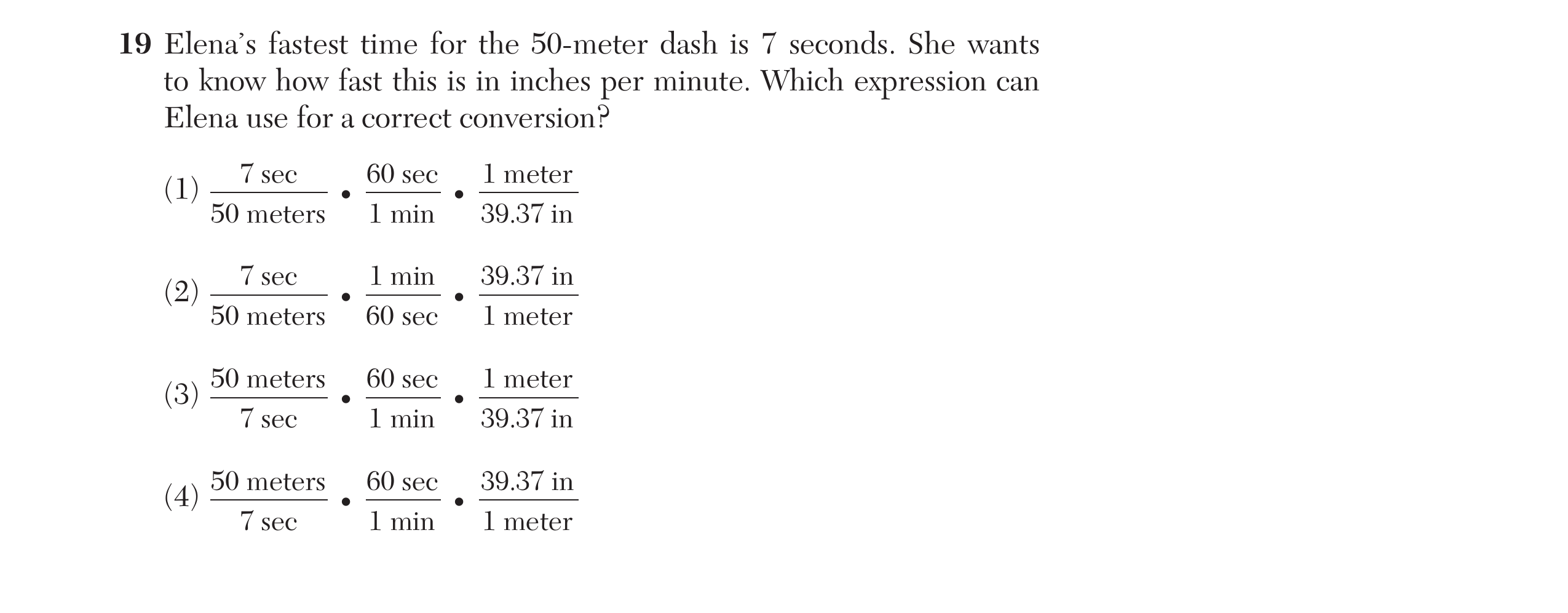
Elena's fastest time for the 50-meter dash is 7 seconds. She wants to know how fast this is in inches per minute. Which expression can Elena use for a correct conversion?
(1)
(2)
(3)
(4)
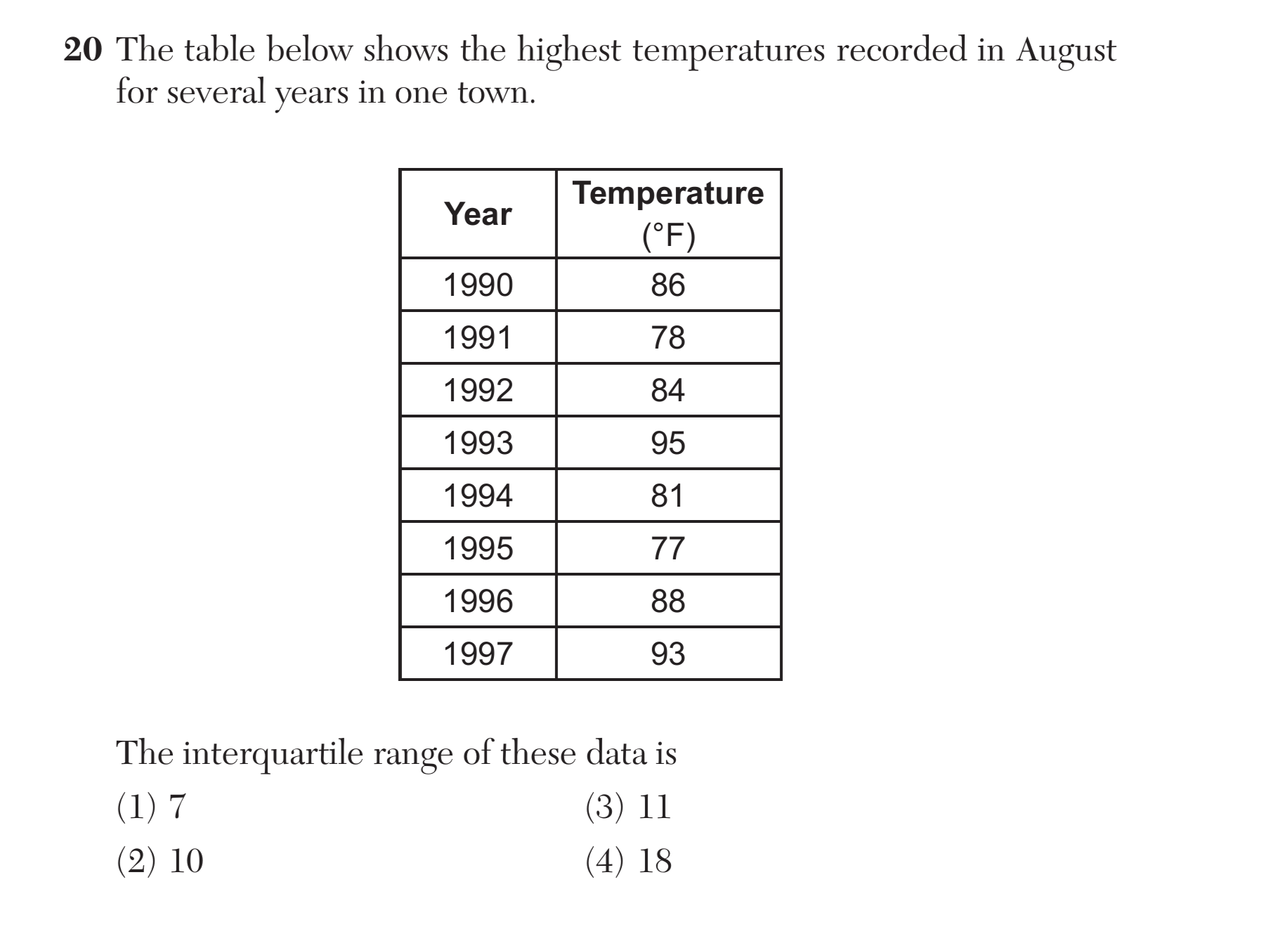
The table below shows the highest temperatures recorded in August for several years in one town.
| Year | Temperature (°F) |
|---|---|
| 1990 | 86 |
| 1991 | 78 |
| 1992 | 84 |
| 1993 | 95 |
| 1994 | 81 |
| 1995 | 77 |
| 1996 | 88 |
| 1997 | 93 |
The interquartile range of these data is
(1) 7
(2) 10
(3) 11
(4) 18
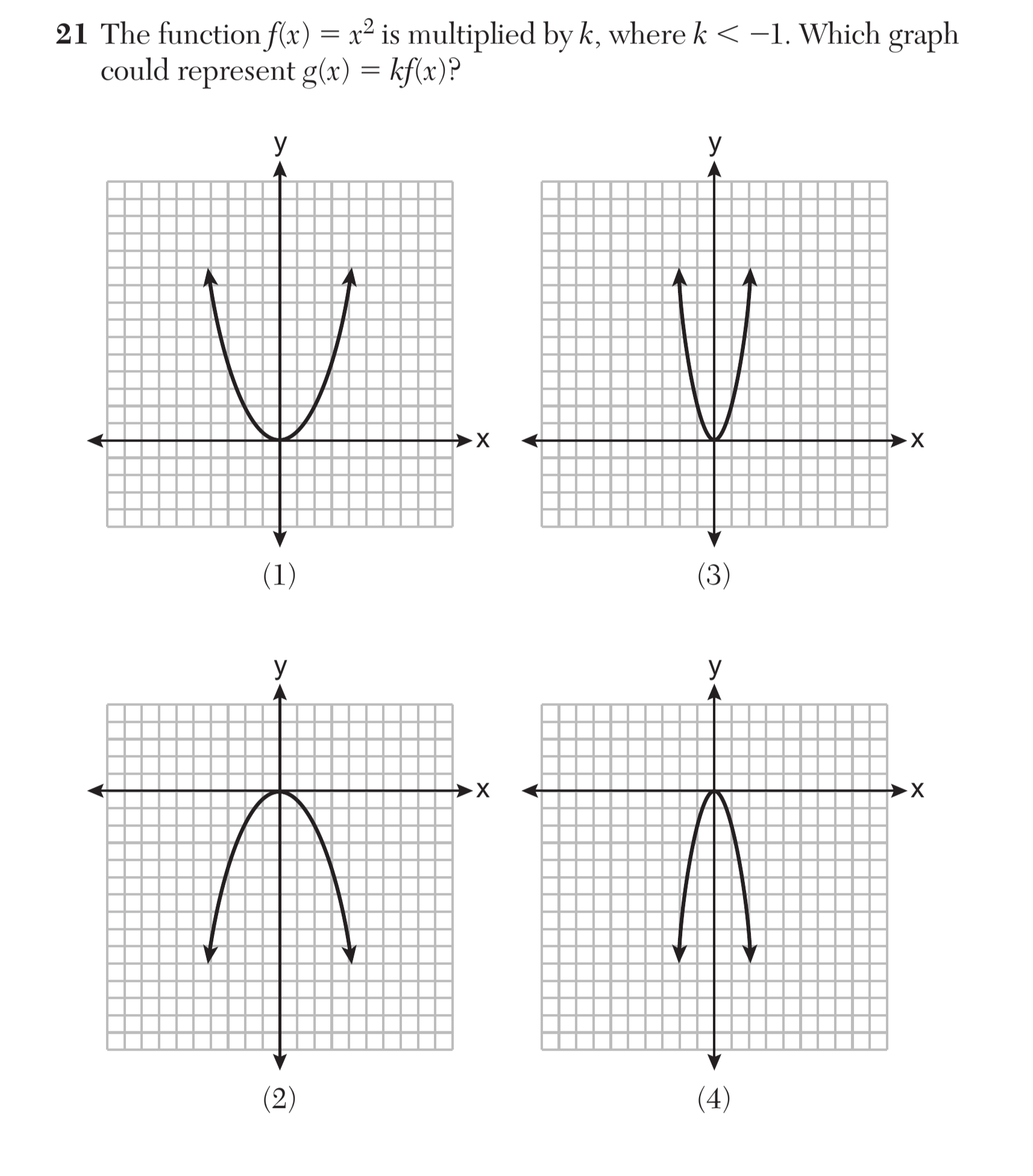
The function is multiplied by , where . Which graph could represent ?
Image Description: Four graphs of parabolas on coordinate grids are shown, each with vertex at the origin.
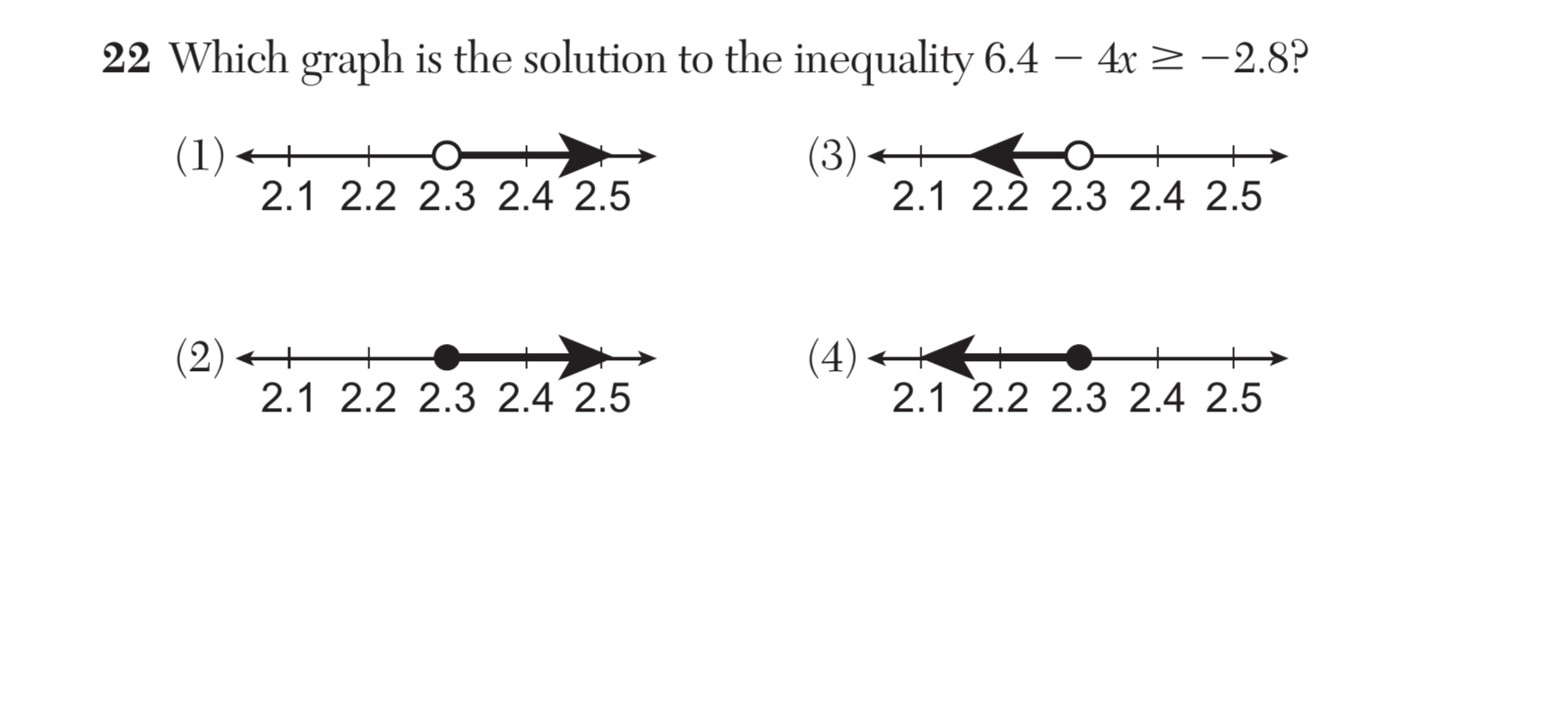
Which graph is the solution to the inequality ?
Image Description: Four number lines are shown, each marked from 2.1 to 2.5.
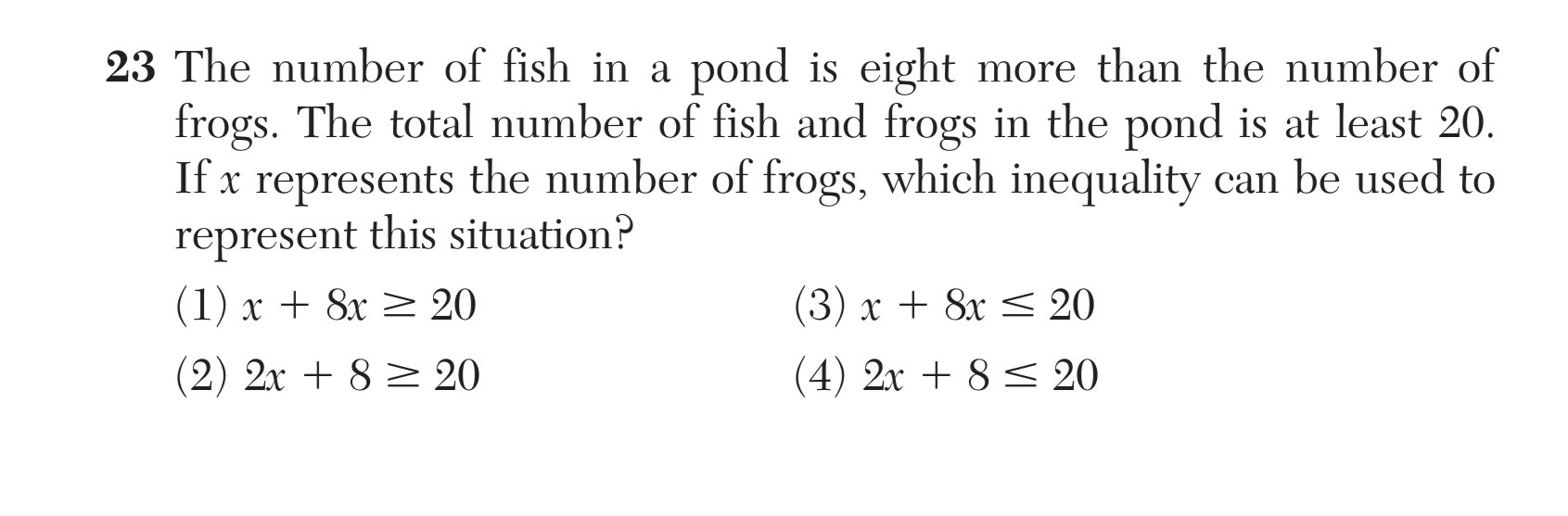
The number of fish in a pond is eight more than the number of frogs. The total number of fish and frogs in the pond is at least 20. If represents the number of frogs, which inequality can be used to represent this situation?
(1)
(2)
(3)
(4)
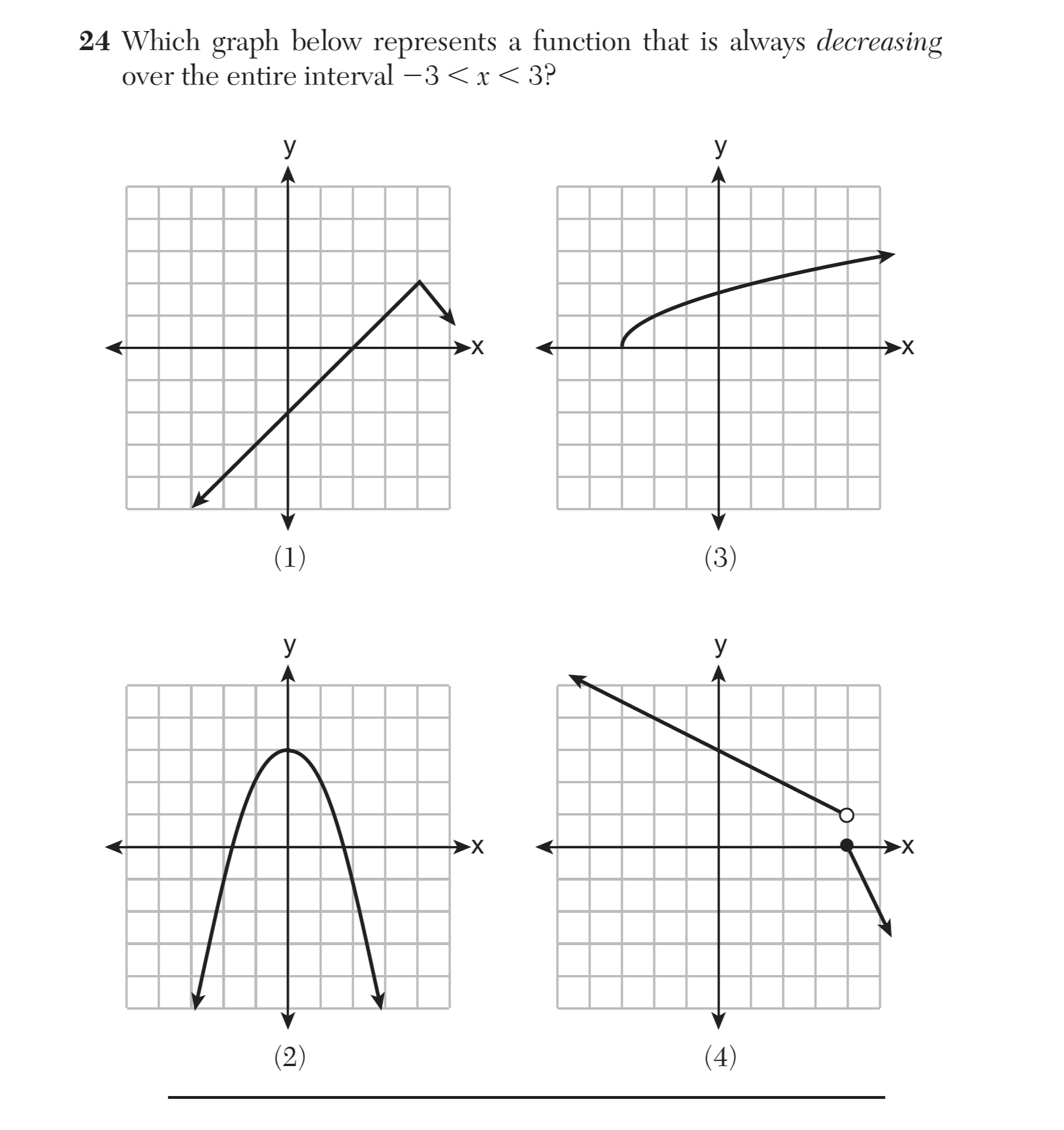
Which graph below represents a function that is always decreasing over the entire interval ?
Image Description: Four graphs are shown on coordinate grids.
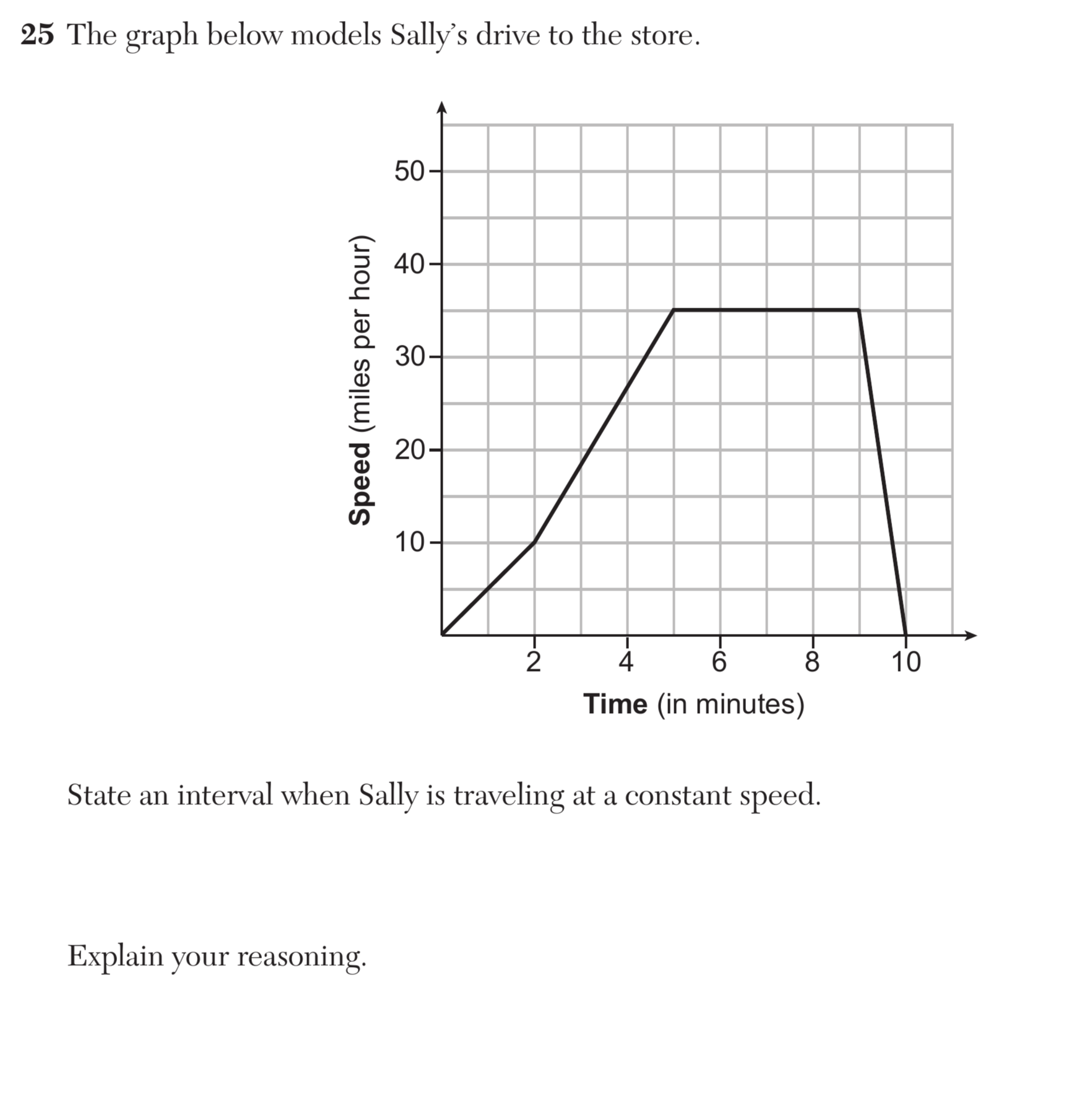
The graph below models Sally's drive to the store.
Image Description: A coordinate plane graph with the x-axis labeled "Time (in minutes)" ranging from 0 to 10, and the y-axis labeled "Speed (miles per hour)" ranging from 0 to 50. The graph shows a piecewise linear function with line segments connecting the following points: to , to , to , and to .
State an interval when Sally is traveling at a constant speed.
Explain your reasoning.
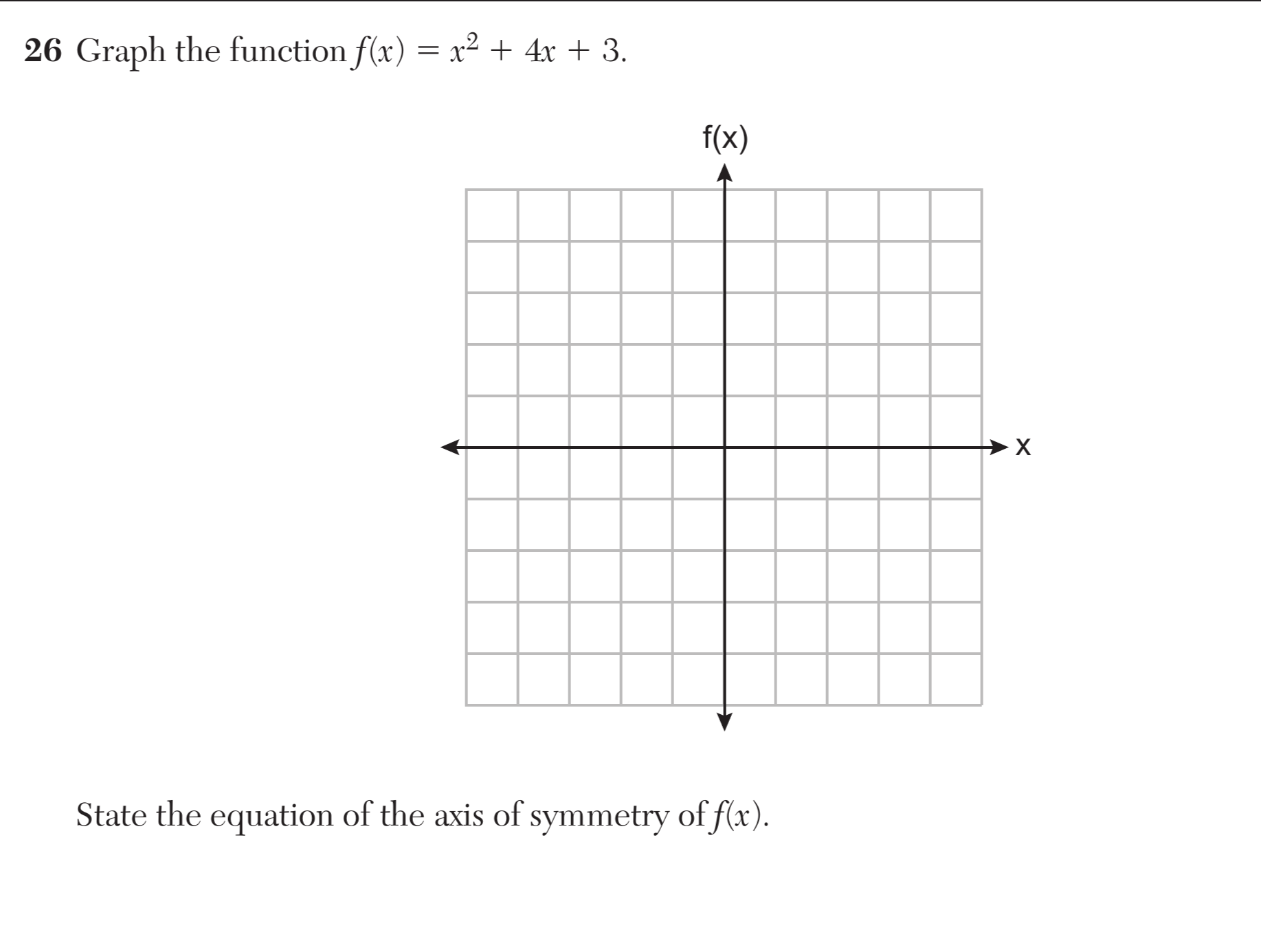
Graph the function .
Image Description: A coordinate plane with x-axis and f(x)-axis, with gridlines. The axes are labeled x and f(x).
State the equation of the axis of symmetry of .
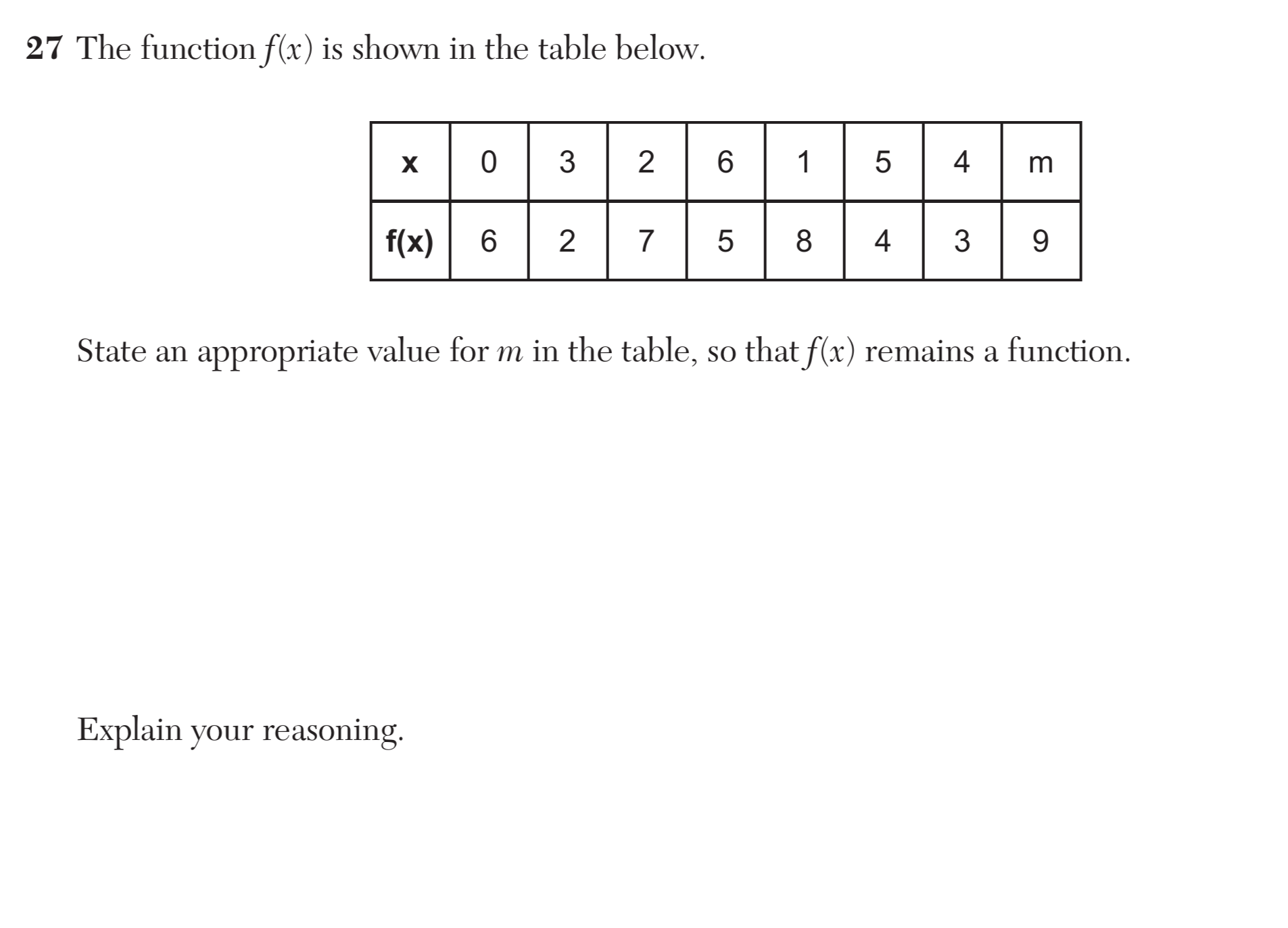
The function is shown in the table below.
| 0 | 3 | 2 | 6 | 1 | 5 | 4 | ||
| 6 | 2 | 7 | 5 | 8 | 4 | 3 | 9 |
State an appropriate value for in the table, so that remains a function.
Explain your reasoning.
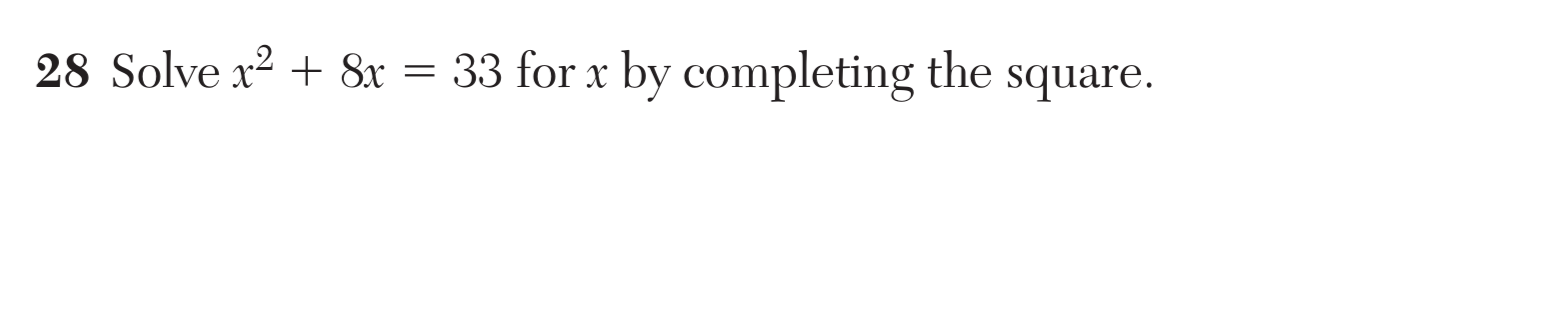
Solve for by completing the square.
If , algebraically determine the value of when .

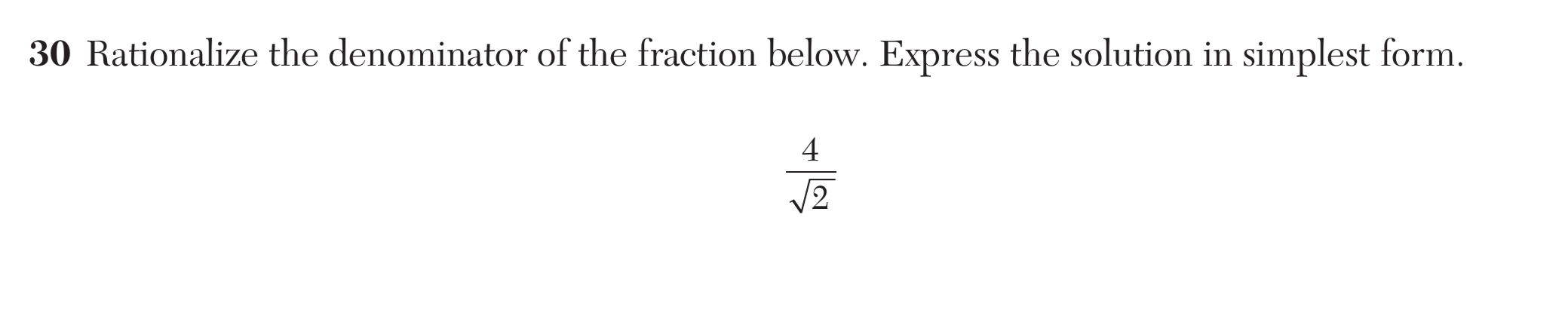
Rationalize the denominator of the fraction below. Express the solution in simplest form.
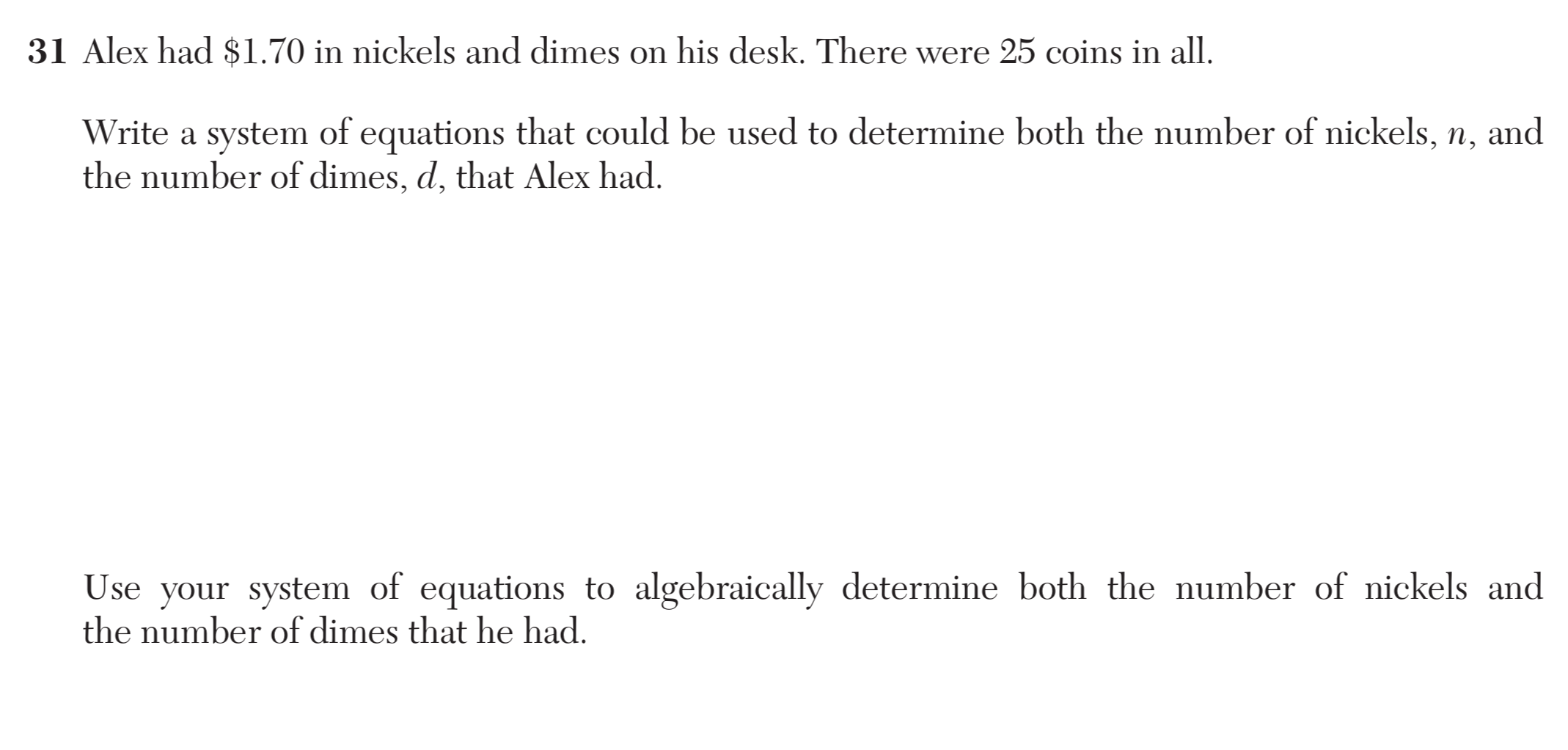
Alex had $1.70 in nickels and dimes on his desk. There were 25 coins in all.
Write a system of equations that could be used to determine both the number of nickels, , and the number of dimes, , that Alex had.
Use your system of equations to algebraically determine both the number of nickels and the number of dimes that he had.
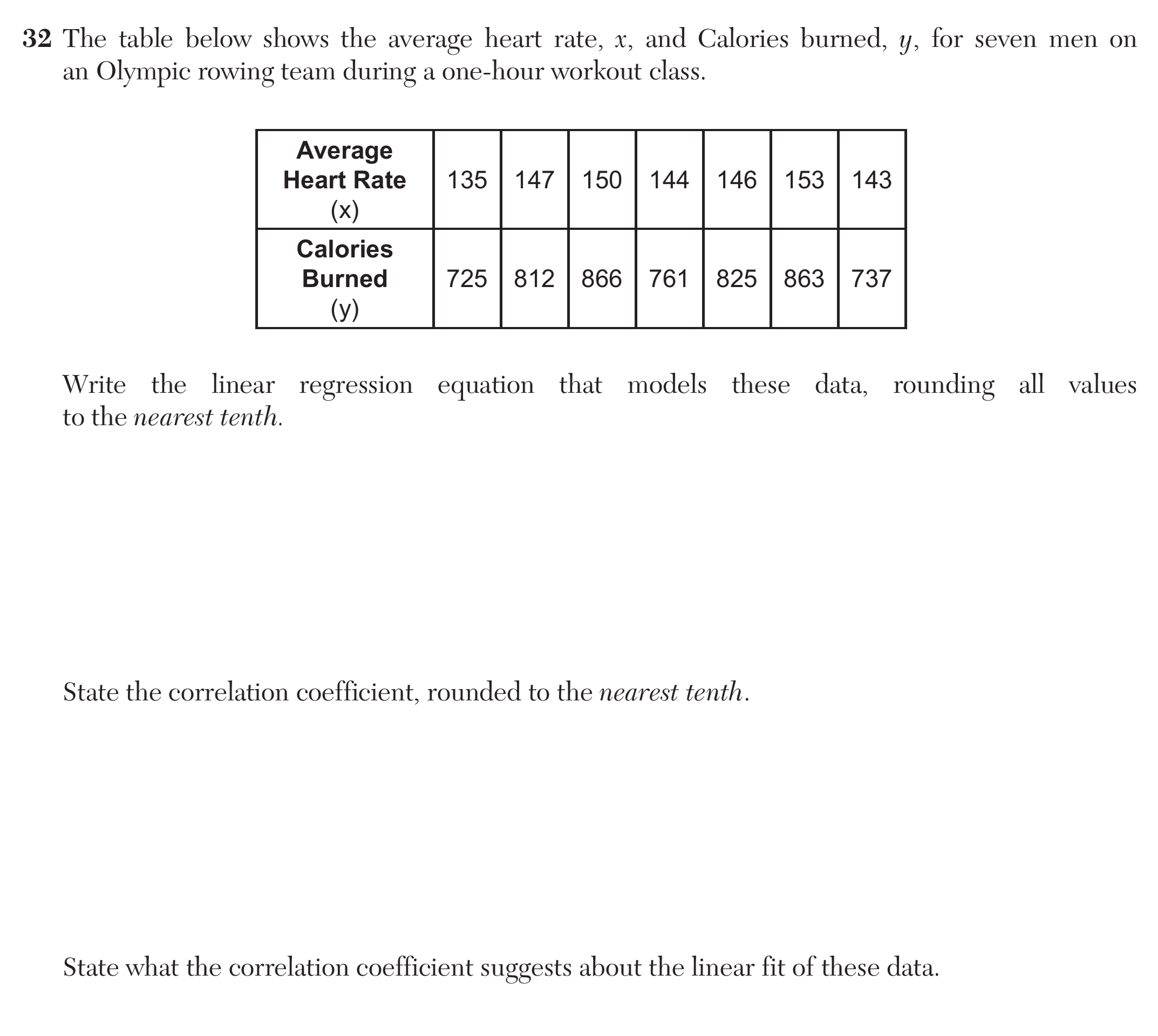
The table below shows the average heart rate, , and Calories burned, , for seven men on an Olympic rowing team during a one-hour workout class.
| Average Heart Rate | 135 | 147 | 150 | 144 | 146 | 153 | 143 |
|---|---|---|---|---|---|---|---|
| Calories Burned | 725 | 812 | 866 | 761 | 825 | 863 | 737 |
Write the linear regression equation that models these data, rounding all values to the nearest tenth.
State the correlation coefficient, rounded to the nearest tenth.
State what the correlation coefficient suggests about the linear fit of these data.
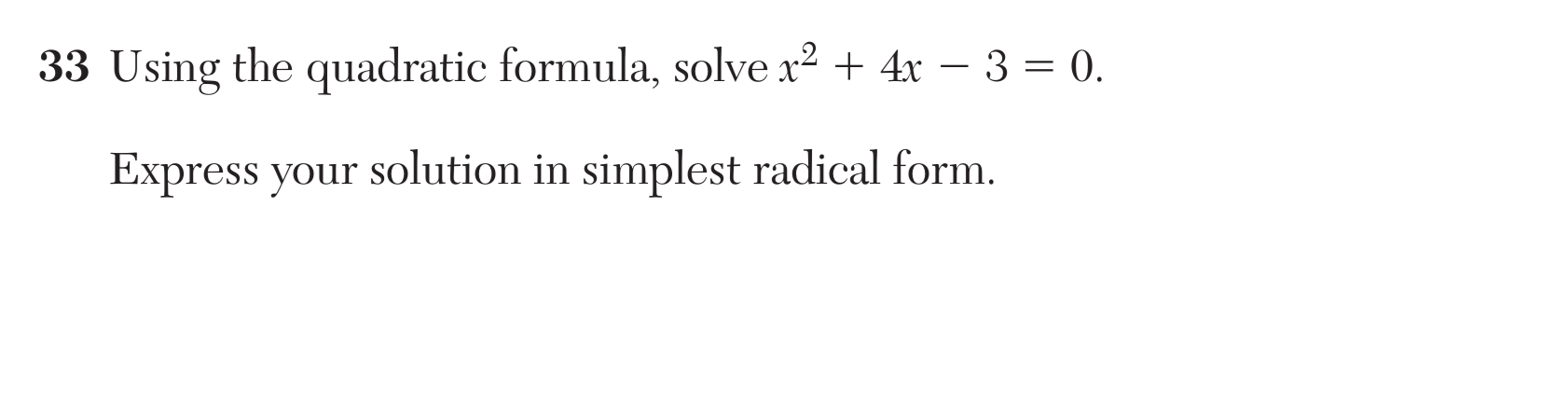
Using the quadratic formula, solve .
Express your solution in simplest radical form.
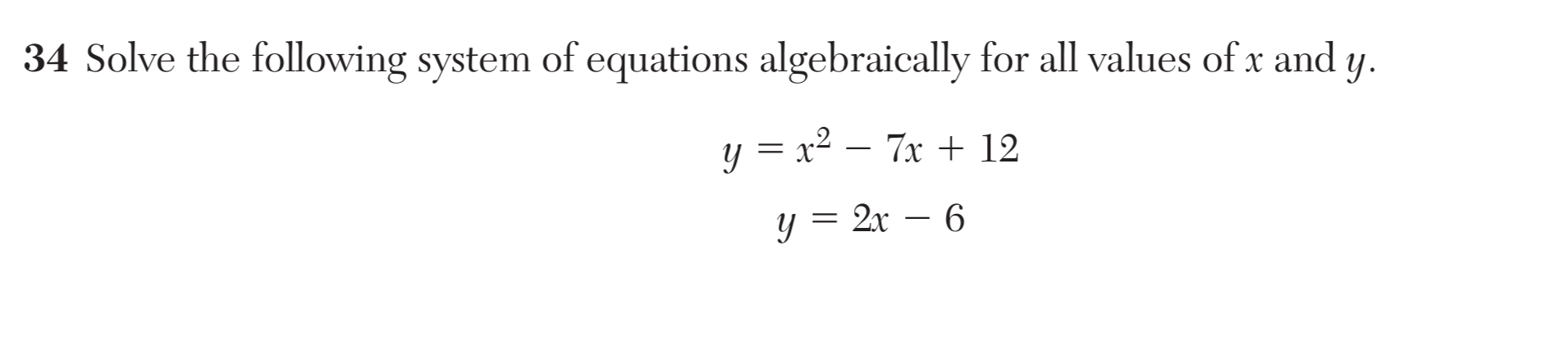
Solve the following system of equations algebraically for all values of and .
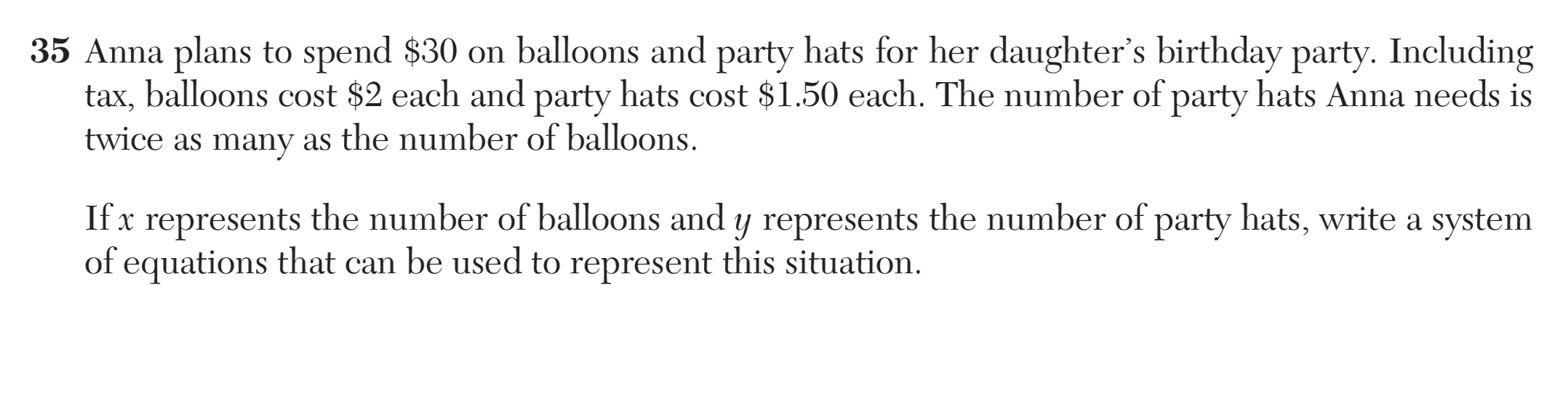
Anna plans to spend $30 on balloons and party hats for her daughter's birthday party. Including tax, balloons cost $2 each and party hats cost $1.50 each. The number of party hats Anna needs is twice as many as the number of balloons.
If represents the number of balloons and represents the number of party hats, write a system of equations that can be used to represent this situation.
Use your system of equations to algebraically determine the number of balloons and the number of party hats Anna can buy.
(3)
(1)
(4)
(1)
(2)
(2)
(4)
(1)
(2)
(1)
(1)
(3)
(3)
(4)
(4)
(2)
(1)
(2)
(4)
(3)
(2)
(4)
(2)
(4)
Looking at the graph, Sally is traveling at a constant speed during the interval minutes.
During this interval, the graph is a horizontal line segment at 35 miles per hour. A horizontal line on a speed vs. time graph means the speed is not changing, so Sally is traveling at a constant speed of 35 mph.
To graph , first find the vertex. The x-coordinate of the vertex is .
The y-coordinate is .
So the vertex is at .
Create a table of values:
Plot these points and draw a smooth parabola opening upward through them.
The axis of symmetry is a vertical line through the vertex, so the equation is .
(any value except 0, 1, 2, 3, 4, 5, or 6 is acceptable)
For to be a function, each input (x-value) must have exactly one output (y-value). This means no x-value can be repeated.
The x-values already used in the table are: 0, 3, 2, 6, 1, 5, and 4.
The value of must be different from all of these existing x-values, because if equaled any of them, that x-value would be mapped to two different outputs, which would violate the definition of a function.
Therefore, can be any value except 0, 1, 2, 3, 4, 5, or 6. For example, is an appropriate value.
or
Start with the equation:
To complete the square, take half of the coefficient of , which is , and square it: .
Add 16 to both sides:
Take the square root of both sides:
Solve for :
The solutions are and .
Set and solve for :
Multiply both sides by 2:
Add 5 to both sides:
Divide both sides by :
To rationalize the denominator, multiply the numerator and denominator by :
Simplify:
Let = the number of nickels and = the number of dimes.
Since there were 25 coins in all:
Since the total value is $1.70, and nickels are worth $0.05 and dimes are worth $0.10:
Enter the data into a graphing calculator using the statistics mode:
: 135, 147, 150, 144, 146, 153, 143
: 725, 812, 866, 761, 825, 863, 737
Perform a linear regression (LinReg) to obtain:
and
Rounding to the nearest tenth: and .
The linear regression equation is .
and
Identify the coefficients: , , .
Apply the quadratic formula:
Simplify :
The solutions are and .
and
Set the two expressions for equal to each other:
Move all terms to one side:
Factor the quadratic:
Find the corresponding -values using :
When :
When :
The solutions are and .
Balloons cost $2 each and party hats cost $1.50 each, with a total budget of $30:
The number of party hats is twice as many as the number of balloons: