1.
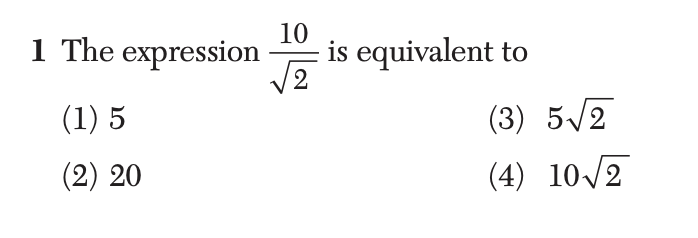
The expression is equivalent to
(1)
(2)
(3)
(4)
Task Image
Standard
NGLS.Math.Content.AI.N-RN.B
Domain
Number
The expression is equivalent to
(1)
(2)
(3)
(4)
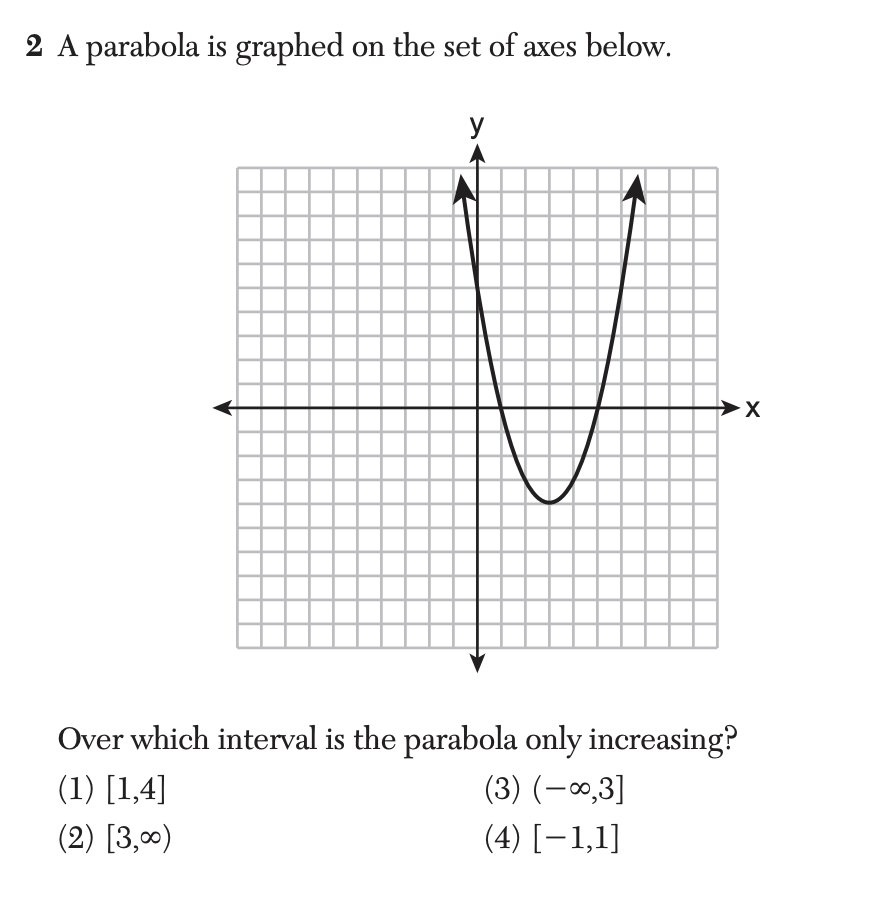
A parabola is graphed on the set of axes below.
Image Description: An upward-opening parabola on a coordinate plane. The vertex is at . The parabola passes through and .
Over which interval is the parabola only increasing?
(1)
(2)
(3)
(4)
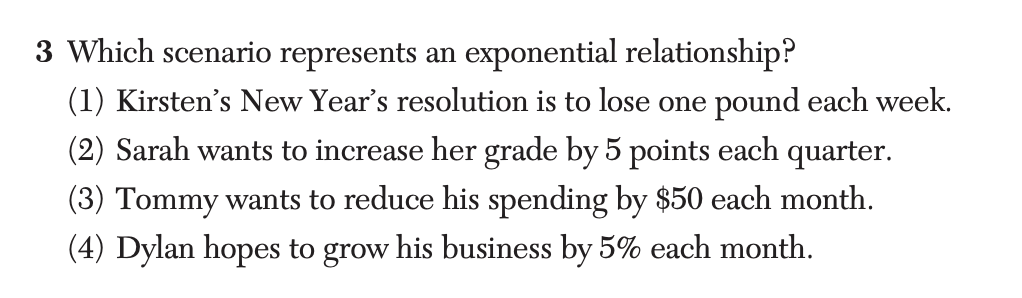
Which scenario represents an exponential relationship?
(1) Kirsten's New Year's resolution is to lose one pound each week.
(2) Sarah wants to increase her grade by 5 points each quarter.
(3) Tommy wants to reduce his spending by $50 each month.
(4) Dylan hopes to grow his business by 5% each month.
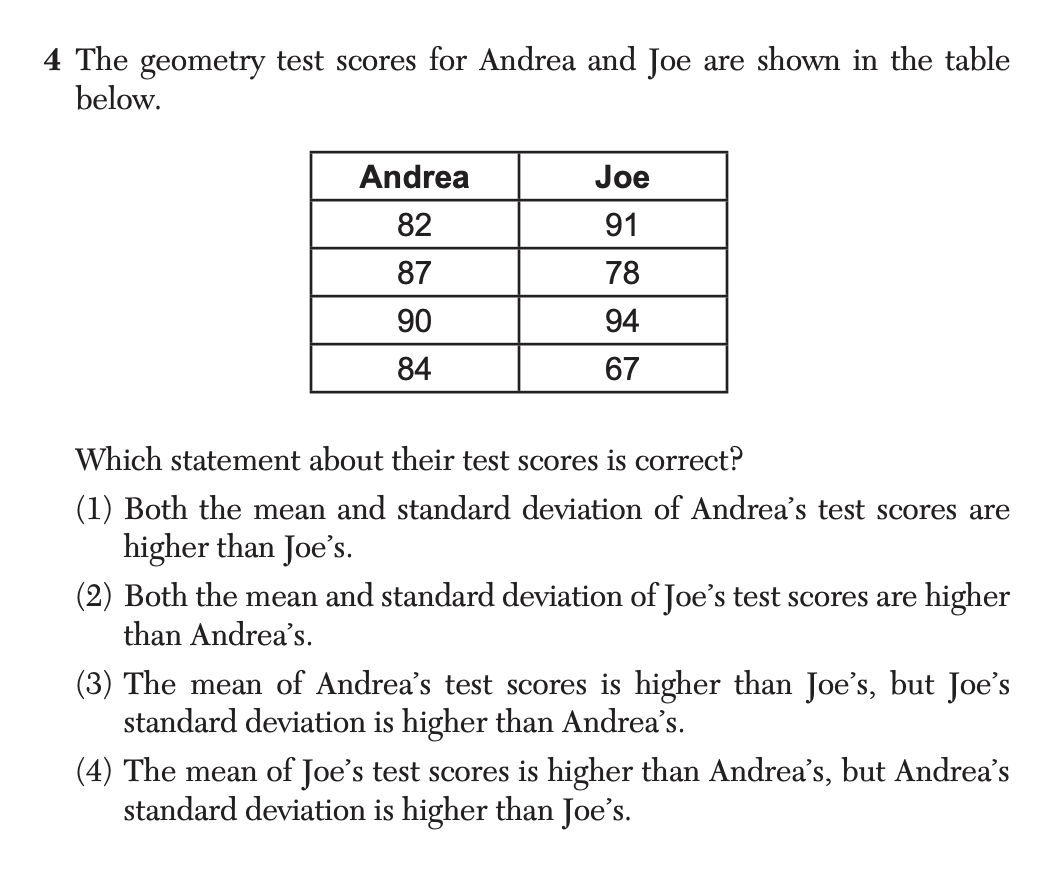
The geometry test scores for Andrea and Joe are shown in the table below.
| Andrea | Joe |
|---|---|
| 82 | 91 |
| 87 | 78 |
| 90 | 94 |
| 84 | 67 |
Which statement about their test scores is correct?
(1) Both the mean and standard deviation of Andrea's test scores are higher than Joe's.
(2) Both the mean and standard deviation of Joe's test scores are higher than Andrea's.
(3) The mean of Andrea's test scores is higher than Joe's, but Joe's standard deviation is higher than Andrea's.
(4) The mean of Joe's test scores is higher than Andrea's, but Andrea's standard deviation is higher than Joe's.
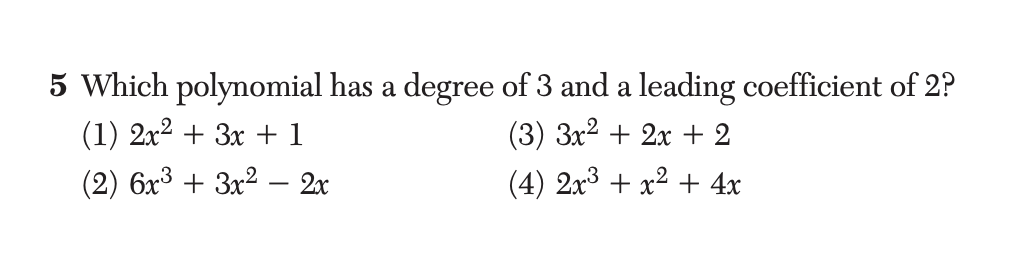
Which polynomial has a degree of 3 and a leading coefficient of 2?
(1)
(2)
(3)
(4)
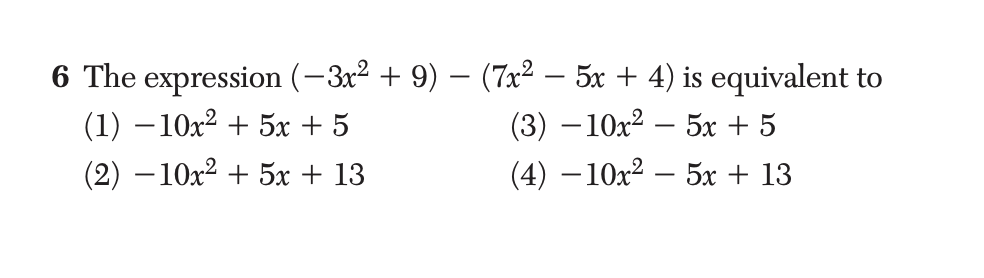
The expression is equivalent to
(1)
(2)
(3)
(4)
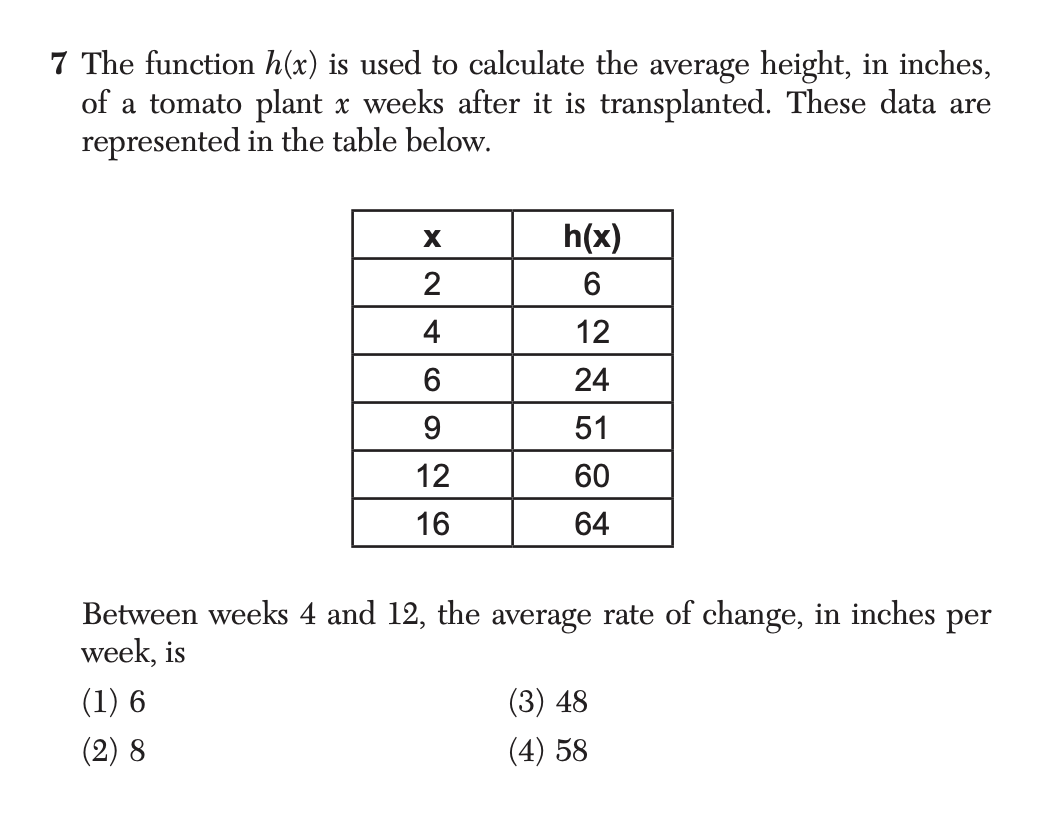
The function is used to calculate the average height, in inches, of a tomato plant weeks after it is transplanted. These data are represented in the table below.
| x | h(x) |
|---|---|
| 2 | 6 |
| 4 | 12 |
| 6 | 24 |
| 9 | 51 |
| 12 | 60 |
| 16 | 64 |
Between weeks 4 and 12, the average rate of change, in inches per week, is
(1) 6
(2) 8
(3) 48
(4) 58
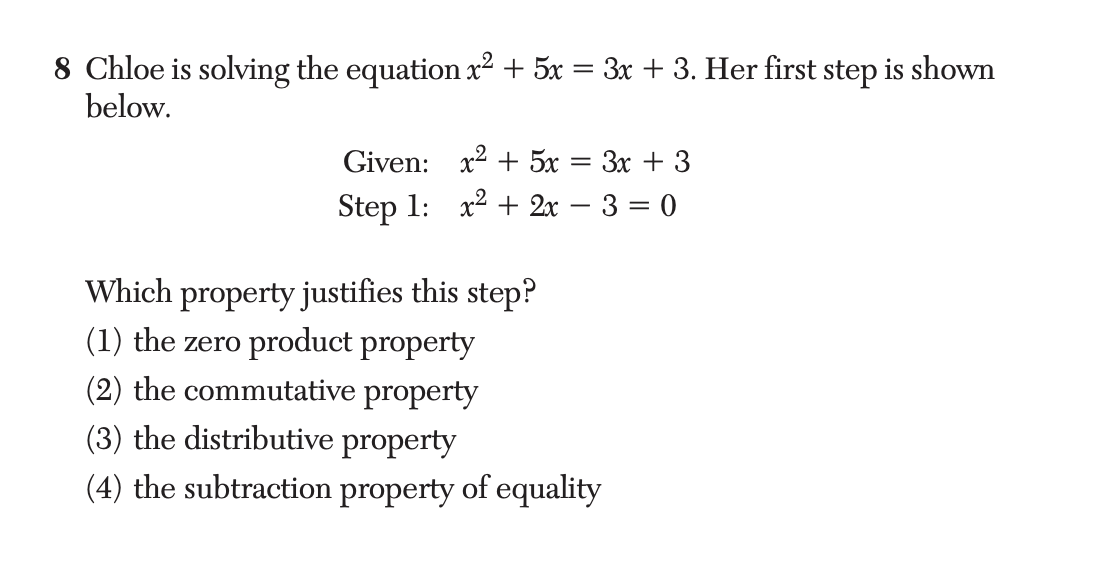
Chloe is solving the equation . Her first step is shown below.
Given:
Step 1:
Which property justifies this step?
(1) the zero product property
(2) the commutative property
(3) the distributive property
(4) the subtraction property of equality
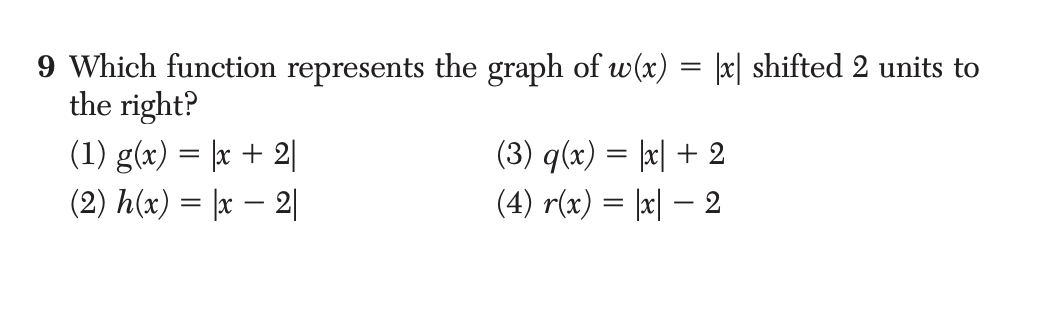
Which function represents the graph of shifted 2 units to the right?
(1)
(2)
(3)
(4)
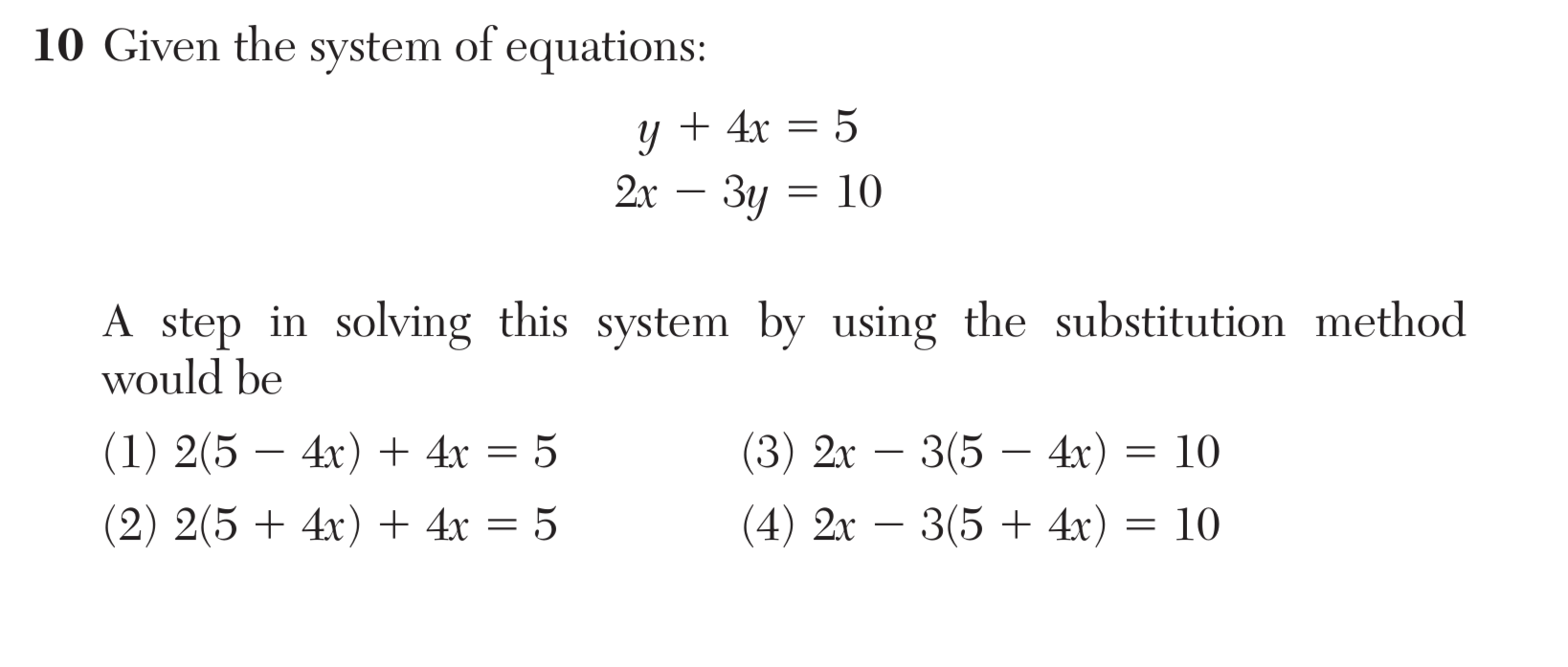
Given the system of equations:
A step in solving this system by using the substitution method would be
(1)
(2)
(3)
(4)
Which equation is equivalent to ?
(1)
(2)
(3)
(4)

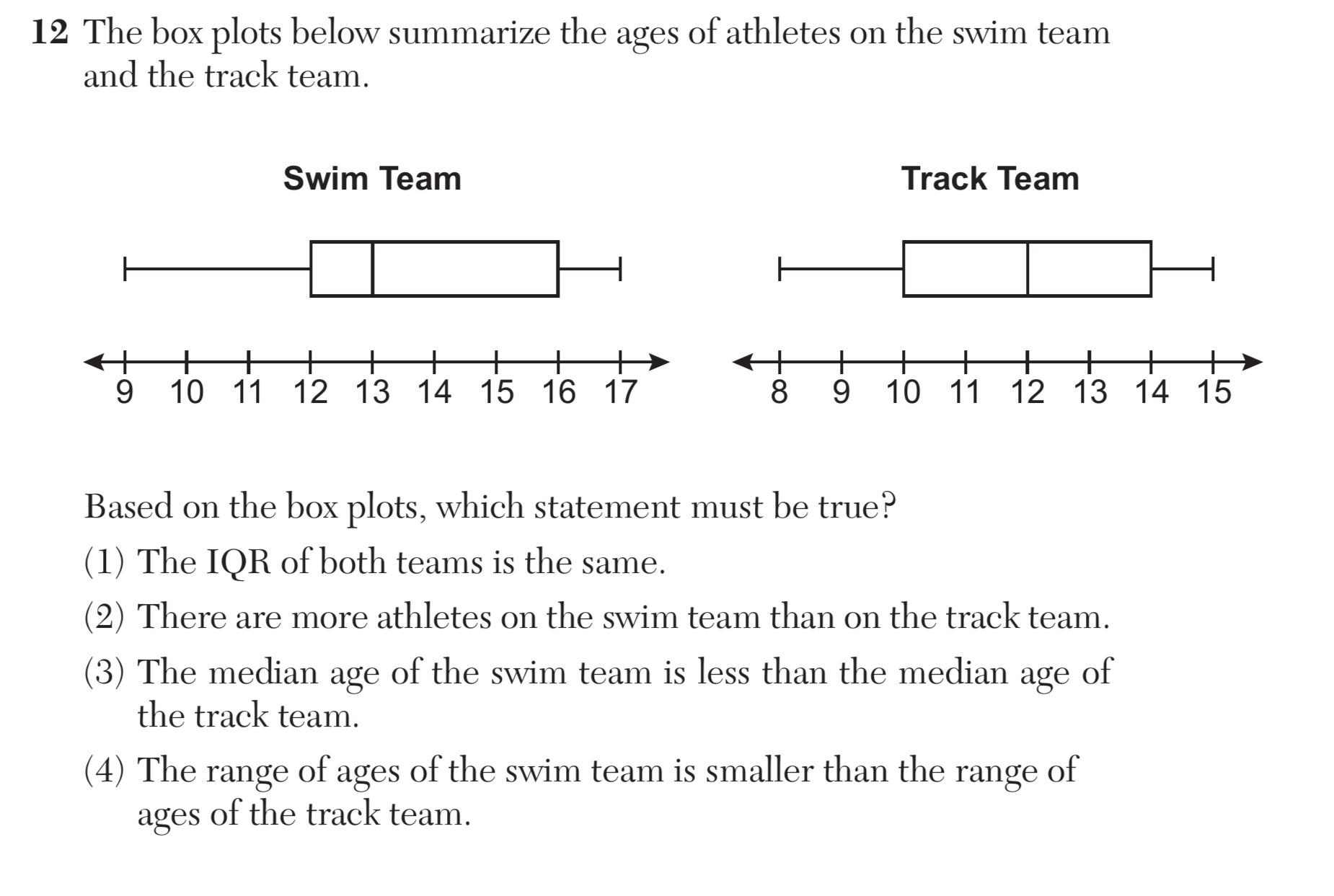
The box plots below summarize the ages of athletes on the swim team and the track team.
Image Description: Two box plots on number lines. Swim Team: minimum 9, Q1 12, median 13, Q3 16, maximum 17. Track Team: minimum 8, Q1 10, median 12, Q3 14, maximum 15.
Based on the box plots, which statement must be true?
(1) The IQR of both teams is the same.
(2) There are more athletes on the swim team than on the track team.
(3) The median age of the swim team is less than the median age of the track team.
(4) The range of ages of the swim team is smaller than the range of ages of the track team.
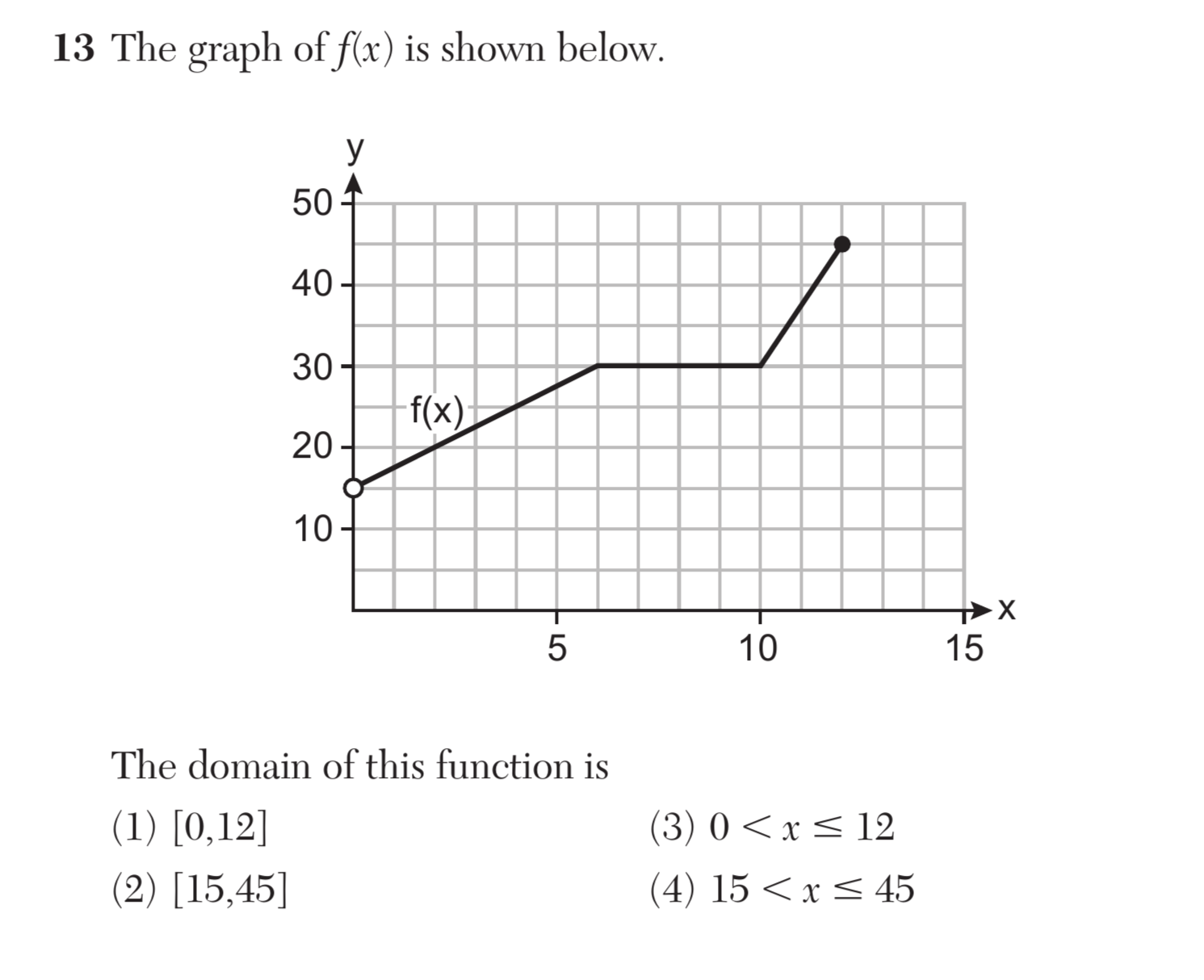
The graph of is shown below.
Image Description: A piecewise linear function on a coordinate plane. The graph starts with an open circle at , increases to approximately , remains constant at 30 from to , then increases to a closed circle at . The x-axis goes from 0 to 15, the y-axis from 0 to 50.
The domain of this function is
(1)
(2)
(3)
(4)
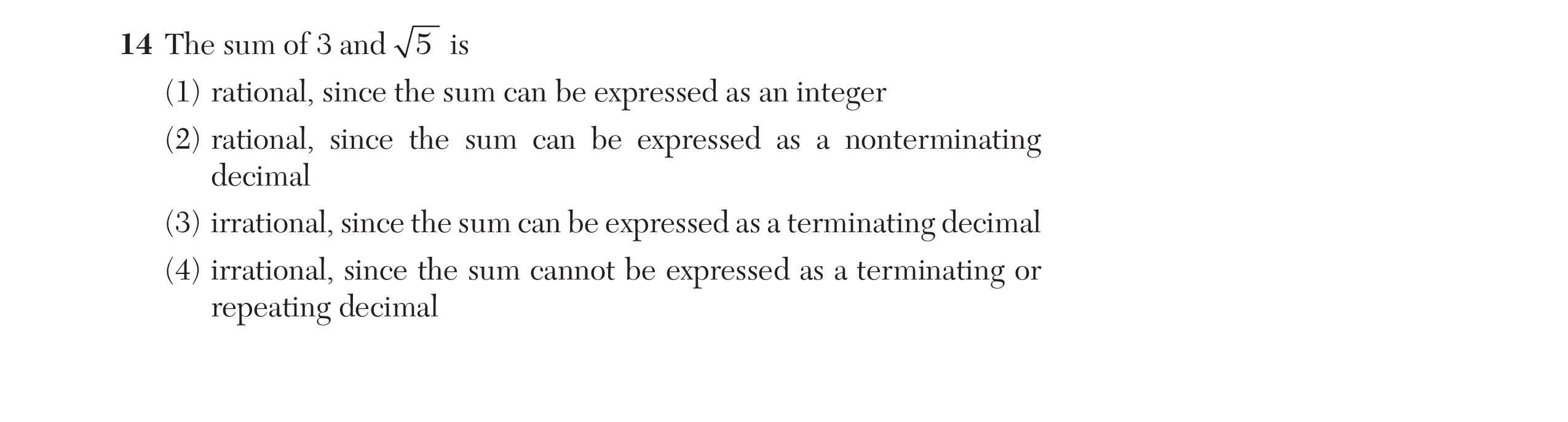
The sum of 3 and is
(1) rational, since the sum can be expressed as an integer
(2) rational, since the sum can be expressed as a nonterminating decimal
(3) irrational, since the sum can be expressed as a terminating decimal
(4) irrational, since the sum cannot be expressed as a terminating or repeating decimal
Which expression is equivalent to ?
(1)
(2)
(3)
(4)

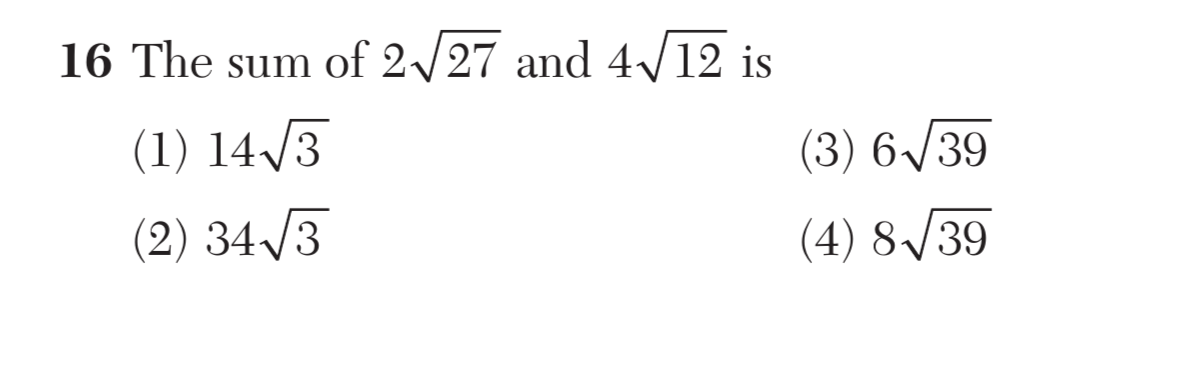
The sum of and is
(1)
(2)
(3)
(4)
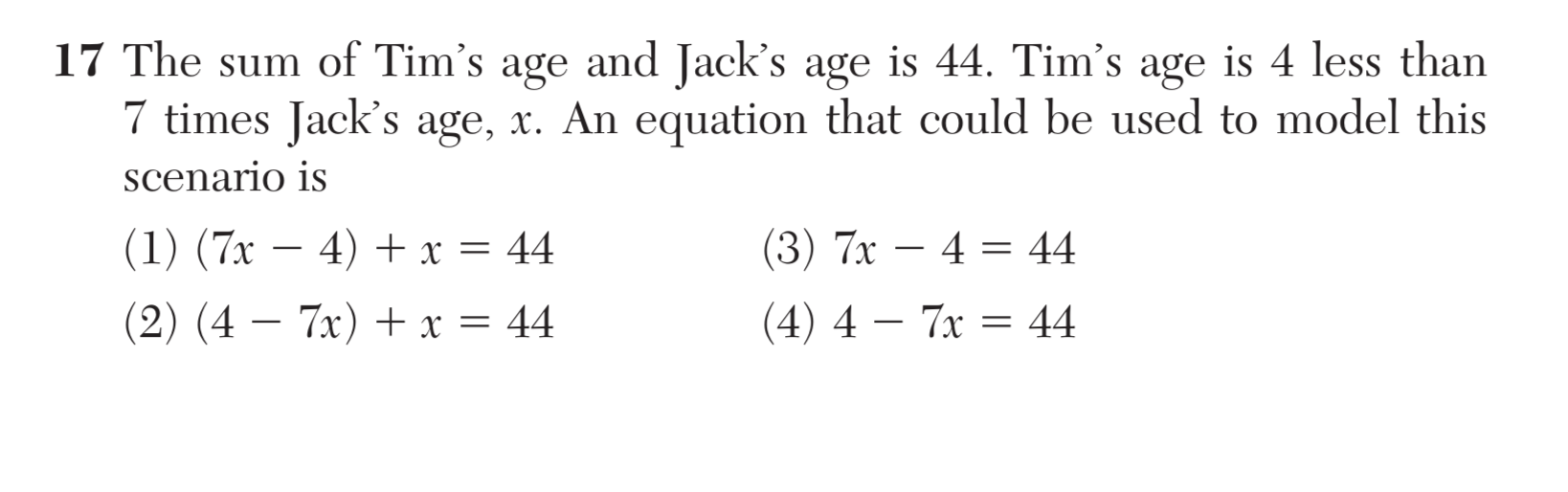
The sum of Tim's age and Jack's age is 44. Tim's age is 4 less than 7 times Jack's age, . An equation that could be used to model this scenario is
(1)
(2)
(3)
(4)
Given the function , what is the value of ?
(1)
(2)
(3)
(4)

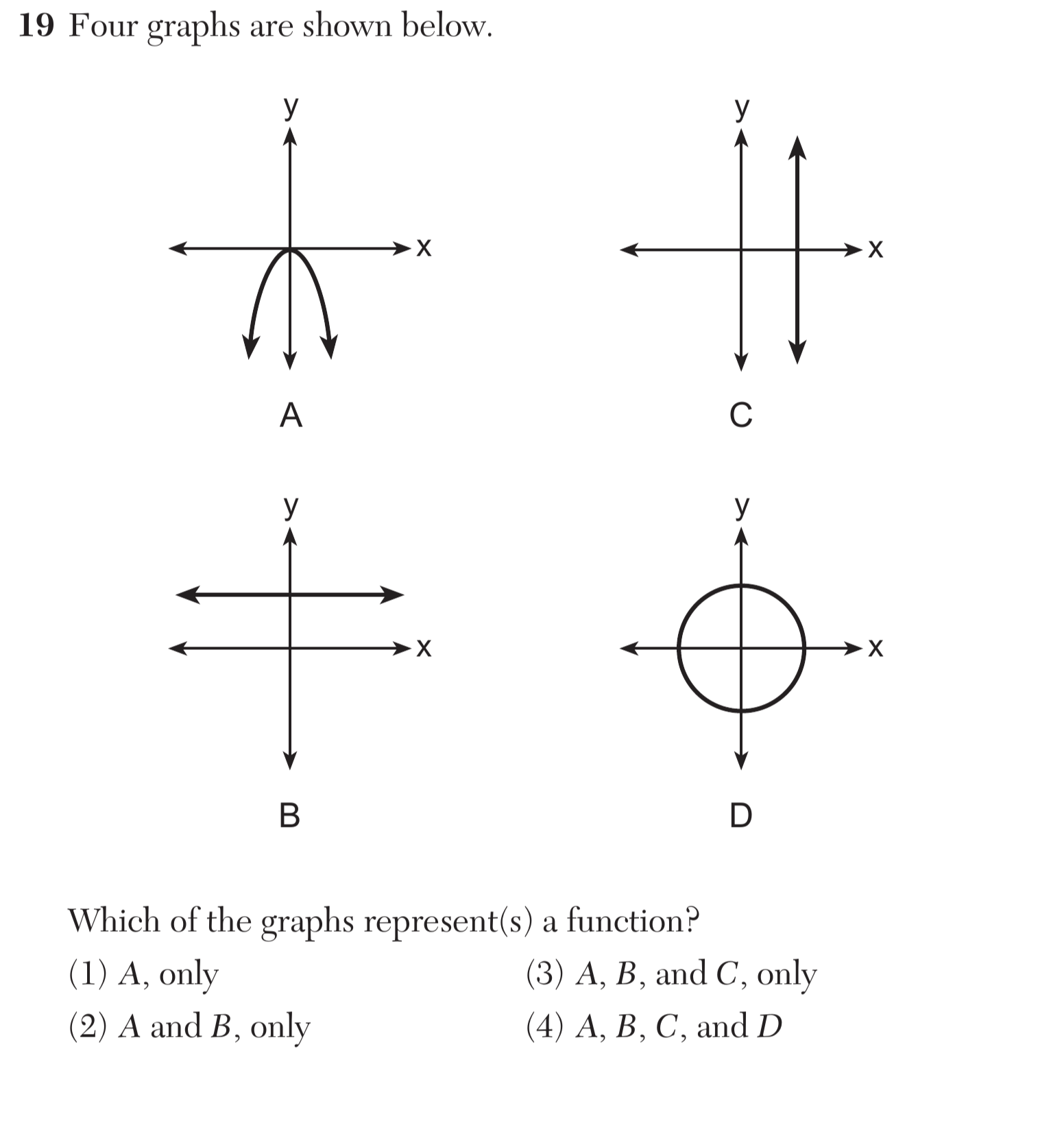
Four graphs are shown below.
Image Description: Four graphs labeled A, B, C, and D on separate coordinate planes.
Which of the graphs represent(s) a function?
(1) A, only
(2) A and B, only
(3) A, B, and C, only
(4) A, B, C, and D
The formula to calculate kinetic energy is , where is kinetic energy, is mass, and is velocity. When is written in terms of and , the equation is
(1)
(2)
(3)
(4)
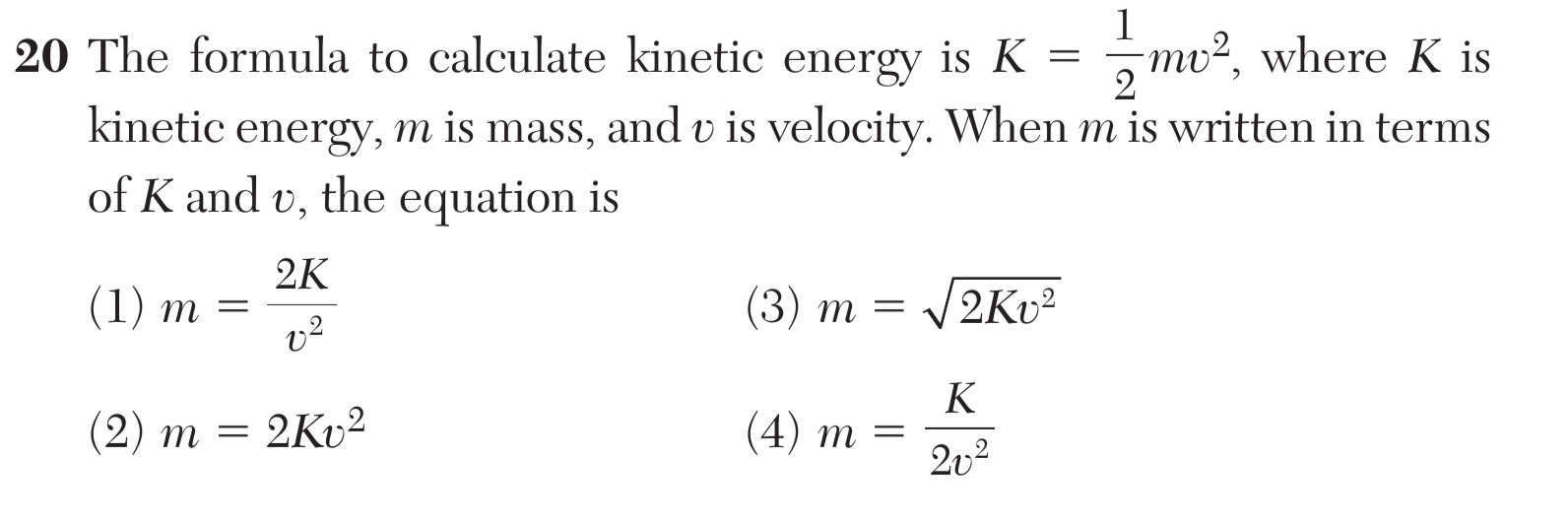
The solution to the equation is
(1)
(2)
(3)
(4)
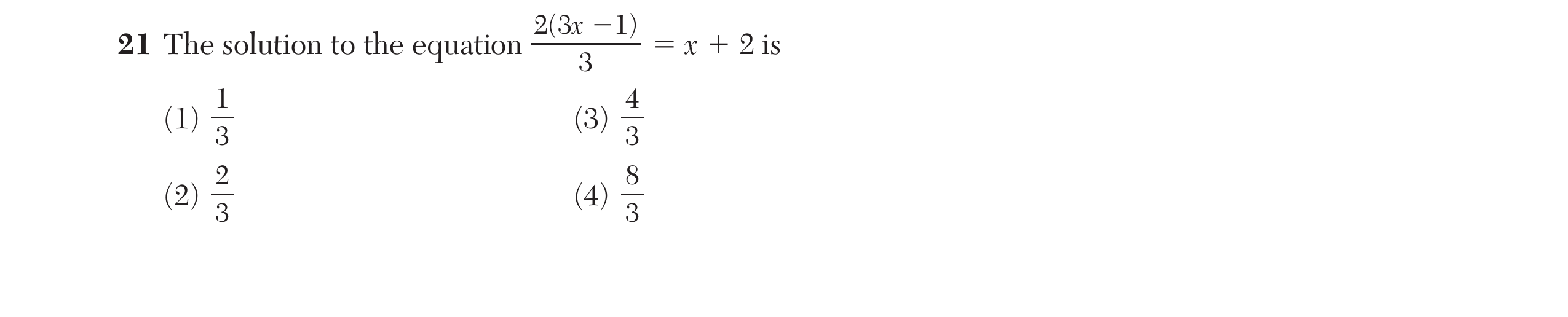
Which equation represents the sequence , where ?
(1)
(2)
(3)
(4)
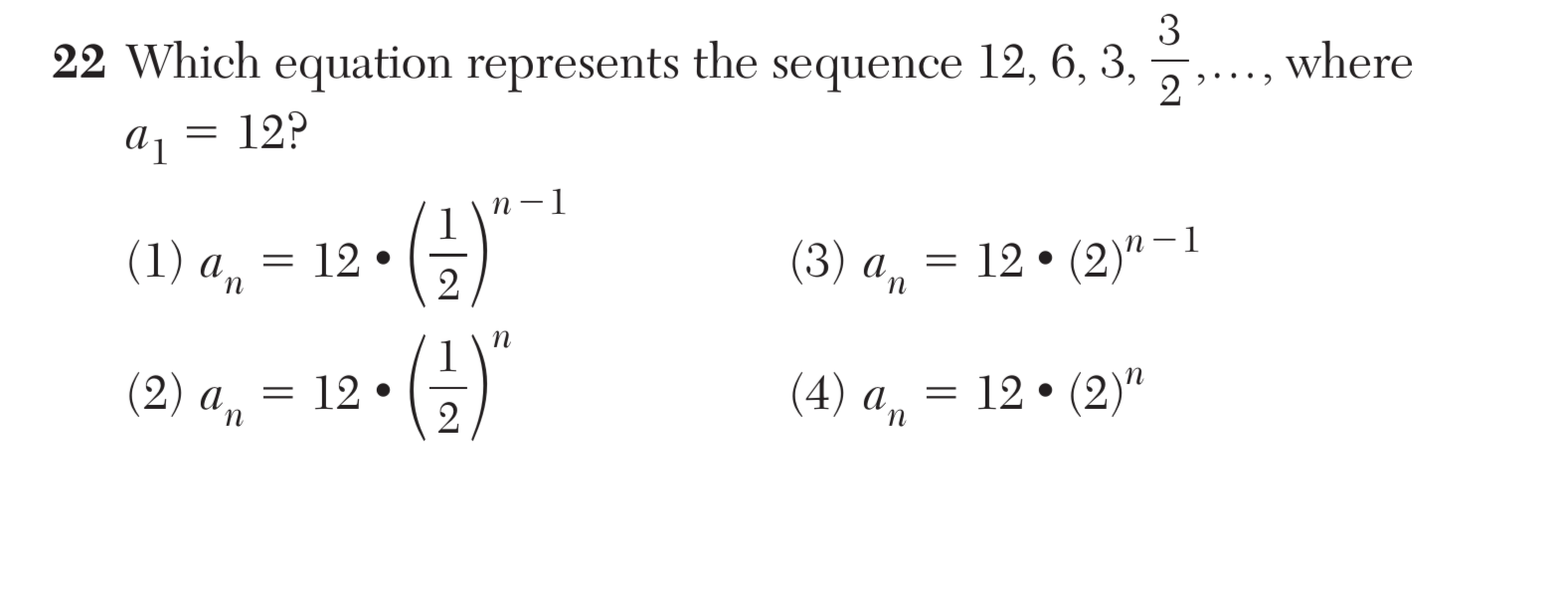
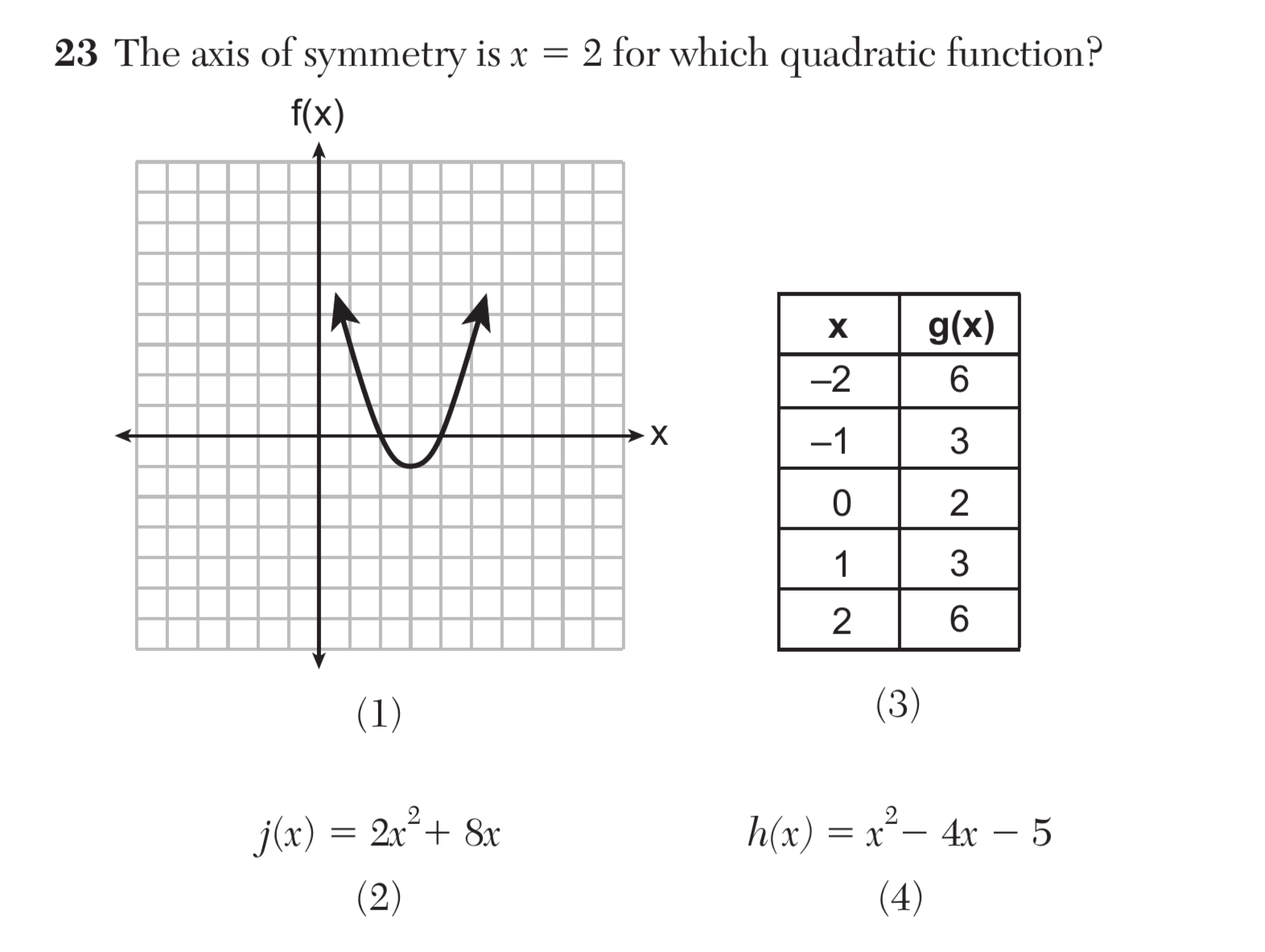
The axis of symmetry is for which quadratic function?
Image Description: Four quadratic function representations are shown.
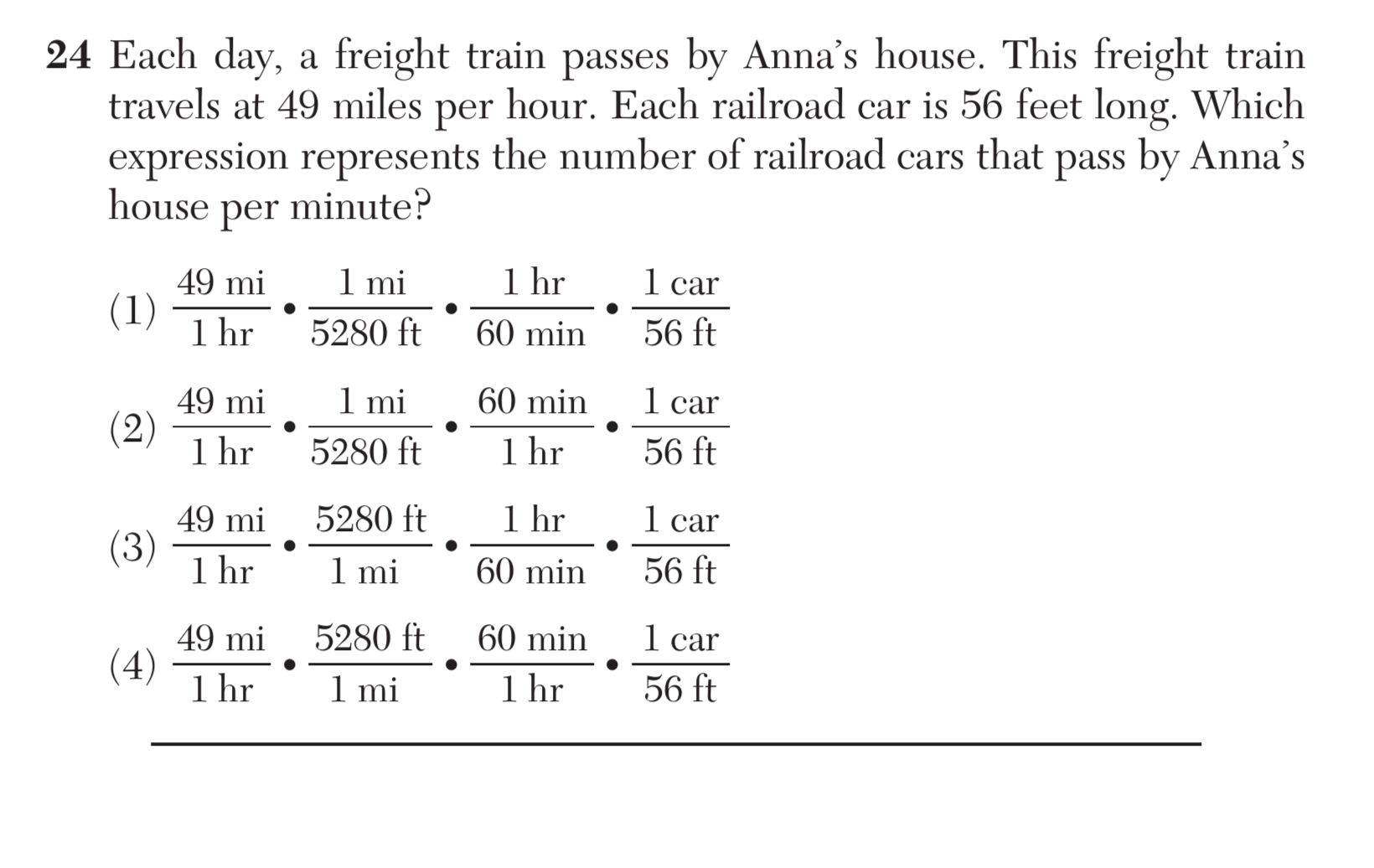
Each day, a freight train passes by Anna's house. This freight train travels at 49 miles per hour. Each railroad car is 56 feet long. Which expression represents the number of railroad cars that pass by Anna's house per minute?
(1)
(2)
(3)
(4)
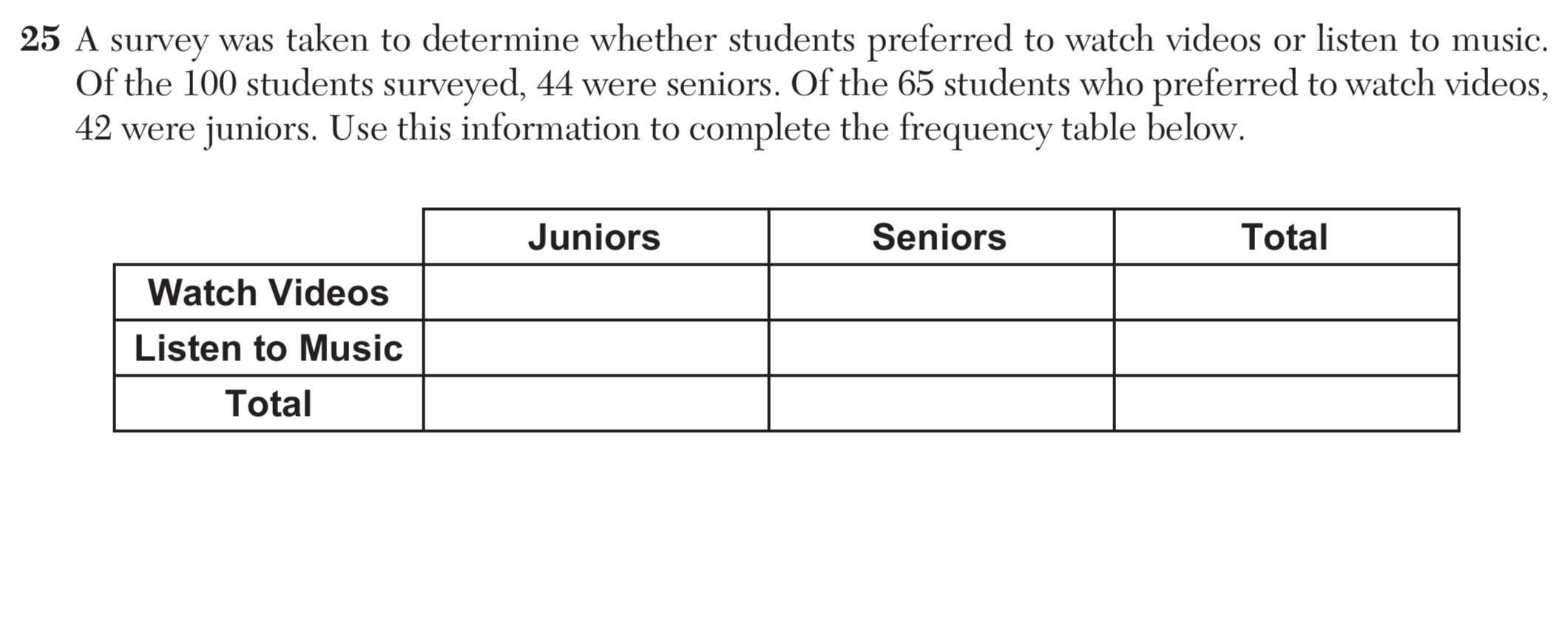
A survey was taken to determine whether students preferred to watch videos or listen to music. Of the 100 students surveyed, 44 were seniors. Of the 65 students who preferred to watch videos, 42 were juniors. Use this information to complete the frequency table below.
| Juniors | Seniors | Total | |
|---|---|---|---|
| Watch Videos | |||
| Listen to Music | |||
| Total |
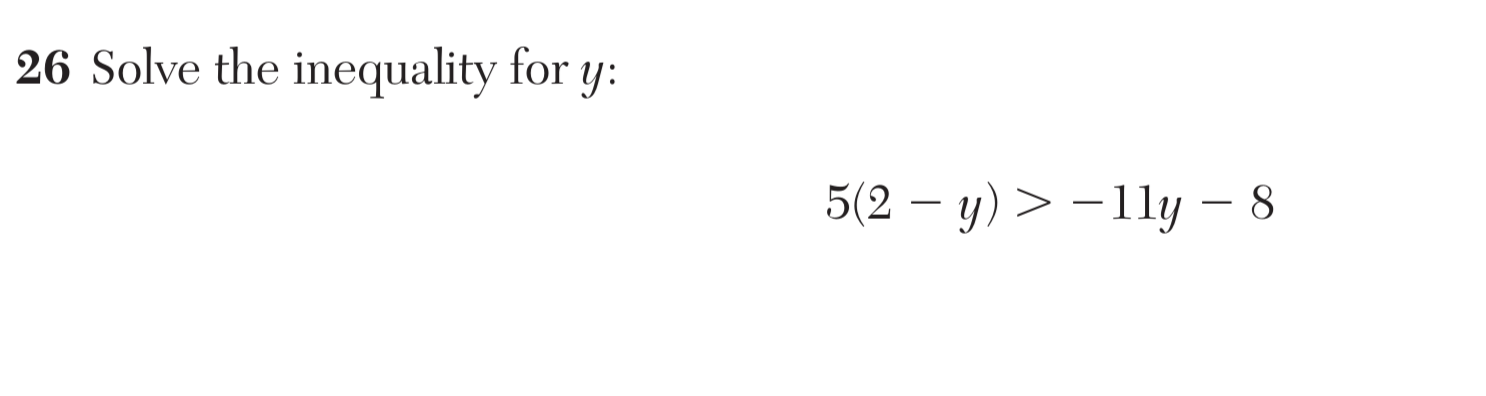
Solve the inequality for :
Express as a trinomial in standard form.

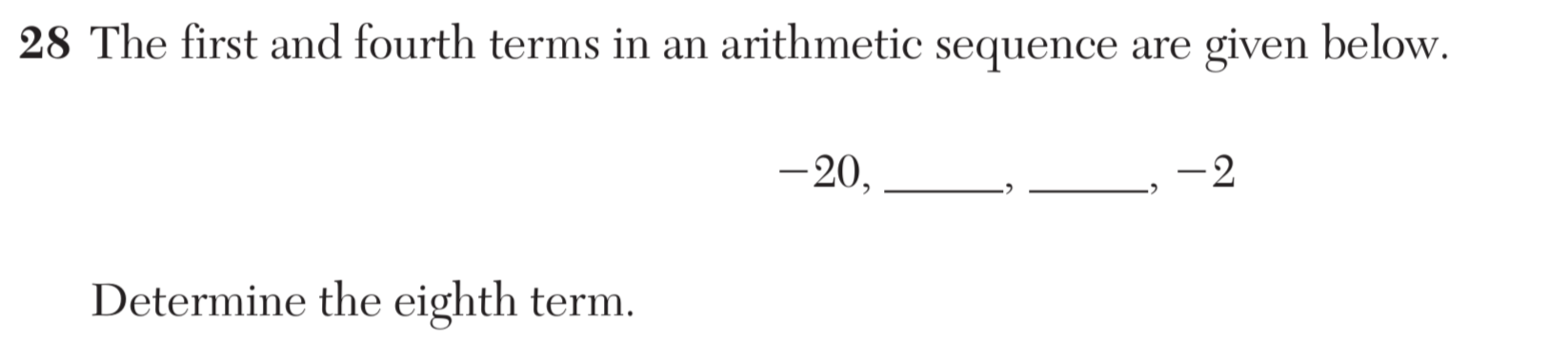
The first and fourth terms in an arithmetic sequence are given below.
, ___, ___,
Determine the eighth term.
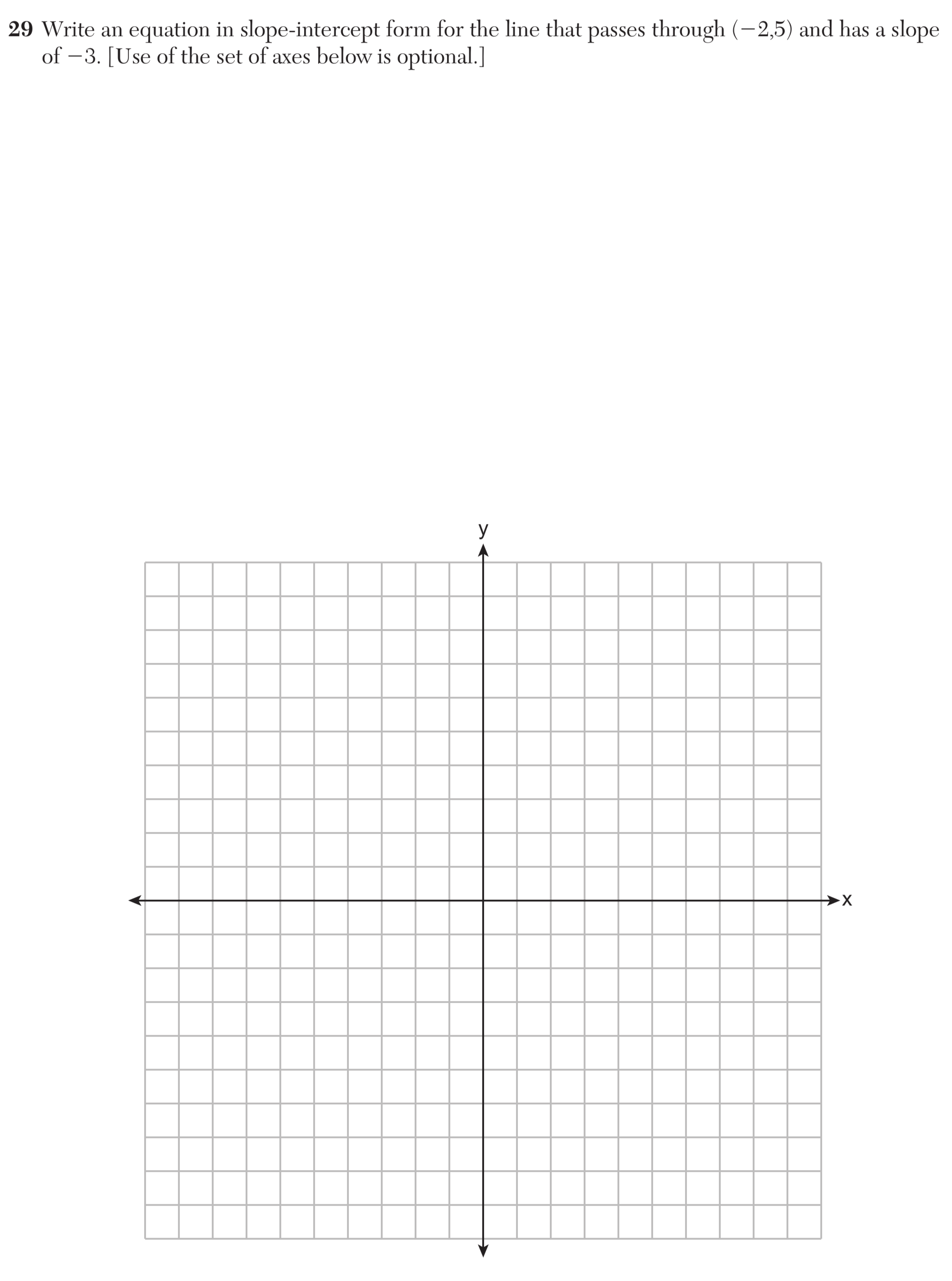
Write an equation in slope-intercept form for the line that passes through and has a slope of . [Use of the set of axes below is optional.]
Image Description: A blank coordinate grid with x-axis and y-axis.
Factor the expression completely.

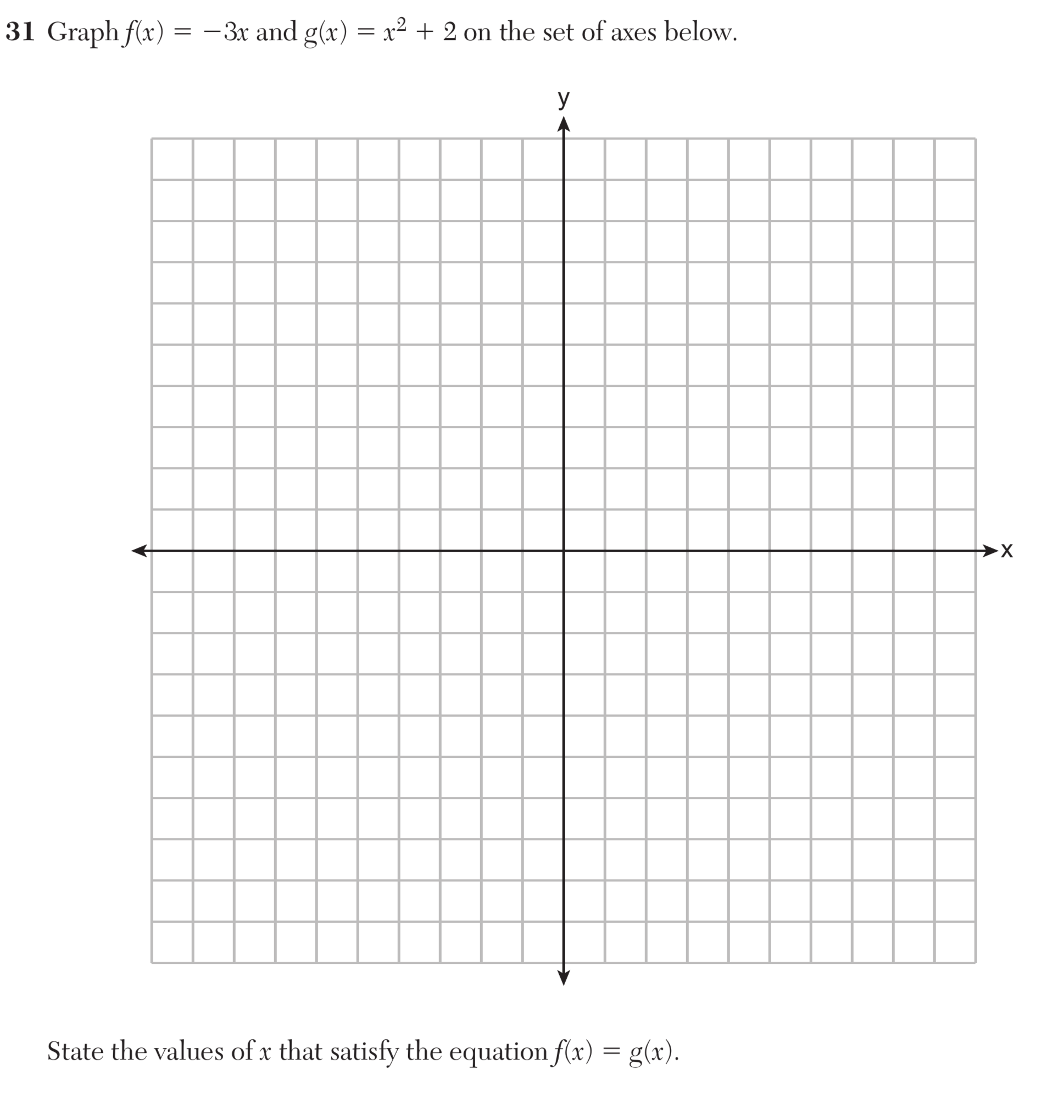
Graph and on the set of axes below.
Image Description: A blank coordinate grid with x-axis and y-axis.
State the values of that satisfy the equation .
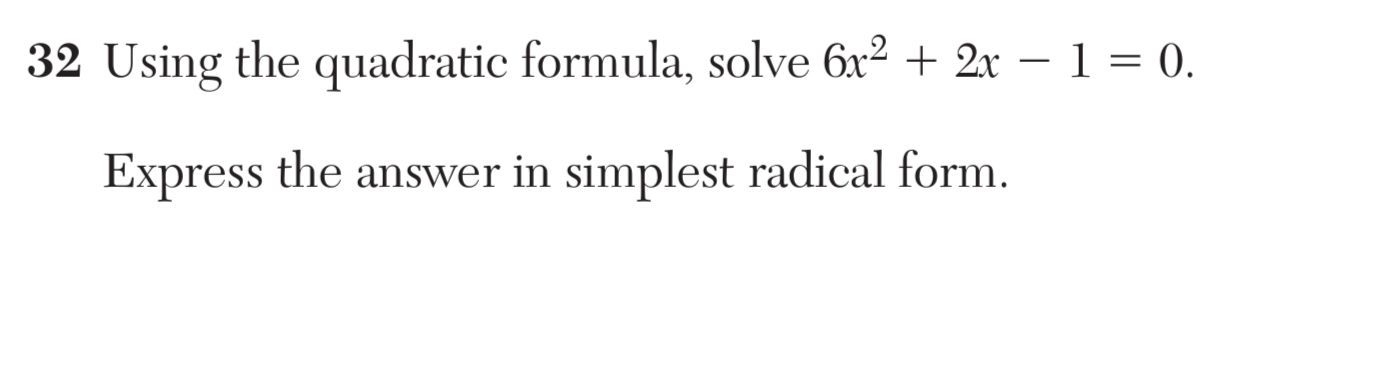
Using the quadratic formula, solve .
Express the answer in simplest radical form.
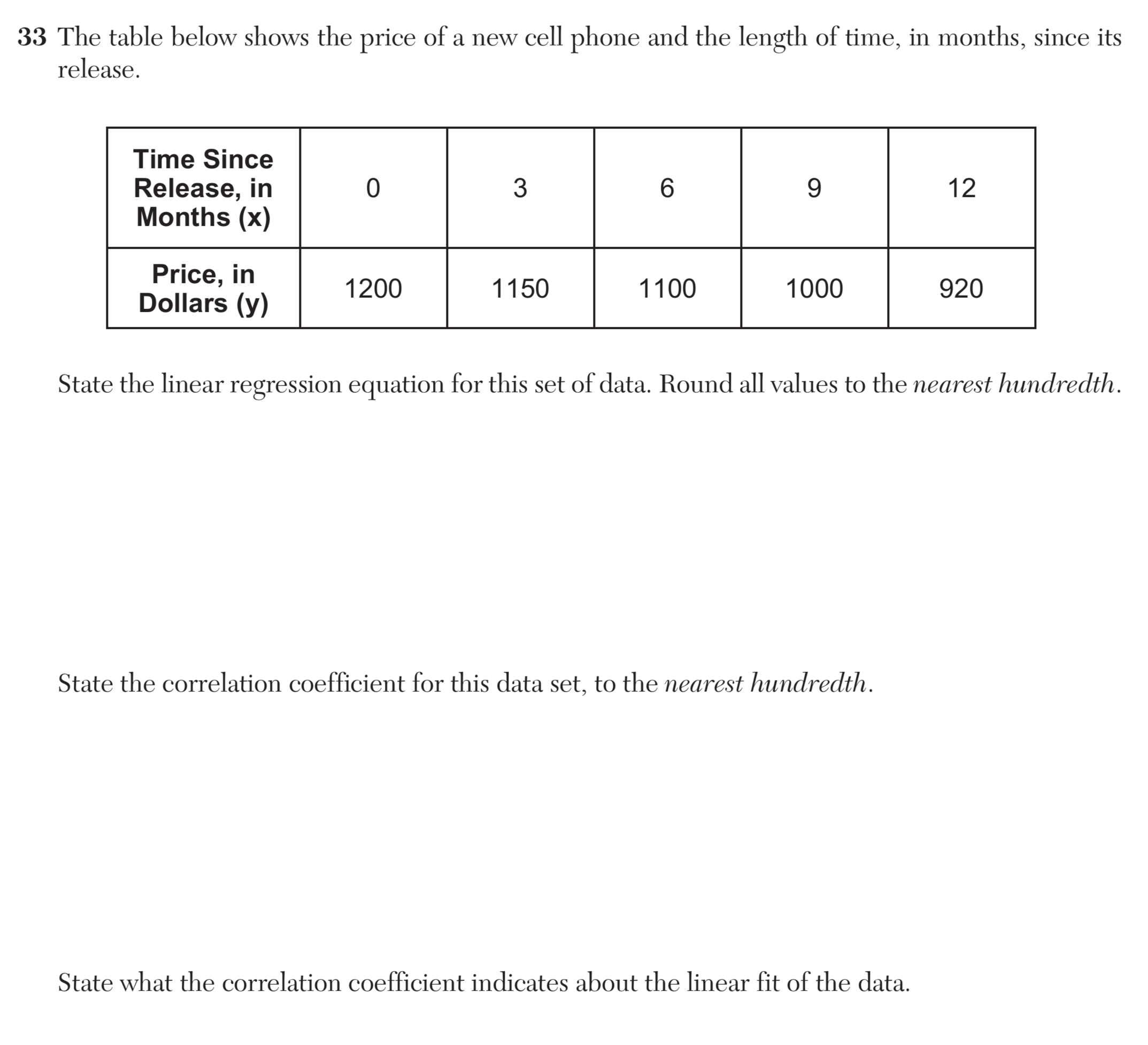
The table below shows the price of a new cell phone and the length of time, in months, since its release.
| Time Since Release, in Months (x) | 0 | 3 | 6 | 9 | 12 |
|---|---|---|---|---|---|
| Price, in Dollars (y) | 1200 | 1150 | 1100 | 1000 | 920 |
State the linear regression equation for this set of data. Round all values to the nearest hundredth.
State the correlation coefficient for this data set, to the nearest hundredth.
State what the correlation coefficient indicates about the linear fit of the data.
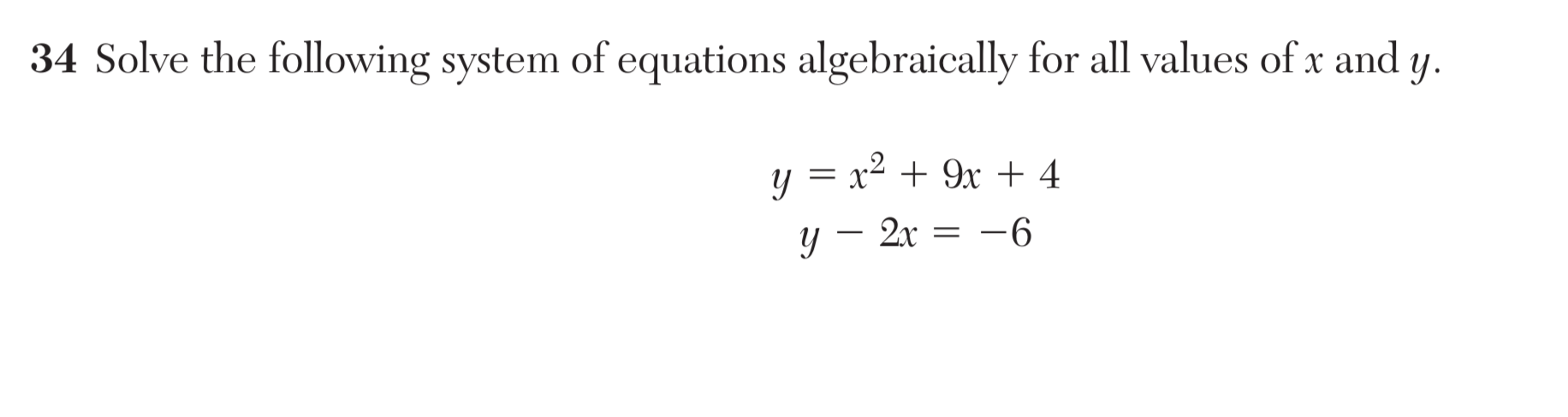
Solve the following system of equations algebraically for all values of and .
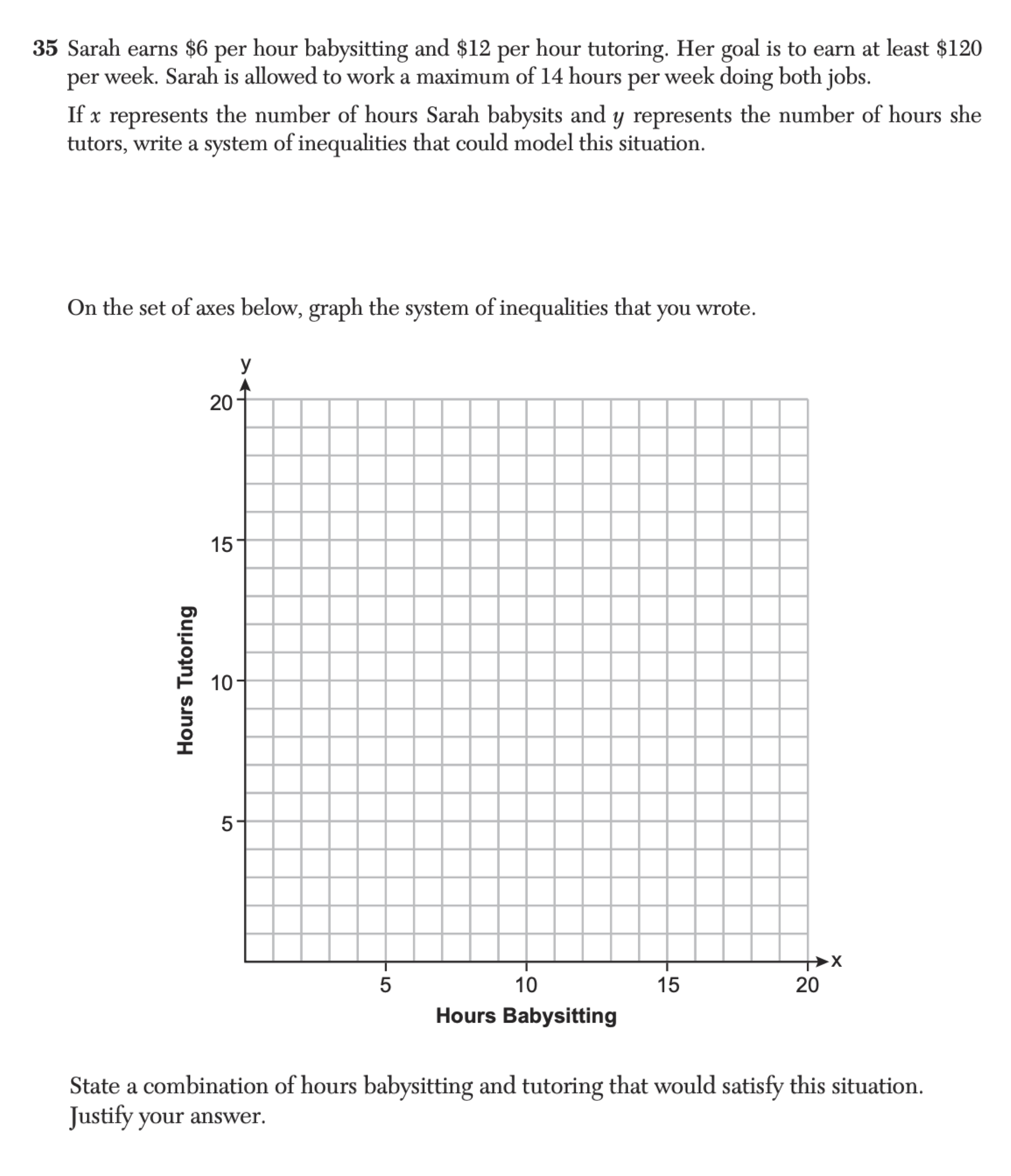
Sarah earns $6 per hour babysitting and $12 per hour tutoring. Her goal is to earn at least $120 per week. Sarah is allowed to work a maximum of 14 hours per week doing both jobs.
If represents the number of hours Sarah babysits and represents the number of hours she tutors, write a system of inequalities that could model this situation.
On the set of axes below, graph the system of inequalities that you wrote.
Image Description: A coordinate grid with the x-axis labeled "Hours Babysitting" (0 to 20) and y-axis labeled "Hours Tutoring" (0 to 20).
State a combination of hours babysitting and tutoring that would satisfy this situation. Justify your answer.
(3)
(1)
(4)
(3)
(4)
(1)
(1)
(4)
(2)
(3)
(2)
(1)
(3)
(4)
(3)
(1)
(1)
(1)
(2)
(1)
(4)
(1)
(4)
(3)
Watch Videos: Juniors = 42, Seniors = 23, Total = 65
Listen to Music: Juniors = 14, Seniors = 21, Total = 35
Total: Juniors = 56, Seniors = 44, Total = 100
Total students = 100, Seniors = 44, so Juniors = .
Watch Videos total = 65, Watch Videos Juniors = 42, so Watch Videos Seniors = .
Listen to Music total = .
Listen to Music Juniors = .
Listen to Music Seniors = .
22
The first term is and the fourth term is .
Using point-slope form with and point :
and
Set :
or
, ,
The correlation coefficient indicates a strong negative linear relationship, meaning the linear equation is a good fit for the data.
Using the data points , , , , :
, , , ,
Slope:
Intercept:
, indicating a strong negative linear relationship.
and
From the second equation:
Substitute into the first equation:
or
When :
When :
Solutions: and
System of inequalities:
One valid combination: ,
System of inequalities:
(earnings goal)
(maximum hours)
,
Simplifying the first inequality:
One valid combination: hours babysitting, hours tutoring.
Check: