Trailing zeros after a decimal point do not change a number's value (e.g., 34.560 = 34.56)
Line up place values vertically when adding or subtracting decimals
You may need to 'regroup' (carry or borrow) just like with whole numbers
Base-ten diagrams can help us understand subtraction. Suppose we are finding 0.23 −0.07. Here is a diagram showing 0.23, or 2 tenths and 3 hundredths.
Subtracting 7 hundredths means removing 7 small squares, but we do ;not have enough to remove. Because 1 tenth is equal to 10 hundredths, we can decompose one of the tenths (1 rectangle) into 10 hundredths (10 small squares).
Base ten diagram. 0 point 23. Two rectangles in the tenths column. 3 small squares in the hundredths column. A dotted rectangle is drawn around one of the rectangles with an arrow to 10 small squares. The arrow is labeled decompose.
We now have 1 tenth and 13 hundredths, from which we can remove 7 hundredths.
Base ten diagram. 0 point 23. One rectangle in the tenths column. 13 small squares in the hundredths column. 7 small squares have an X through them. The words subtract 0 point 0 7 is below the small squares.
We have 1 tenth and 6 hundredths remaining, so 0.23−0.07 =0.16.
Here is a vertical calculation of 0.23−0.07.
Vertical subtraction. First line. 0 point 23. The 2 is crossed out and has a 1 above it. The 3 is crossed out and has 13 above it. Second line. Minus 0 point 0 0 7. Horizontal line. Third line. 0 point 17.
Notice how this representation also shows that a tenth is decomposed into 10 hundredths in order to subtract 7 hundredths.
This works for any decimal place. Suppose we are finding 0.023 −0.007. Here is a diagram showing 0.023.
We want to remove 7 thousandths (7 small rectangles). We can decompose one of the hundredths into 10 thousandths.
Base 10 diagram. 0 point 0 2 3. Two small squares in the hundredths column. Three small rectangles in the thousandths column. A square is drawn around 1 small square. An arrow is drawn to 10 small rectangles. The arrow is labeled decompose.
Now we can remove 7 thousandths.
Base 10 diagram. 0 point 0 2 3. One small square in the hundredths column. 13 small rectangles in the thousandths column. 7 small rectangles have an X through them. Below the small rectangles are the words subtract 0 point 0 0 7.
We have 1 hundredth and 6 thousandths remaining, so 0.023−0.007 =0.016.
Here is a vertical calculation of 0.023−0.007.
Vertical subtraction. First line. 0 point 0 2 3. The 2 is crossed out and has a 1 above it. The 3 is crossed out and has 13 above it. Second line. Minus 0 point 0 0 7. Horizontal line. Third line. 0 point 0 1 6.
Calculate the Difference (1 problem)
Find the value of each expression and show your reasoning.
1.56+0.083
0.2−0.05
Show Solution
1.643. Sample reasoning: Six hundredths and 8 hundredths make 14 hundredths, or 1 tenth and 4 hundredths. The sum has 1 one, 6 tenths, 4 hundredths, and 3 thousandths.
Fluently add, subtract, multiply, and divide multi-digit decimals using a standard algorithm for each operation.
For numbers with many digits, vertical calculation is more efficient than base-ten diagrams
Pad with trailing zeros so both numbers have the same number of decimal places (2.4 → 2.4000)
Regroup across multiple place values when subtracting
Base-ten diagrams work best for representing subtraction of numbers with few non-zero digits, such as 0.16−0.09. For numbers with many non-zero digits, such as 0.25103−0.04671, it would take a long time to draw the base-ten diagram. With vertical calculations, we can find this difference efficiently.
Thinking about base-ten diagrams can help us make sense of this calculation.
A setup for the subtraction calculation 0 point 2 5 1 0 3 subtract 0 point 0 4 6 7 1 results in 0 point 1 0 4 3 2. The number 0 point 2 5 1 0 3 is on top with the subtract 0 point 0 4 6 7 1 beneath, and the 0 from the first number lines up vertically with the 0 from the second number, the 2 from the first number lines up vertically with the 0 from the second, the 5 from the first number lines up vertically with the 4 from the second, and so on. The 1 in the thousandths place of the first number is unbundled to make ten groups of ten thousandths. The five in the hundredths place has 1 unbundled to make 4 hundredths and 10 thousandths.
The thousandth in 0.25103 is decomposed to make 10 ten-thousandths so that we can subtract 7 ten-thousandths. Similarly, one of the hundredths in 0.25103 is decomposed to make 10 thousandths.
How Much Farther? (1 problem)
A runner has run 1.192 kilometers of a 10-kilometer race. How much farther does she need to run to finish the race? Show your reasoning.
Show Solution
8.808 kilometers. Sample reasoning:
9.999−1.192=8.807. Adding 0.001 to 8.807 gives 8.808.
Section A Check
Section A Checkpoint
Problem 1
Which calculation shows a correct way to find 31.076+4.85?
Decimals can be written as fractions with denominators of 10, 100, 1000, etc.
To multiply decimals, rewrite them as fractions, multiply, then convert back
The number of decimal places in the product equals the total decimal places in the factors
We can use fractions like 101 and 1001 to reason about the location of the decimal point in a product of two decimals.
Let’s take 24⋅(0.1) as an example. There are several ways to find the product:
We can interpret it as 24 groups of 1 tenth (or 24 tenths), which is 2.4.
We can think of it as 24⋅101, which is equal to 1024 (and also equal to 2.4).
Because multiplying by 101 has the same result as dividing by 10, we can also think of it as24÷10, which is equal to 2.4.
Similarly, we can think of (0.7)⋅(0.09) as 7 tenths times 9 hundredths, and write:
(7⋅101)⋅(9⋅1001)
We can rearrange the whole numbers and fractions:
(7⋅9)⋅(101⋅1001)
This tells us that (0.7)⋅(0.09)=0.063.
63⋅1,0001=1,00063
Here is another example: To find (1.5)⋅(0.43), we can think of 1.5 as 15 tenths and 0.43 as 43 hundredths. We can write the tenths and hundredths as fractions and rearrange the factors.
(15⋅101)⋅(43⋅1001)=15⋅43 ⋅1,0001
Multiplying 15 and 43 gives us 645, and multiplying 101 and 1001 gives us 1,0001. So (1.5)⋅(0.43) is 645⋅1,0001, which is 0.645.
Explaining and Calculating Products (1 problem)
Use what you know about decimals or fractions to explain why (0.2)⋅(0.002)=0.0004.
A rectangular plot of land is 0.4 kilometer long and 0.07 kilometer wide. What is its area in square kilometers?
Show Solution
Sample response: 0.2 is 102, and 0.002 is 1,0002. Multiplying the two we have: 102⋅1,0002=10,0004, which is 0.0004.
0.028 square kilometers, because (0.4)⋅(0.07)=0.028
Fluently add, subtract, multiply, and divide multi-digit decimals using a standard algorithm for each operation.
To multiply decimals: multiply the digits as whole numbers, then place the decimal point
Count the total decimal places in both factors to know where the decimal goes in the product
Example: 1.25 x 0.7 -> compute 125 x 7 = 875, then shift 3 decimal places -> 0.875
To multiply two decimals, such as (1.25)⋅(0.7), we can multiply the whole numbers that have the same digits, 125⋅7, and then use what we know about place value to place the decimal point.
Multiplying 125 and 7 gives 875.
We know that 125 is 100 times 1.25, and 7 is 10 times 0.7, so the product of 125 and 7 is 1,000 times the product of 1.25 and 0.7.
This means we need to divide 875 by 1,000, which moves the digits 3 places to the right and gives 0.875.
Let’s find the product of 8.4 and 4.3!
First, we multiply 84 and 43.
84 is 10 times 8.4, and 43 is 10 times 4.3, so the product of 84 and 43 is 100 times the product of 8.4 and 4.3.
Dividing 3,612 by 100 moves the digits 2 places to the right, giving 36.12.
Notice that:
The factor 1.25 has 2 decimal places, the factor 0.7 has 1 decimal place, and the product 0.875 has 3 decimal places.
The factors 8.4 and 4.3 each have 1 decimal place, and the product 36.12 has 2 decimal places.
In general, to find the product of decimals, we can first multiply the corresponding whole numbers. Then we can place the decimal point so the product has as many decimal places as the sum of decimal places in the factors.
Calculate This! (1 problem)
Calculate (1.6)⋅(0.215). Show your reasoning.
Show Solution
0.344. Sample reasoning:
Section B Check
Section B Checkpoint
Problem 1
A rectangular wall is 7.2 meters long and is 3.8 meters in height. What is its area in square meters? Show your reasoning.
Show Solution
27.36 square meters. Sample reasoning:
(7.2)⋅(3.8)=1072⋅1038=1002,736=27.36
Problem 2
Find the product of 64 and 9.
Explain how you can use the value of 64⋅9 to find the value of (6.4)⋅(0.009).
Show Solution
576
Sample responses:
There is 1 decimal place in 6.4 and 3 decimal places in 0.009, so the product will have 4 decimal places. I can move the digits in 576 to the right 4 places to get 0.0576.
64 is 10⋅(6.4), and 9 is 1,000⋅(0.009), so the product of 64 and 9 is 10,000 times the product of 6.4 and 0.009. Dividing 576 by 10,000 gives 0.0576.
Fluently divide multi-digit numbers using a standard algorithm.
Division can be done in parts by subtracting groups from the dividend
Partial quotients uses place value: start with the largest chunks you can
Add up all the partial quotients to get the final answer
Another way to find the quotient of 345÷3 is by using partial quotients, in which we keep subtracting 3 groups of some amount from 345. We can organize the steps and record the partial quotients in a vertical calculation.
Here are two calculations for finding 345÷3:
2 partial quotients methods of 345 divided by 3. First calculation, 11 rows. First row: 115. Second row: 5. Third row: 10. Fourth row: 100. Fifth row: 3, long division symbol with 345 inside. Sixth row: minus 300, 3 groups of 100. Horizontal line. Seventh row: 45. Eighth row: minus 30, 3 groups of 10. Horizontal line. Ninth row: 15. Tenth row: minus 15, 3 groups of 5. Horizontal line. Eleventh row: 0. Second calculation, 11 rows. First row: 115. Second row: 50. Third row: 50. Fourth row: 15. Fifth row: 3, long division symbol with 345 inside. Sixth row: minus 45, 3 groups of 15. Horizontal line. Seventh row: 300. Eighth row: minus 150, 3 groups of 50. Horizontal line. Ninth row: 150. Tenth row: minus 150, 3 groups of 50. Horizontal line. Eleventh row: 0
In the calculation on the left, first we subtract 3 groups of 100, then 3 groups of 10, and then 3 groups of 5. Adding up the partial quotients (100+10+5) gives us 115.
The calculation on the right shows a different amount per group subtracted each time (3 groups of 15, 3 groups of 50, and 3 more groups of 50), but the total amount in each of the 3 groups is still 115.
There are other ways of calculating 345÷3 using partial quotients. We can calculate with fewer steps by removing groups of larger sizes.
Fluently divide multi-digit numbers using a standard algorithm.
Long division works even when the quotient is not a whole number
When there is a remainder, add a decimal point and zeros to the dividend to keep dividing
Place the decimal point in the quotient directly above the decimal in the dividend
We can use long division to find quotients even when the numbers involved are not whole numbers. Here is the long-division calculation of 86÷4, which results in a decimal quotient.
Long division calculation of 86 divided by 4. 8 rows. First row: 21 point 5, Second row: 4, long division symbol with 86 inside. Third row: minus 8. Horizontal line. Fourth row: 6. Fifth row: minus 4. Horizontal line. Sixth row: 2 point 0. Seventh row: minus 2 point 0. Horizontal line. Eighth row: 0.
The calculation shows that, after removing 4 groups of 21, there are 2 ones remaining. We can continue dividing by writing a 0 to the right of the 2 and thinking of that remainder as 20 tenths, which can then be divided into 4 groups.
To show that the quotient we are working with now is in the tenths place, we put a decimal point to the right of the 1 (which is in the ones place) at the top. It may also be helpful to draw a vertical line to separate the ones and the tenths.
There are 4 groups of 5 tenths in 20 tenths, so we write 5 in the tenths place at the top. The calculation likewise shows 86÷4=21.5.
Calculating Quotients (1 problem)
Use long division to find each quotient. Show your computation, and write your answer as a decimal.
Fluently divide multi-digit numbers using a standard algorithm.
6.NS.3
Fluently add, subtract, multiply, and divide multi-digit decimals using a standard algorithm for each operation.
Multiplying both dividend and divisor by the same power of 10 doesn't change the quotient
Use this to turn decimal divisors into whole numbers before dividing
Example: 4.5 / 0.3 = 45 / 3 = 15 (multiply both by 10)
We know that two fractions are equivalent when the numerators and denominators are related by the same factor, and when dividing the numerator by the denominator gives the same quotient. For example, we can tell that 46 and 4060 are equivalent fractions because:
Dividing 6 by 4 and dividing 60 by 40 both give 1.5.
The numerators and denominators of 46 and 4060 are related by the same factor of 10: 4⋅106⋅10=4060.
Division expressions can also be equivalent. For example, the expression 5,400÷900 is equivalent to 54÷9 because:
They both have a quotient of 6.
The dividends and divisors in 5,400÷900 and 54÷9 are related by the same factor of 100: 54⋅100=5,400 and 9⋅100=900.
This means that an expression such as 5.4÷0.9 also has the same value as 54÷9. The dividend and divisor in 54÷9 are each 10 times those in 5.4÷0.9, but their quotients are the same.
This understanding can help us divide a decimal dividend by a decimal divisor: We can multiply each decimal by the same power of 10 so that both the dividend and the divisor are whole numbers, and then we divide the whole numbers.
For example, to calculate 7.65÷1.2 we can multiply each decimal by 100, and then calculate 765÷120. Here is the calculation with long division:
Long division of 765 divided by 120. 10 rows. Top row: 6 point 3 7 5. Second row: 120, long division symbol with 765 inside. Third row: minus 720. Horizontal line. Fourth row: 45 point 0. Fifth row: minus 36 point 0. Horizontal line. Sixth row: 9 point 0 0. Seventh row: minus 8 point 4 0. Horizontal line. Eighth row: point 6 0 0. Ninth row: minus point 6 0 0. Horizontal line. Tenth row: 0.
Because the expression 765÷120 is equivalent to 7.65÷1.2, we know that 6.375 is also a quotient of 7.65÷1.2.
The Quotient of Two Decimals (1 problem)
Write two division expressions that have the same value as 36.8÷2.3.
6. A ribbon is 6.384 meters long. It is cut into 4 equal pieces. How long is each piece?
7. Find the product: (0.24)(0.7)
8. Find the product: (0.035)(0.52)
9. A baker used these amounts of flour for four recipes: 2.75 cups, 1.8 cups, 3.125 cups, and 4 cups. (a) How much flour was used in total? (b) How much more flour was used in the fourth recipe than the first?
10. A box of supplies costs $18.00. Each supply kit inside costs $7.50. How many kits are in the box?
1. A poster is 11.5 inches long and 8 inches wide. What is the area of the poster?
2. To find 10% of a number, you can multiply by 0.10. Find 10% of $85.00.
3. A store sells 6 water bottles for $15.00. What is the price per bottle?
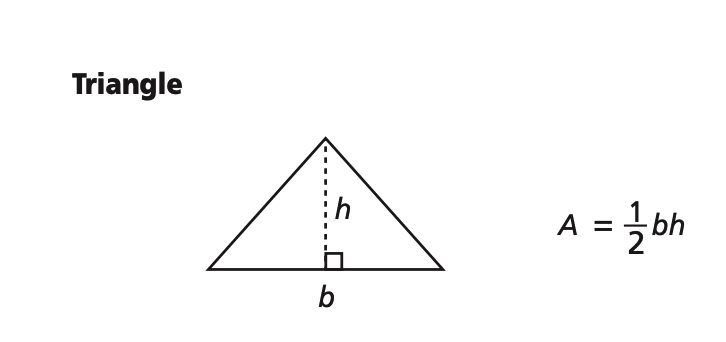
4. A triangle has a base of 6.4 cm and a height of 5 cm. Find the area. (Area of triangle =21×base×height)
5. To calculate a 20% tip on a meal, you can multiply the bill by 0.20. A restaurant bill is $36.75. What is the tip? Explain or show your reasoning.
6. Two stores sell the same notebook. • Store A sells 4 notebooks for $9.00 • Store B sells 5 notebooks for $10.50 Which store has the lower price per notebook? Explain how you know.
7. A rectangular garden is 8.5 meters long and 4.2 meters wide. A triangular flower bed with a base of 4.2 meters and a height of 3 meters is cut out of one corner. What is the area of the remaining garden? Show your work. (Area of triangle LATEX1)
8. Maya buys 3 notebooks at $4.75 each and a pack of pens for $6.50. She pays with a $25.00 bill. (a) How much did Maya spend in total? (b) How much change did she receive?
For part of a science experiment, Andre adds 0.25 milliliters of food coloring to 12.3 milliliters of water. How many milliliters does the mixture contain?
A.12.05
B.12.325
C.12.55✓
D.14.8
Show Solution
C
Problem 4
Four runners are training for long races. Noah ran 5.123 miles, Andre ran 6.34 miles, Jada ran 7.1 miles, and Diego ran 8 miles.
What is the total running distance of the four runners?
Compared to Noah, how much farther did Jada run?
Show Solution
26.563 miles
1.977 miles
Problem 5
One way to compute a 15% tip for a bill is to multiply it by 0.15.
A restaurant bill was $42.40. Calculate the tip. Explain or show your reasoning.
Show Solution
$6.36. Sample reasoning: I multiplied 42.40 by 0.1 to get 4.24 and then found half of that to get LATEX0. Then I added the two answers to get $6.36.
Problem 6
A woodworker wants to cut a board that is 8.225 feet long into 5 equal-length pieces. How long will each piece be?
A.
0.1645 foot
B.
1.645 feet
C.
4.1125 feet
D.
41.125 feet
Show Solution
1.645 feet
Problem 7
The list below shows the cost of the same candle at two different stores.
Store ABC sells 6 of these candles for $12.00.
Store XYZ sells 8 of these candles for $14.00.
Which store sells the candle for a lower unit rate?
Explain how you determined your answer.
Problem 8
A diagram of a rectangular flag, with a shaded section, is shown below.
What is the area, in square centimeters, of the shaded section of the flag?
Show your work.
Answer: ______ square centimeters
Problem 9
A tutoring company charges $25.00 per hour to tutor a student. How many hours of tutoring would cost $62.50?