Grade 8

End-of-Unit Assessment

End-of-Unit Assessment
1.

A cylinder has volume 78 cm3^3. What is the volume of a cone with the same radius and height?

A.

26 cm3^3

B.

39 cm3^3

C.

156 cm3^3

D.

234 cm3^3

Answer: A

2.

Which is closest to the difference in the volume of the two cylinders?
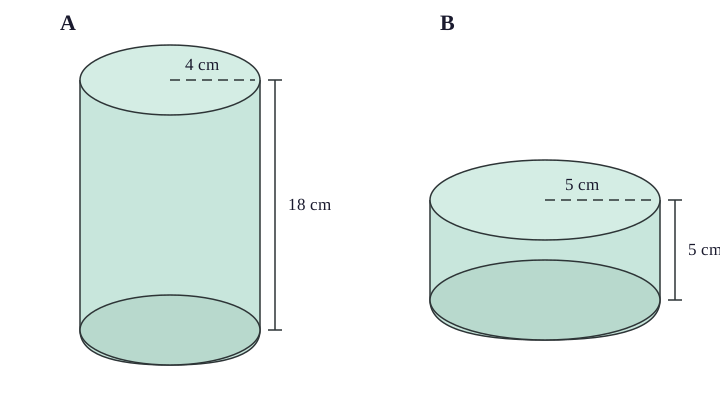
Two cylinders. Cylinder A has radius 4 cm and height 18 cm. Cylinder B has radius 5 cm and height 5 cm.

A.

15,795 cm3^3

B.

2,534 cm3^3

C.

806 cm3^3

D.

512 cm3^3

Answer: D

3.

A sphere has radius 2.7 centimeters.

Sphere, radius, 2 point 7 centimeters.

What is its volume, to the nearest cubic centimeter?

A.

23

B.

26

C.

62

D.

82

Answer: D

4.

For cones with radius 6 units, let hh represent the cone's height, in units and vv represent the cone's volume in cubic units.

Blank coordinate plane, horizontal, height of cone, 0 to 10, vertical, volume of cone, 0 to 500 by 100.

  1. Sketch the graph of this relationship on the axes.
  2. Is there a linear relationship between height and volume? Explain how you know.

Answer:

<p>A line graphed on a coordinate plane.</p>

  1. See graph.
  2. Yes. Sample explanations: There is a linear relationship because the equation relating height and volume is in the same form as y=mx+by = mx + b with m=12πm=12\pi and b=0b=0; There is a linear relationship because there is a proportional relationship, and all proportional relationships are linear.

Minimal Tier 1 response:

  • Work is complete and correct.
  • Sample:
  1. See graph.
  2. Yes, because the volume is 12π12 \pi times the height.

Tier 2 response:

  • Work shows general conceptual understanding and mastery, with some errors.
  • Sample errors: Some points in part a are incorrectly plotted, but the explanation for part b is correct based on independent justification; answer for part b is something like "the graph looks like a line" without further justification that the graph is linear.

Tier 3 response:

  • Significant errors in work demonstrate lack of conceptual understanding or mastery.
  • Sample errors: Any explanation for part b that does not appeal to slope, proportionality, the form of the equation for a line, or other concepts related to linearity; an incorrect graph in part a, with an incorrect answer to part b (including answers based on the nonlinearity of the graph).

5.

A cylinder has a radius of 1.6 meters. Its volume is 95 cubic meters. Find its height to the nearest tenth of a meter.

Answer:

11.8 meters. If the height in meters is hh, then the equation π(1.6)2h=95\pi \boldcdot (1.6)^2 \boldcdot h = 95 is true. Using 3.14 as an approximation for π\pi gives the equation 8.04h=958.04h = 95, and the solution to this equation is h11.8h \approx 11.8.

6.

Cones A and B both have volume 48π48\pi cubic units but have different dimensions. Cone A has radius 6 units and height 4 units. Find one possible radius and height for Cone B. Explain how you know Cone B has the same volume as Cone A.

Answer:

Sample explanations:

  • Cone B has radius 3 units and height 16 units. When the radius is halved, the height must be multiplied by 4 to keep the volume the same.
  • Cone B could have any radius rr and height hh as long as 13r2h=48\frac 1 3 r^2h = 48, or r2h=144r^2h = 144. One possible solution is radius 2 units and height 36 units, but there are others.

Minimal Tier 1 response:

  • Work is complete and correct.
  • Acceptable errors: Omission of units; work demonstrates that the volume of Cone B is 48π48\pi but does not directly compare to Cone A.
  • Sample: Radius 4 and height 9, which has volume 13π429\frac13 \cdot\pi \cdot 4^2 \cdot 9. This is 48π48\pi cubic units, the same as Cone A.

Tier 2 response:

  • Work shows general conceptual understanding and mastery, with some errors.
  • Sample errors: Arithmetic errors involving scaling; carefully written work reveals arithmetic errors involving the volume formula of a cone; scaling arguments involving a similar but incorrect volume formula, such as the formula for the volume of a cylinder.

Tier 3 response:

  • Significant errors in work demonstrate lack of conceptual understanding or mastery.
  • Sample errors: Conceptual errors involving scaling; calculations are done using an incorrect volume formula; incorrect answer with no or little work shown; correct answer with no work shown and no comparison to Cone A.

7.

Two electricians, Electrician A and Electrician B, offer pricing plans for their work. Each electrician charges an initial fee for a service call plus an hourly rate. The charges for each electrician are represented by the equation and the table shown below.

ELECTRICIAN A

C=25x+50C = 25x + 50

ELECTRICIAN B

Time (hours) Total Charge (dollars)
3 130
4 150
5 170

Which statement comparing the charges for each electrician is true?

A.

Electrician A has an initial fee and an hourly rate that are both less than those for Electrician B.

B.

Electrician A has an initial fee and an hourly rate that are both greater than those for Electrician B.

C.

Electrician A has an initial fee that is less than that for Electrician B. The hourly rate for Electrician A is greater than that for Electrician B.

D.

Electrician A has an initial fee that is greater than that for Electrician B. The hourly rate for Electrician A is less than that for Electrician B.

Answer: C

8.

The table of values shown below represents a relation.

xx yy
−2 −5
−1 −1
0 3
1 7
2 11

Which statement describes the relation?

A.

The table represents a function because each input has only one output.

B.

The table represents a function because each output has only one input.

C.

The table does not represent a function because each input has only one output.

D.

The table does not represent a function because each output has only one input.

Answer: A