Solutions to Inequalities in One Variable
Student Summary
The equation 21t=10 is an equation in one variable. Its solution is any value of t that makes the equation true. Only t=20 meets that requirement, so 20 is the only solution.
The inequality 21t>10 is an inequality in one variable. Any value of t that makes the inequality true is a solution. For instance, 30 and 48 are both solutions because substituting these values for t produces true inequalities. 21(30)>10 is true, as is 21(48)>10. Because the inequality has a range of values that make it true, we sometimes refer to all the solutions as the solution set.
One way to find the solutions to an inequality is by reasoning. For example, to find the solution to 2p<8, we can reason that if 2 times a value is less than 8, then that value must be less than 4. So a solution to 2p<8 is any value of p that is less than 4.
Another way to find the solutions to 2p<8 is to solve the related equation 2p=8. In this case, dividing each side of the equation by 2 gives p=4. This point, where p is 4, is the boundary of the solution to the inequality.
To find out the range of values that make the inequality true, we can try values less than and greater than 4 in our inequality and see which ones make a true statement.
Let's try some values less than 4:
- If p=3, the inequality is 2(3)<8 or 6<8, which is true.
- If p=-1, the inequality is 2(-1)<8 or -2<8, which is also true.
Let's try values greater than 4:
- If p=5, the inequality is 2(5)<8 or 10<8, which is false.
- If p=12, the inequality is 2(12)<8 or 24<8, which is also false.
In general, the inequality is false when p is greater than or equal to 4 and true when p is less than 4.
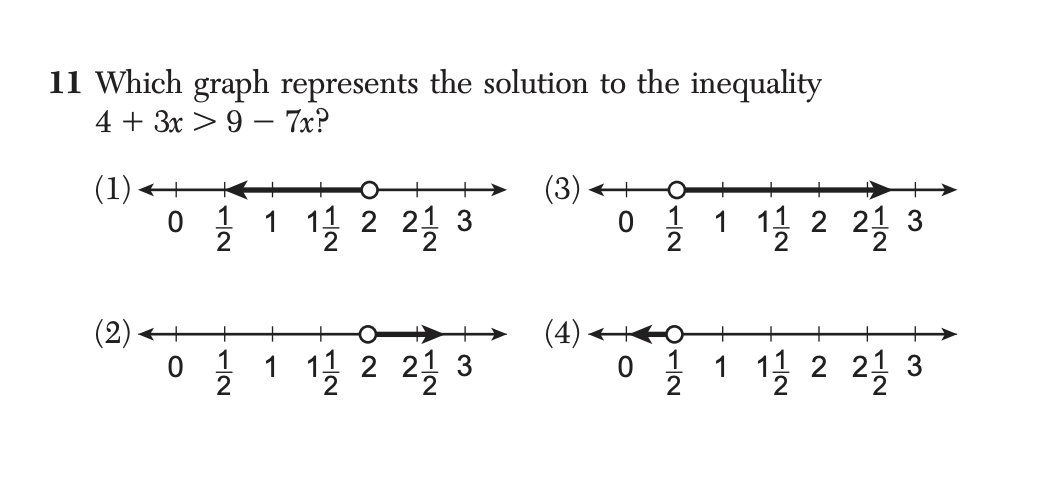
We can represent the solution set to an inequality by writing an inequality, p<4, or by graphing on a number line. The ray pointing to the left represents all values less than 4.
Visual / Anchor Chart

Standards
7.EE.4.b
Use variables to represent quantities in a real-world or mathematical problem, and construct simple equations and inequalities to solve problems by reasoning about the quantities.
A-REI.312 questions
Solve linear equations and inequalities in one variable, including equations with coefficients represented by letters.


A-CED.1
Create equations and inequalities in one variable to represent a real-world context.
A-REI.312 questions
Solve linear equations and inequalities in one variable, including equations with coefficients represented by letters.