Data Representations
Student Summary
The table shows a list of the number of minutes people could intensely focus on a task before needing a break. Fifty people of different ages are represented.
- 19
- 7
- 1
- 16
- 20
- 2
- 7
- 19
- 9
- 13
- 3
- 9
- 18
- 13
- 20
- 8
- 3
- 14
- 13
- 2
- 8
- 5
- 17
- 7
- 18
- 17
- 8
- 8
- 7
- 6
- 2
- 20
- 7
- 7
- 10
- 7
- 6
- 19
- 3
- 18
- 8
- 19
- 7
- 13
- 20
- 14
- 6
- 3
- 19
- 4
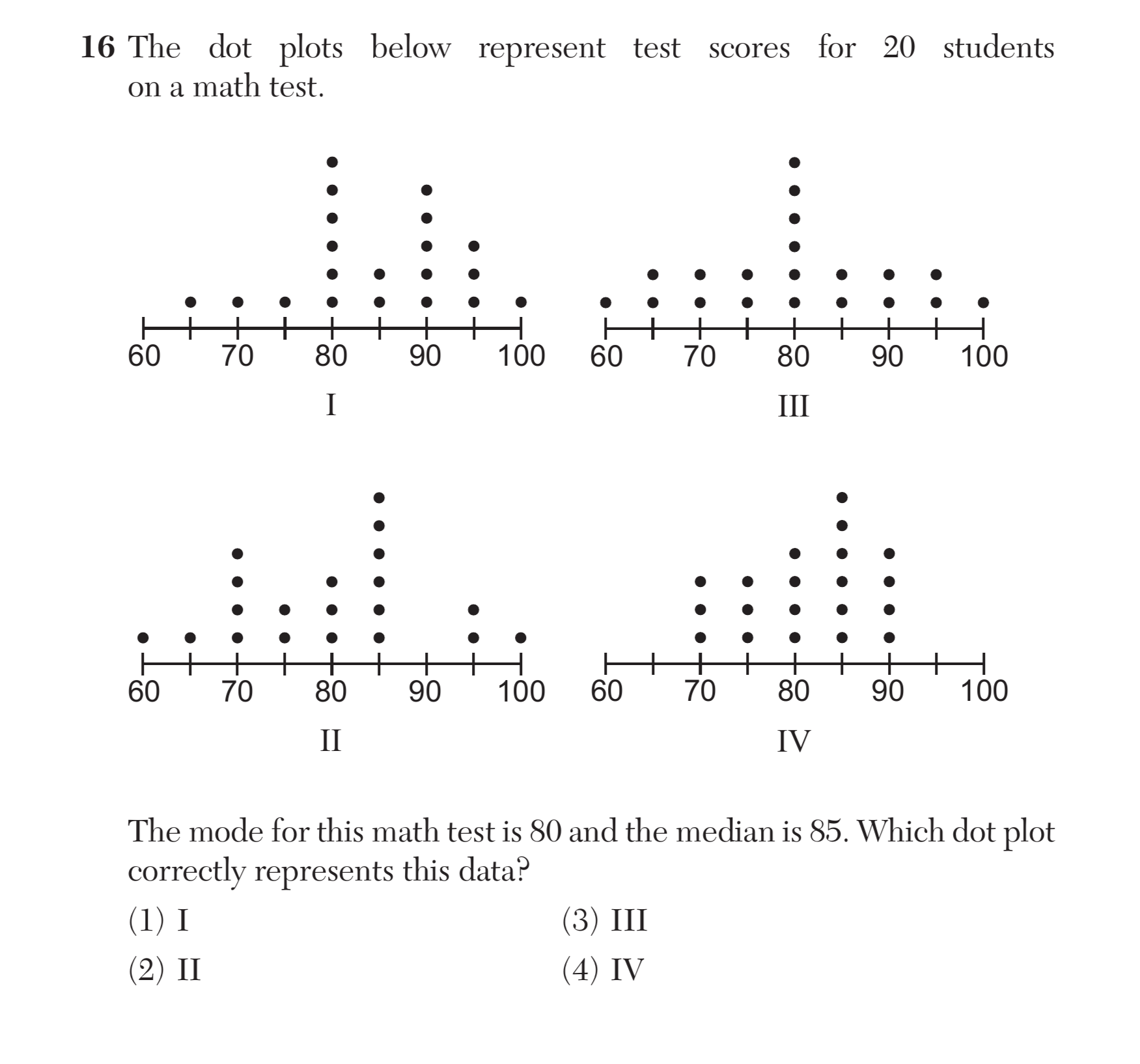
There were quite a few people that lost focus at around 3, 7, 13, and 19 minutes, and nobody lost focus at 11, 12, or 15 minutes. Dot plots are useful when the data set is not too large and shows all of the individual values in the data set. In this example, a dot plot can easily show all of the data. If the data set is very large (more than 100 values, for example), or if there are many different values that are not exactly the same, it may be hard to see all of the dots on a dot plot.
A histogram is another representation that shows the shape and distribution of the same data.
Most people lost focus between 5 and 10 minutes or between 15 and 20 minutes, while only 4 of the 50 people got distracted between 20 and 25 minutes. When creating histograms, each interval includes the number at the lower end of the interval but not the number at the upper end.
For example, the tallest bar displays values that are greater than or equal to 5 minutes but less than 10 minutes. In a histogram, values that are in an interval are grouped together. Although the individual values get lost with the grouping, a histogram can still show the shape of the distribution.
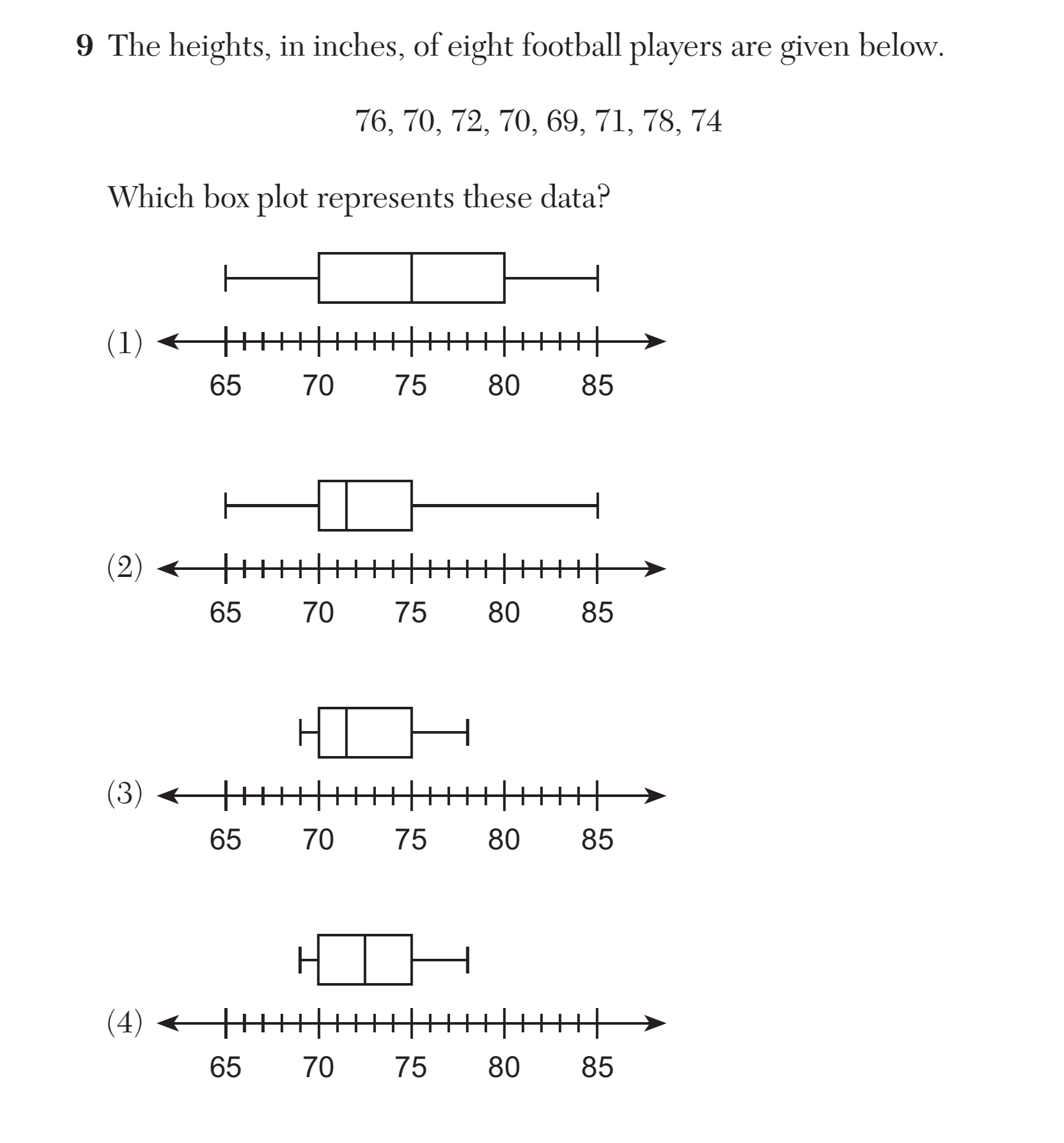
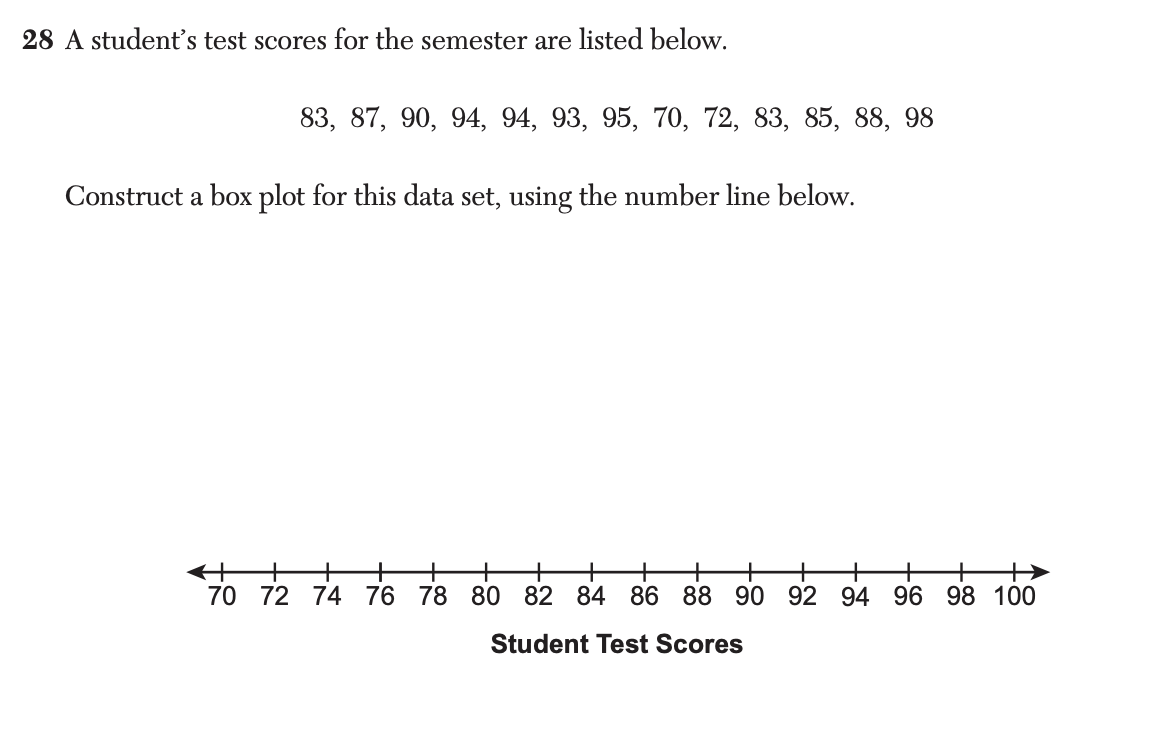
Here is a box plot that represents the same data.
Box plots are created using a five-number summary. For a set of data, the five-number summary consists of these five statistics: the minimum value, the first quartile, the median, the third quartile, and the maximum value. These values split the data into four sections, each representing approximately one-fourth of the data. The median of this data is indicated at 8 minutes, and about 25% of the data fall in the short second quarter of the data between 6 and 8 minutes. Similarly, approximately one-fourth of the data are between 8 and 17 minutes. Like the histogram, the box plot does not show individual data values, but other features such as quartiles, range, and median are seen more easily. Dot plots, histograms, and box plots provide three different ways to look at the shape and distribution while highlighting different aspects of the data.
Visual / Anchor Chart

Standards
6.SP.4
Display quantitative data in plots on a number line, including dot plots, and histograms.
HSS-ID.A.13 questions
Represent data with plots on the real number line (dot plots, histograms, and box plots).
HSS-ID.A.13 questions
Represent data with plots on the real number line (dot plots, histograms, and box plots).
HSS-ID.A.2
Use statistics appropriate to the shape of the data distribution to compare center (median, mean) and spread (inter-quartile range, sample standard deviation) of two or more different data sets.