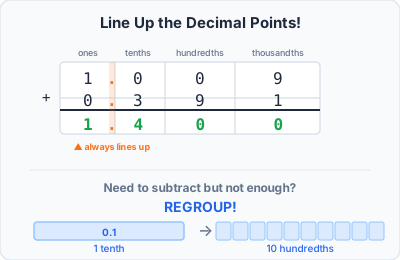
Base-ten diagrams can help us understand subtraction. Suppose we are finding 0.23 −0.07. Here is a diagram showing 0.23, or 2 tenths and 3 hundredths.
Subtracting 7 hundredths means removing 7 small squares, but we do ;not have enough to remove. Because 1 tenth is equal to 10 hundredths, we can decompose one of the tenths (1 rectangle) into 10 hundredths (10 small squares).
Base ten diagram. 0 point 23. Two rectangles in the tenths column. 3 small squares in the hundredths column. A dotted rectangle is drawn around one of the rectangles with an arrow to 10 small squares. The arrow is labeled decompose.
We now have 1 tenth and 13 hundredths, from which we can remove 7 hundredths.
Base ten diagram. 0 point 23. One rectangle in the tenths column. 13 small squares in the hundredths column. 7 small squares have an X through them. The words subtract 0 point 0 7 is below the small squares.
We have 1 tenth and 6 hundredths remaining, so 0.23−0.07 =0.16.
Here is a vertical calculation of 0.23−0.07.
Vertical subtraction. First line. 0 point 23. The 2 is crossed out and has a 1 above it. The 3 is crossed out and has 13 above it. Second line. Minus 0 point 0 0 7. Horizontal line. Third line. 0 point 17.
Notice how this representation also shows that a tenth is decomposed into 10 hundredths in order to subtract 7 hundredths.
This works for any decimal place. Suppose we are finding 0.023 −0.007. Here is a diagram showing 0.023.
We want to remove 7 thousandths (7 small rectangles). We can decompose one of the hundredths into 10 thousandths.
Base 10 diagram. 0 point 0 2 3. Two small squares in the hundredths column. Three small rectangles in the thousandths column. A square is drawn around 1 small square. An arrow is drawn to 10 small rectangles. The arrow is labeled decompose.
Now we can remove 7 thousandths.
Base 10 diagram. 0 point 0 2 3. One small square in the hundredths column. 13 small rectangles in the thousandths column. 7 small rectangles have an X through them. Below the small rectangles are the words subtract 0 point 0 0 7.
We have 1 hundredth and 6 thousandths remaining, so 0.023−0.007 =0.016.
Here is a vertical calculation of 0.023−0.007.
Vertical subtraction. First line. 0 point 0 2 3. The 2 is crossed out and has a 1 above it. The 3 is crossed out and has 13 above it. Second line. Minus 0 point 0 0 7. Horizontal line. Third line. 0 point 0 1 6.