Dividing a Decimal by a Decimal
Student Summary
We know that two fractions are equivalent when the numerators and denominators are related by the same factor, and when dividing the numerator by the denominator gives the same quotient. For example, we can tell that 46 and 4060 are equivalent fractions because:
- Dividing 6 by 4 and dividing 60 by 40 both give 1.5.
- The numerators and denominators of 46 and 4060 are related by the same factor of 10: 4⋅106⋅10=4060.
Division expressions can also be equivalent. For example, the expression 5,400÷900 is equivalent to 54÷9 because:
- They both have a quotient of 6.
- The dividends and divisors in 5,400÷900 and 54÷9 are related by the same factor of 100: 54⋅100=5,400 and 9⋅100=900.
This means that an expression such as 5.4÷0.9 also has the same value as 54÷9. The dividend and divisor in 54÷9 are each 10 times those in 5.4÷0.9, but their quotients are the same.
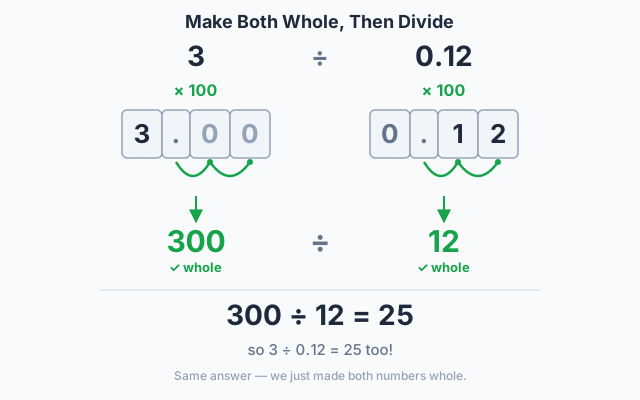
This understanding can help us divide a decimal dividend by a decimal divisor: We can multiply each decimal by the same power of 10 so that both the dividend and the divisor are whole numbers, and then we divide the whole numbers.
For example, to calculate 7.65÷1.2 we can multiply each decimal by 100, and then calculate 765÷120. Here is the calculation with long division:
Because the expression 765÷120 is equivalent to 7.65÷1.2, we know that 6.375 is also a quotient of 7.65÷1.2.
Visual / Anchor Chart
Standards
6.NS.2
Fluently divide multi-digit numbers using a standard algorithm.
6.NS.3
Fluently add, subtract, multiply, and divide multi-digit decimals using a standard algorithm for each operation.
6.NS.2
Fluently divide multi-digit numbers using a standard algorithm.
6.NS.3
Fluently add, subtract, multiply, and divide multi-digit decimals using a standard algorithm for each operation.