Reasoning about Exponential Graphs (Part 2)
Student Summary
If we have enough information about a graph representing an exponential function f, we can write a corresponding equation.
Here is a graph of y=f(x).
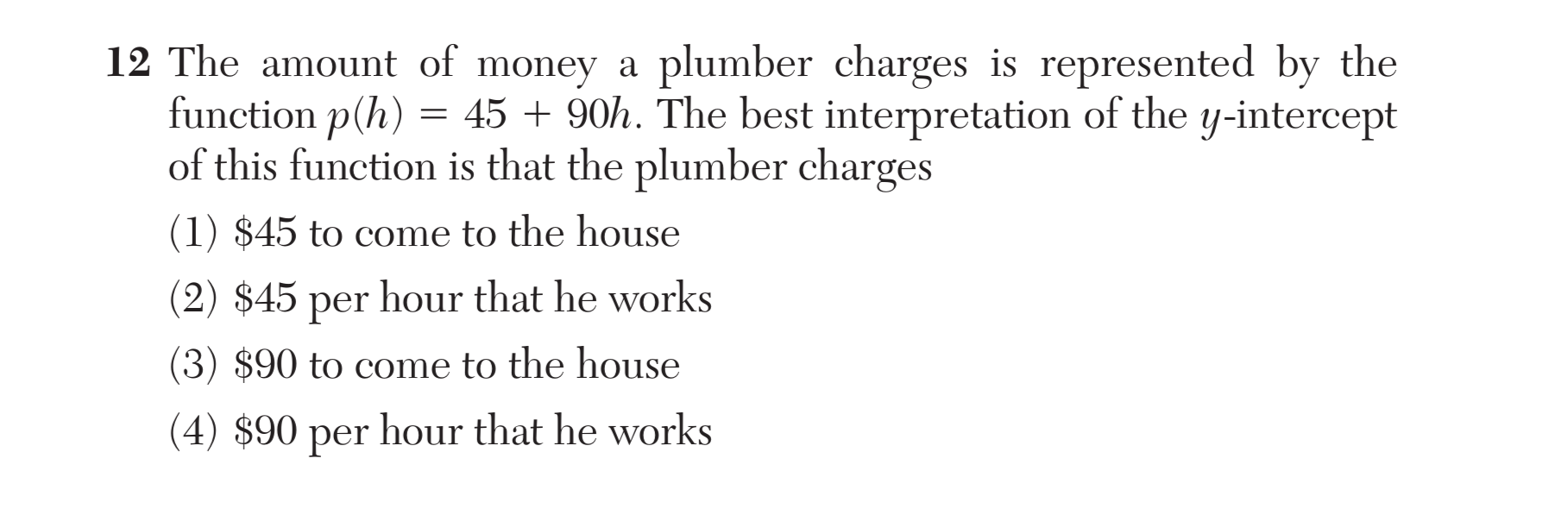
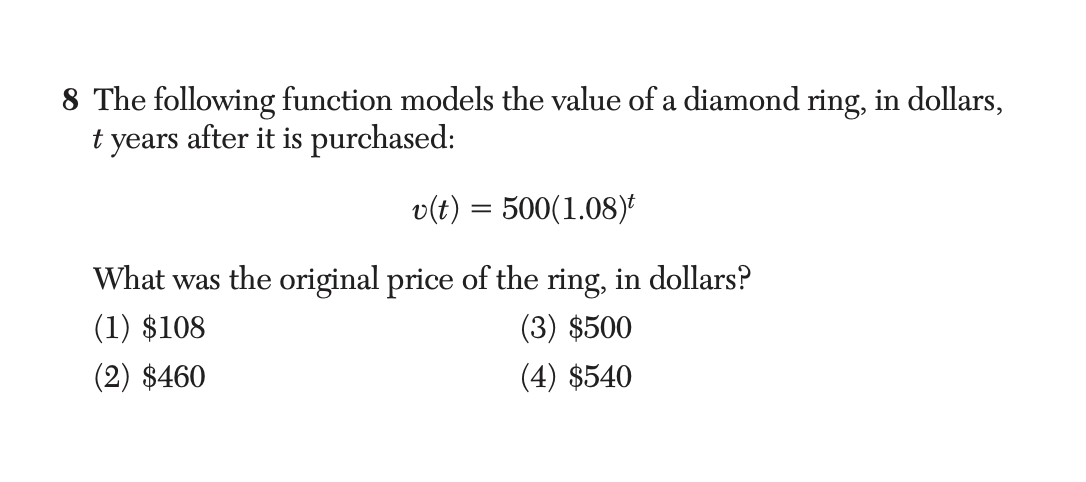
An equation defining an exponential function has the form f(x)=a⋅bx. The value of a is the starting value or f(0), so it is the y-intercept of the graph. We can see that f(0) is 500 and that the function is decreasing.
The value of b is the growth factor. It is the number by which we multiply the function’s output at x to get the output at x+1. To find this growth factor for f, we can calculate f(0)f(1), which is 500300 (or 53).
So an equation that defines f is: f(x)=500⋅(53)x
We can also use graphs to compare functions. Here are graphs representing two different exponential functions, labeled g and h. Each one represents the area of algae (in square meters) in a pond, x days after certain fish were introduced.
- Pond A had 40 square meters of algae. Its area shrinks to 108 of the area on the previous day.
- Pond B had 50 square meters of algae. Its area shrinks to 52 of the area on the previous day.
Can you tell which graph corresponds to which algae population?
We can see that the y-intercept of g's graph is greater than the y-intercept of h's graph. We can also see that g has a smaller growth factor than h because as x increases by the same amount, g is retaining a smaller fraction of its value compared to h. This suggests that g corresponds to Pond B, and h corresponds to Pond A.
Visual / Anchor Chart

Standards
F-LE.21 question
F-LE.53 questions
F-IF.45 questions
For a function that models a relationship between two quantities: i) interpret key features of graphs and tables in terms of the quantities; and ii) sketch graphs showing key features given a verbal description of the relationship.
F-LE.21 question
F-LE.53 questions