Writing and Graphing Systems of Linear Equations
Student Summary
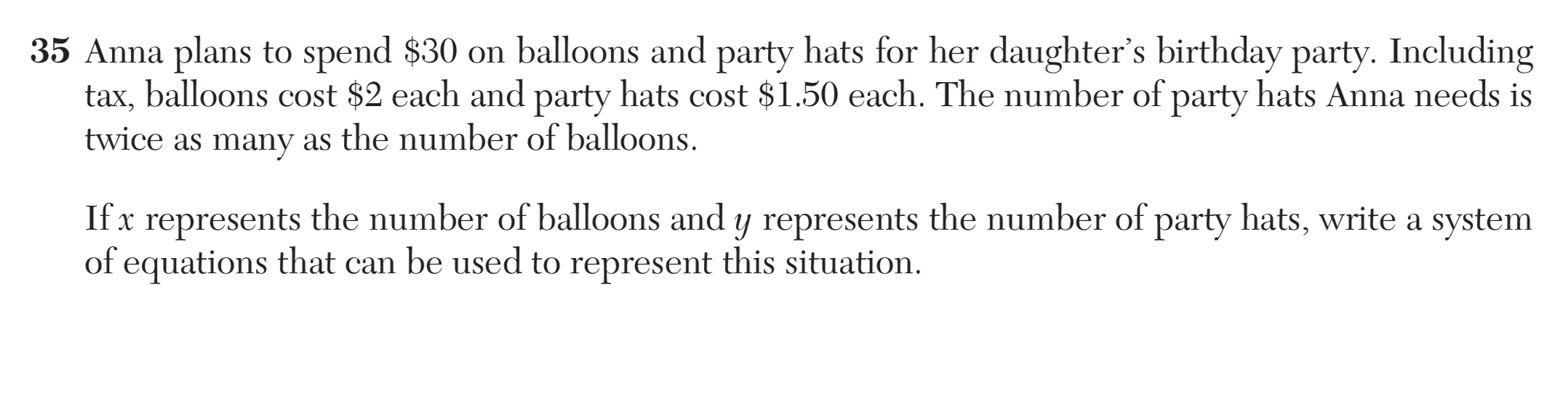
A costume designer needs some silver and gold thread for the costumes for a school play. She needs a total of 240 yards. At a store that sells thread by the yard, silver thread costs $0.04 a yard and gold thread costs $0.07 a yard. The designer has $15 to spend on the thread.
How many of each color should she get if she is buying exactly what is needed and spending all of her budget?
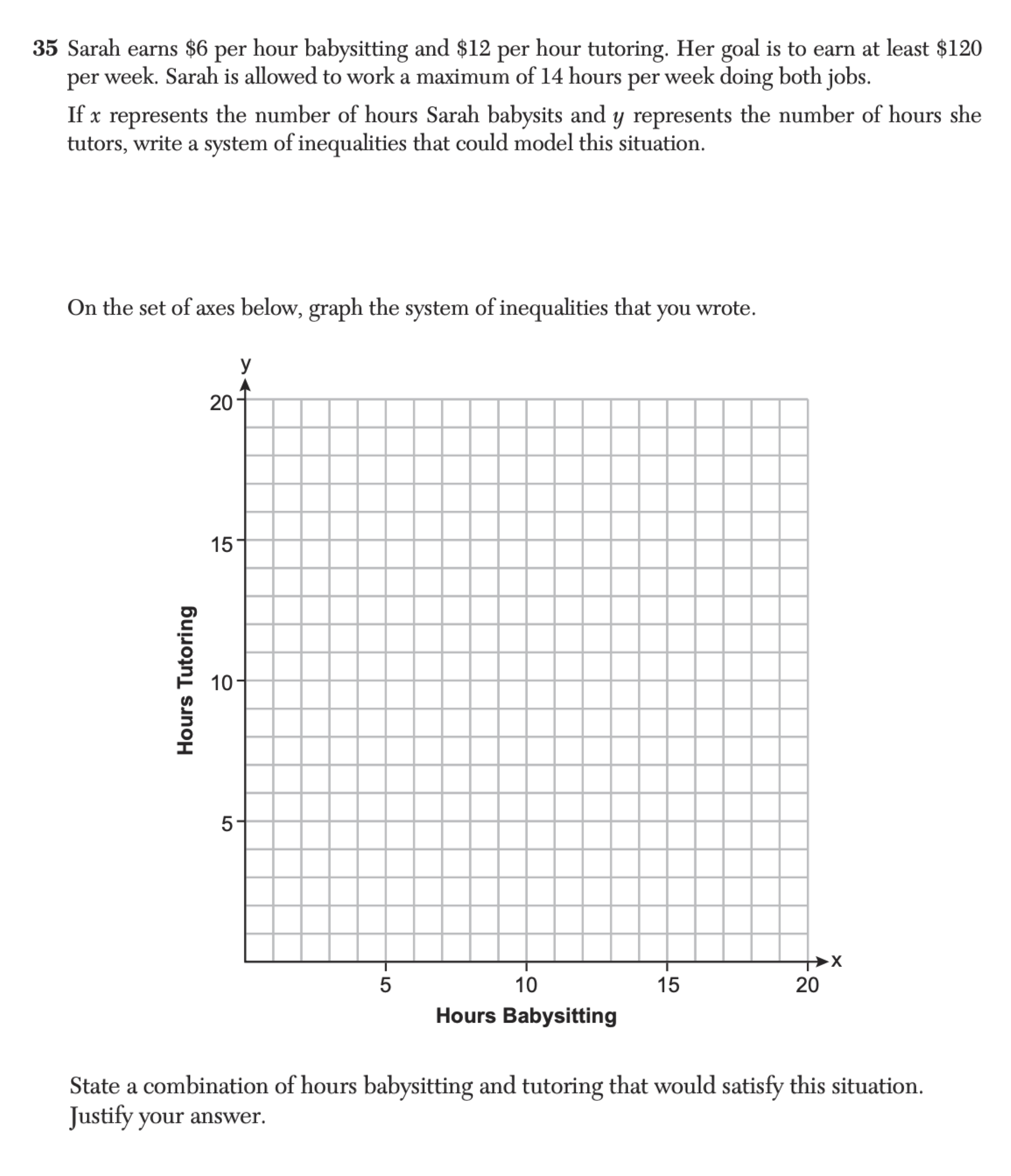
This situation involves two quantities and two constraints—length and cost. Answering the question means finding a pair of values that meets both constraints simultaneously. To do so, we can write two equations and graph them on the same coordinate plane.
Let x represents yards of silver thread and y yards of gold thread.
- The length constraint: x+y=240
- The cost constraint: 0.04x+0.07y=15
Every point on the graph of x+y=240 is a pair of values that meets the length constraint.
Every point on the graph of 0.04x+0.07y=15 is a pair of values that meets the cost constraint.
The point where the two graphs intersect gives the pair of values that meets both constraints.
That point is (60,180), which represents 60 yards of silver thread and 180 yards of gold thread.
If we substitute 60 for x and 180 for y in each equation, we find that these values make the equation true. (60,180) is a solution to both equations simultaneously.
x+y60+180240=240=240=240
0.04x+0.07y0.04(60)+0.07(180)2.40+12.6015=15=15=15=15
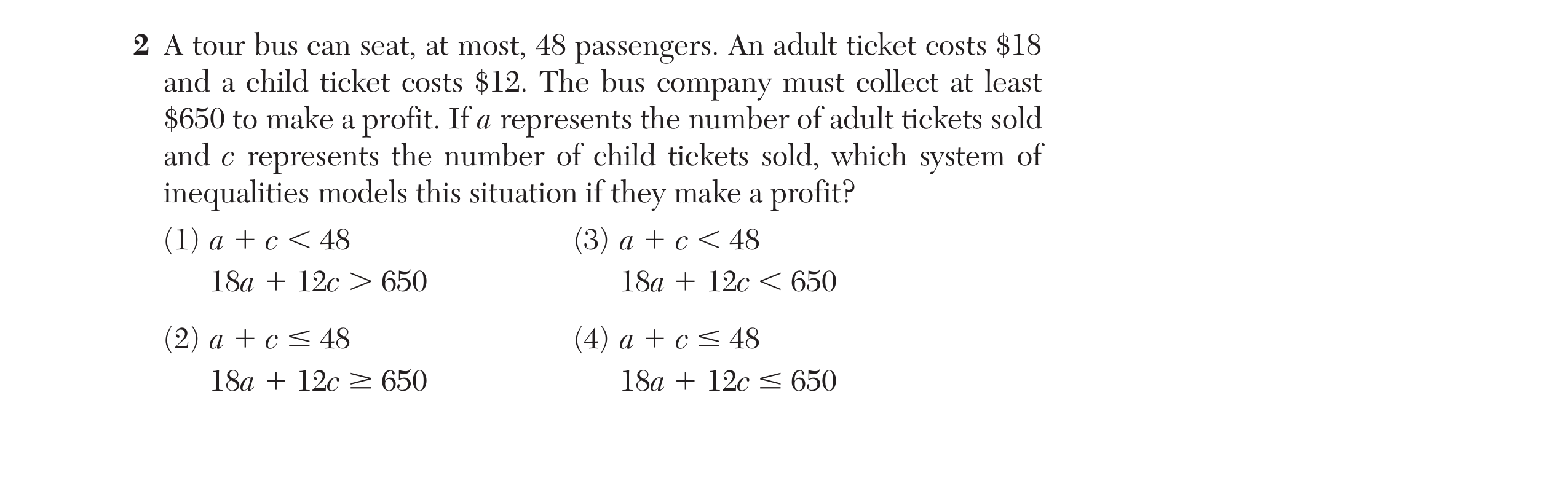
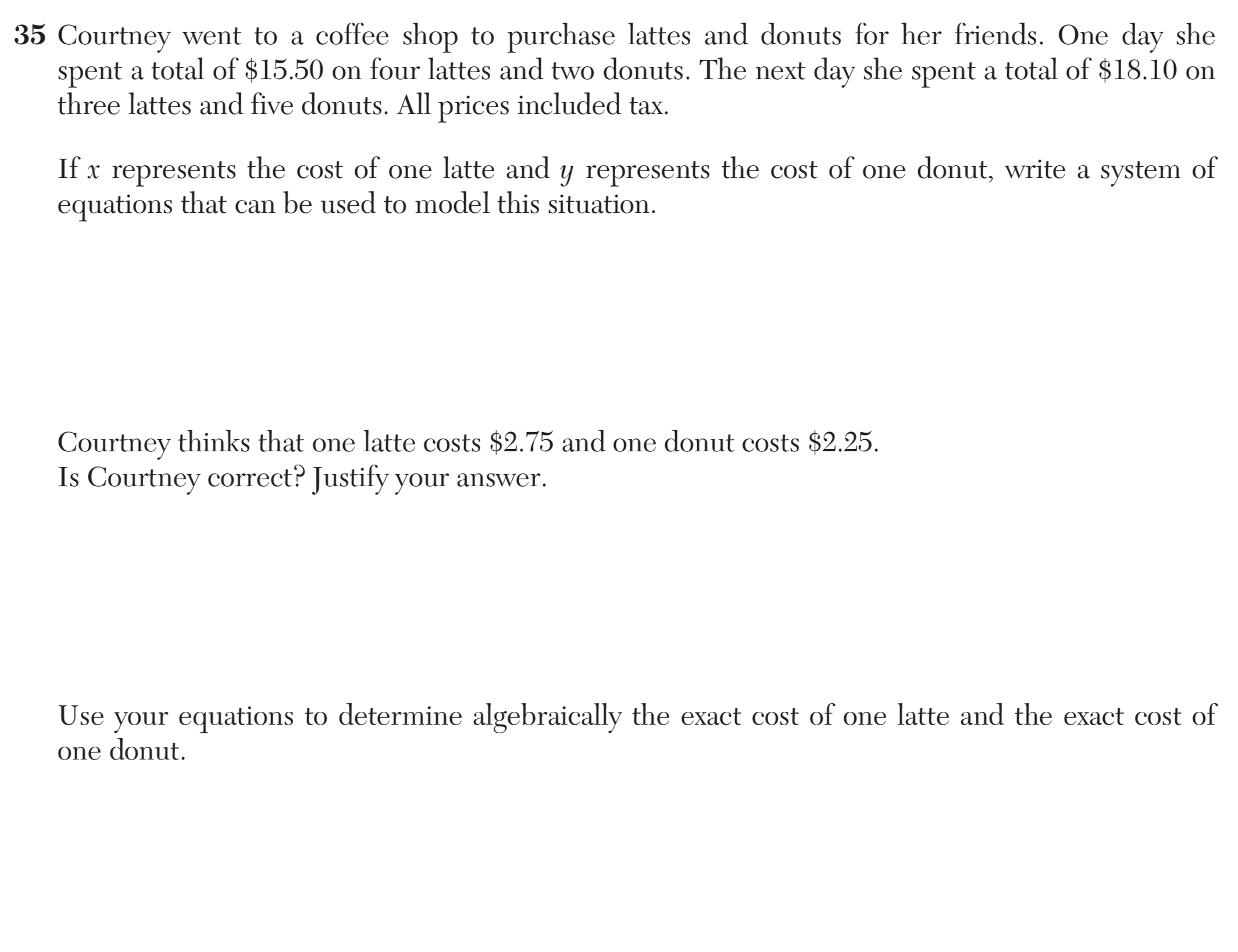
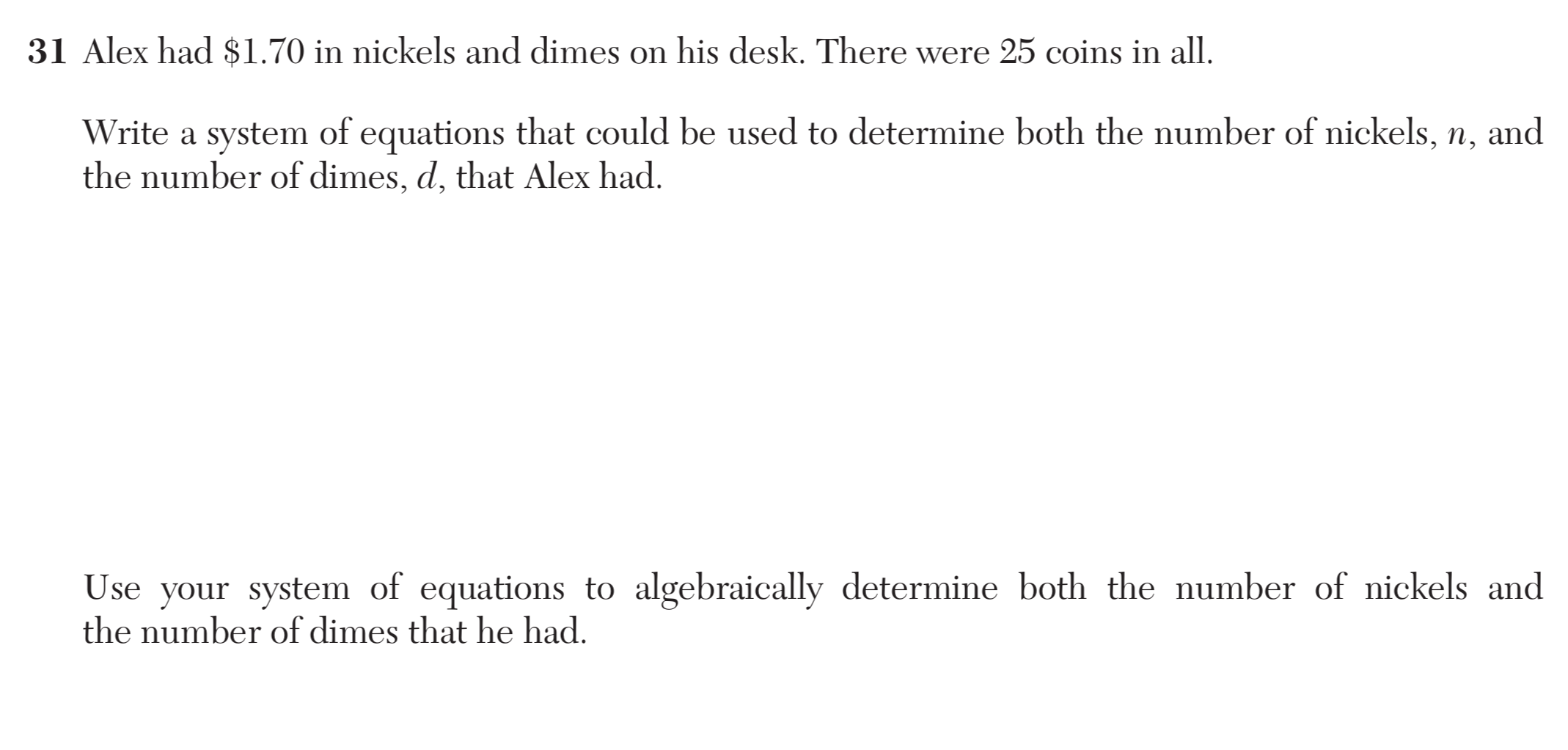
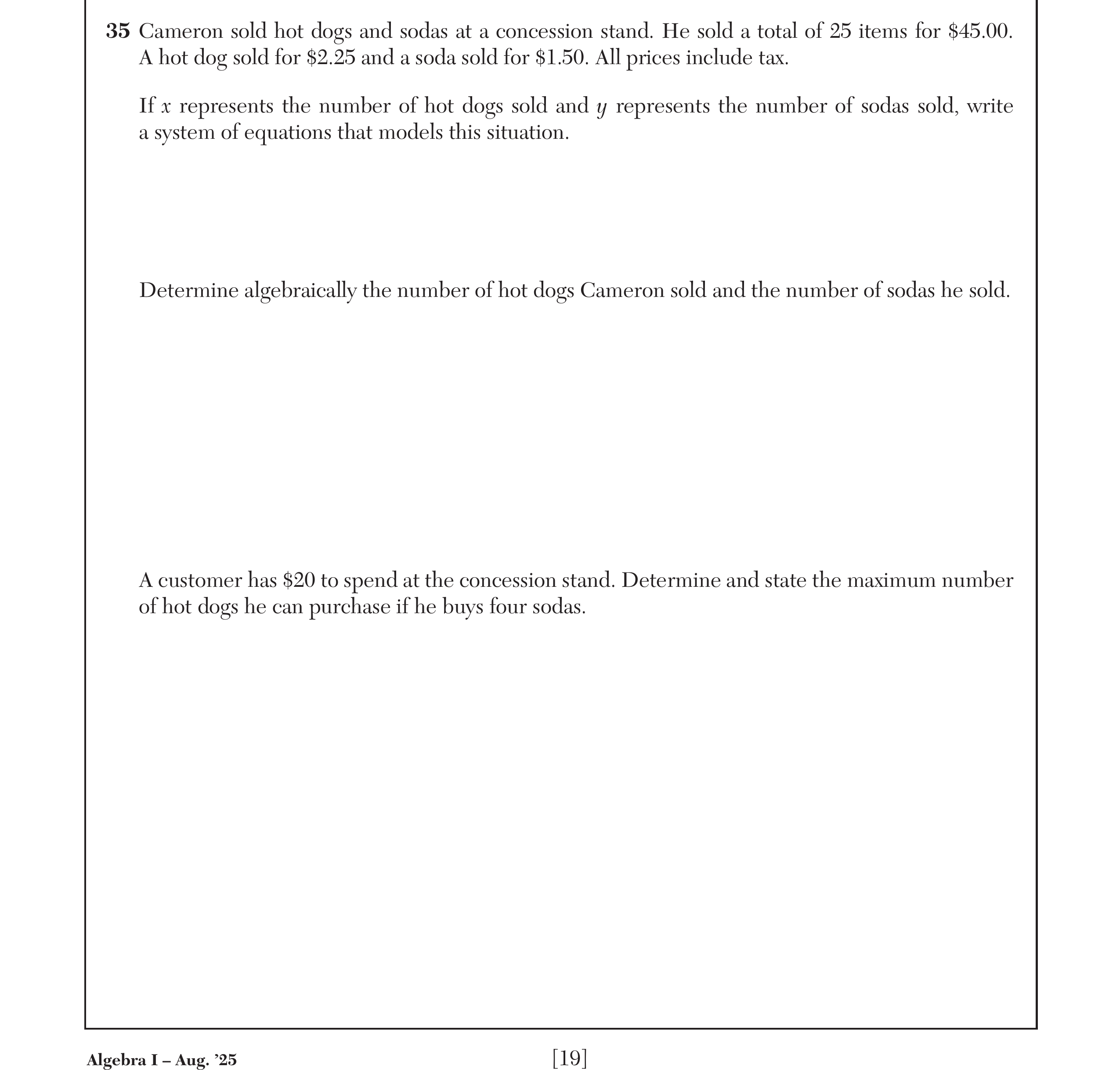
Two or more equations that represent the constraints in the same situation form a system of equations. A curly bracket is often used to indicate a system.
{x+y=2400.04x+0.07y=15
The solution to a system of equations is a pair of values that makes all of the equations in the system true. Graphing the equations is one way to find the solution to a system of equations.
Visual / Anchor Chart

Standards
8.EE.8.a
Analyze and solve pairs of simultaneous linear equations. Understand that solutions to a system of two linear equations in two variables correspond to points of intersection of their graphs. Solve systems of two linear equations in two variables with integer coefficients: graphically, numerically using a table, and algebraically. Solve real-world and mathematical problems involving systems of two linear equations in two variables with integer coefficients.
8.EE.8.b
Analyze and solve pairs of simultaneous linear equations. Understand that solutions to a system of two linear equations in two variables correspond to points of intersection of their graphs. Solve systems of two linear equations in two variables with integer coefficients: graphically, numerically using a table, and algebraically. Solve real-world and mathematical problems involving systems of two linear equations in two variables with integer coefficients.
A-CED.36 questions
Represent constraints by equations or inequalities, and by systems of equations and/or inequalities, and interpret solutions as viable or non-viable options in a modeling context.
A-REI.6
No additional information available.
A-REI.A
No additional information available.
A-REI.6
No additional information available.