Standard Form and Factored Form
Student Summary
A quadratic function can often be represented by many equivalent expressions. For example, a quadratic function, f, might be defined by f(x)=x2+3x+2. The quadratic expression x2+3x+2 is called the standard form, the sum of a multiple of x2 and a linear expression (3x+2 in this case).
In general, standard form is written as ax2+bx+c
We refer to a as the coefficient of the squared term x2, b as the coefficient of the linear term x, and c as the constant term.
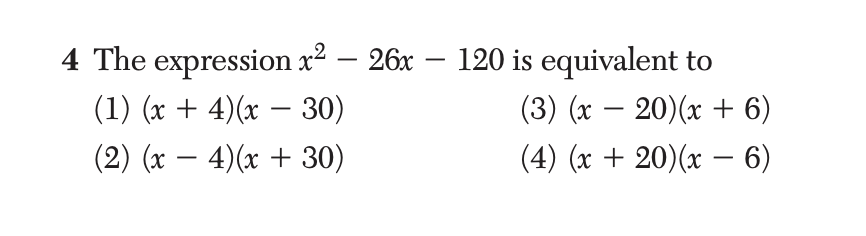
Function f can also be defined by the equivalent expression (x+2)(x+1). When the quadratic expression is a product of two factors where each one is a linear expression, this is called the factored form.
An expression in factored form can be rewritten in standard form by expanding it, which means multiplying out the factors. In a previous lesson we saw how to use a diagram and to apply the distributive property to multiply two linear expressions, such as (x+3)(x+2). We can do the same to expand an expression with a sum and a difference, such as (x+5)(x−2), or to expand an expression with two differences, for example, (x−4)(x−1).
To represent (x−4)(x−1) with a diagram, we can think of subtraction as adding the opposite:
| x | -4 | |
|---|---|---|
| x | x2 | -4x |
| -1 | -x | 4 |
Visual / Anchor Chart

Standards
A-SSE.32 questions
Choose and produce an equivalent form of an expression to reveal and explain properties of the quantity represented by the expression.

A-APR.A
No additional information available.
A-SSE.29 questions
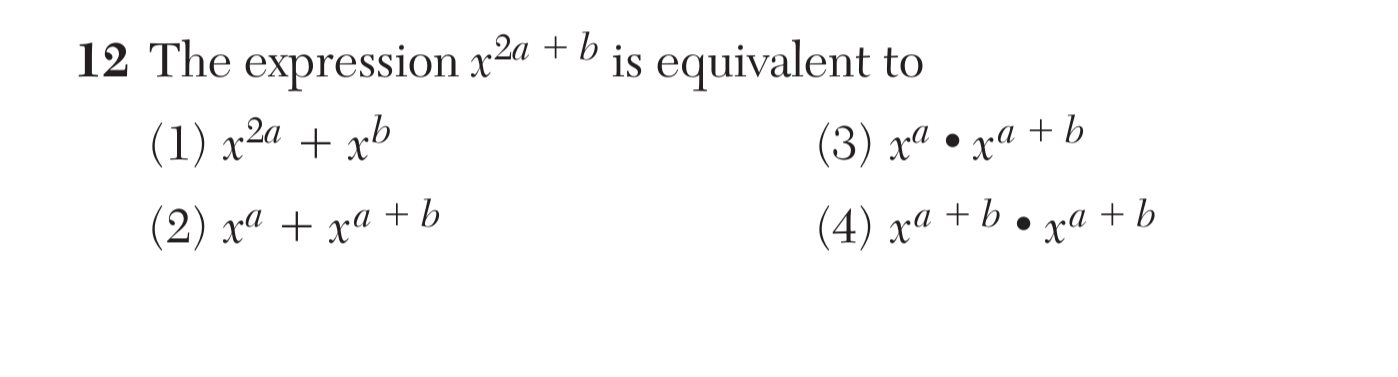
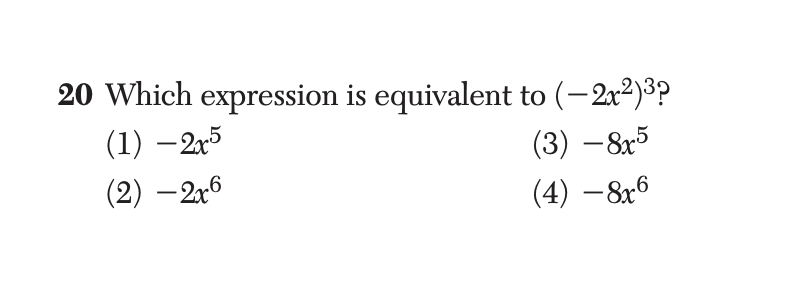
Recognize and use the structure of an expression to identify ways to rewrite it.



F-IF.8
Write a function in different but equivalent forms to reveal and explain different properties of the function.