Vertex Form
Student Summary
Sometimes the expressions that define quadratic functions are written in vertex form. The function f(x)=(x−3)2+4 is in vertex form and is shown in this graph.
The vertex form can tell us about the coordinates of the vertex of the graph of a quadratic function. The expression (x−3)2 reveals that the x-coordinate of the vertex is 3, and the constant term, 4, reveals that the y-coordinate of the vertex is 4. Here the vertex represents the minimum value of function f, and its graph opens upward.
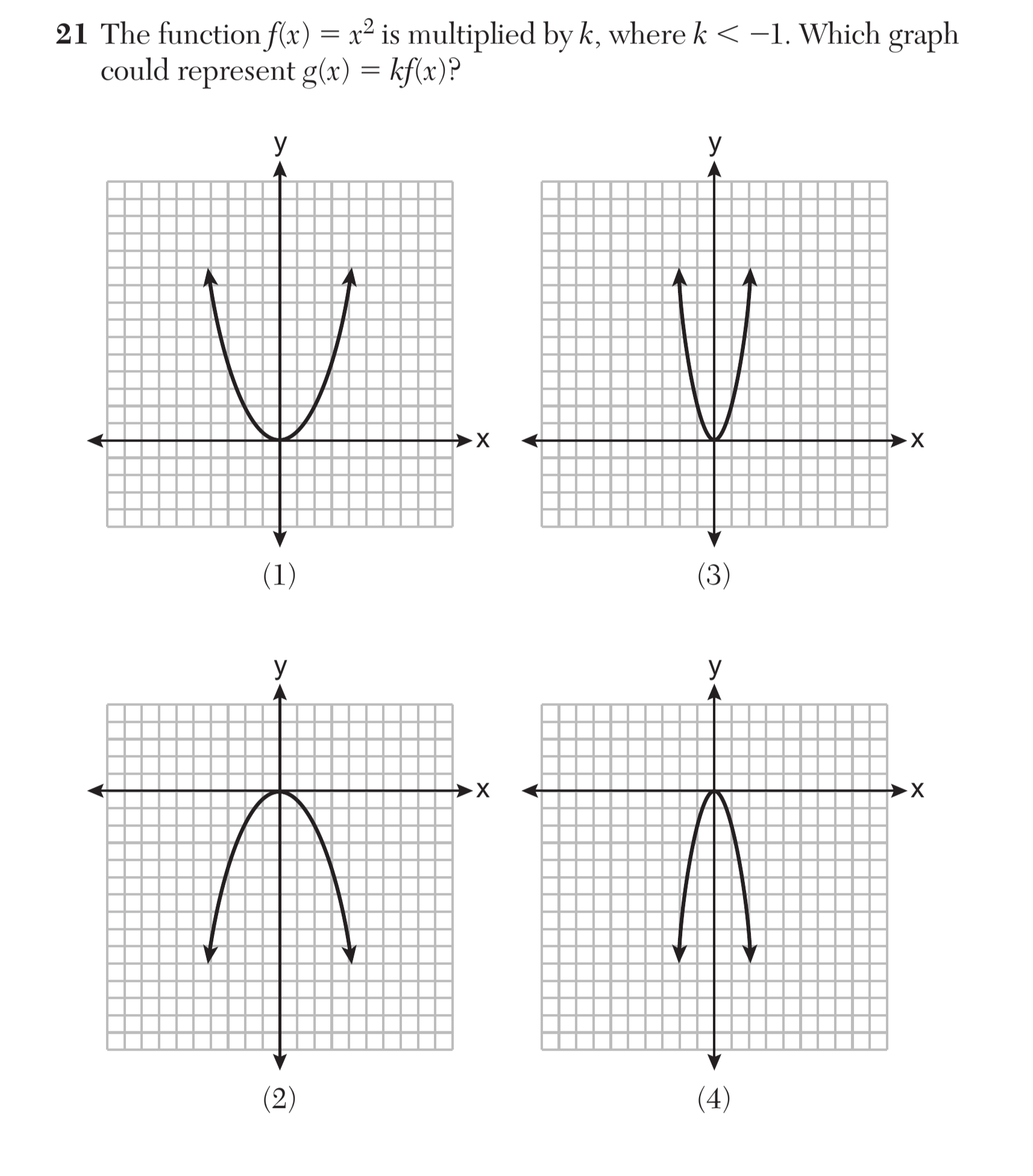
In general, a quadratic function expressed in vertex form is written as y=a(x−h)2+k. The vertex of its graph is at (h,k). The graph of the quadratic function opens upward when the coefficient, a, is positive and opens downward when a is negative.
Visual / Anchor Chart

Standards
F-BF.31 question
F-IF.7.a
Graph functions and show key features of the graph by hand and by using technology where appropriate.
F-IF.8.a
Write a function in different but equivalent forms to reveal and explain different properties of the function.