Solving Quadratic Equations by Reasoning
Student Summary
Some quadratic equations can be solved by performing the same operation on each side of the equal sign and reasoning about which values for the variable would make the equation true.
Suppose we wanted to solve 3(x+1)2−75=0. We can proceed like this:
- Add 75 to each side:
3(x+1)2=75
- Divide each side by 3:
(x+1)2=25
- What number can be squared to get 25?
(300)2=25
- There are two numbers that work, 5 and -5:
52=25 and (-5)2=25
- If x+1=5, then x=4.
- If x+1=-5, then x=-6.
This means that both x=4 and x=-6 make the equation true and are solutions to the equation.
Many quadratic equations have 2 solutions, but some have only 1 or no solution.
Visual / Anchor Chart

Standards
Addressing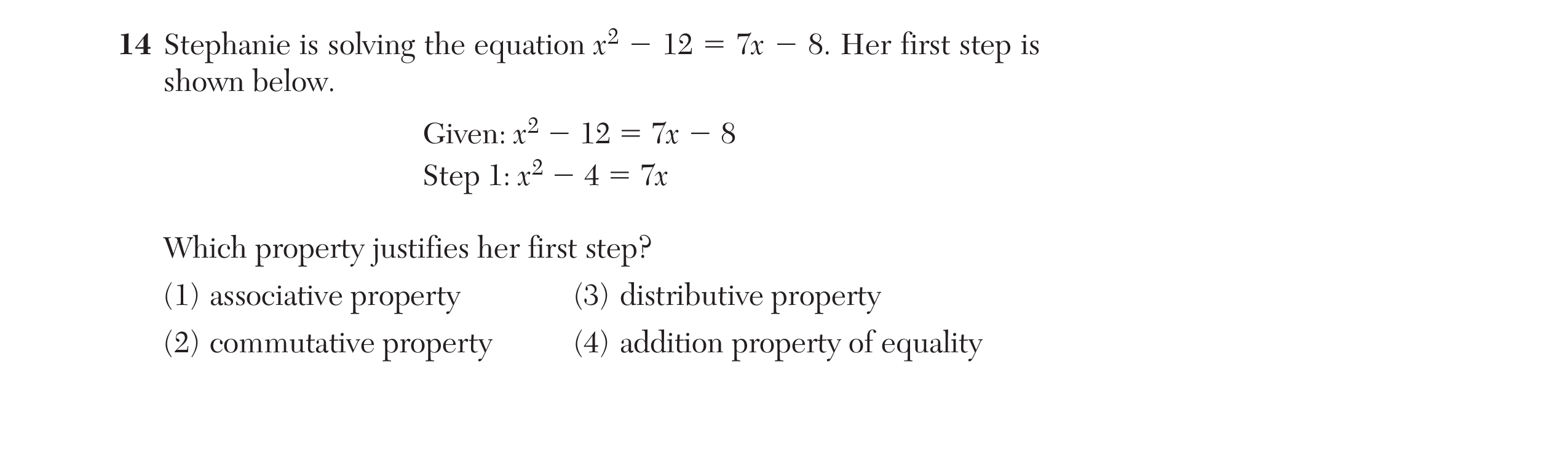
A-REI.11 question
Q14 · 2ptJanuary 2025
A-REI.4.b
Solve quadratic equations in one variable.