Rewriting Quadratic Expressions in Factored Form (Part 1)
Student Summary
Previously, you learned how to expand a quadratic expression in factored form and write it in standard form by applying the distributive property.
For example, to expand (x+4)(x+5), we apply the distributive property to multiply x by (x+5) and 4 by (x+5). Then, we apply the property again to multiply x by x, x by 5, 4 by x, and 4 by 5.
To keep track of all the products, we could make a diagram like this:
| x | 4 | |
|---|---|---|
| x | ||
| 5 |
Next, we could write the products of each pair inside the spaces:
| x | 4 | |
|---|---|---|
| x | x2 | 4x |
| 5 | 5x | 4⋅5 |
The diagram helps us see that (x+4)(x+5) is equivalent to x2+5x+4x+4⋅5, or in standard form, x2+9x+20.
- The linear term, or the term with a single factor of x in the standard form of a quadratic expression, is 9x and has a coefficient of 9, which is the sum of 5 and 4.
- The constant term, 20, is the product of 5 and 4.
We can use these observations to reason in the other direction: starting with an expression in standard form and writing it in factored form.
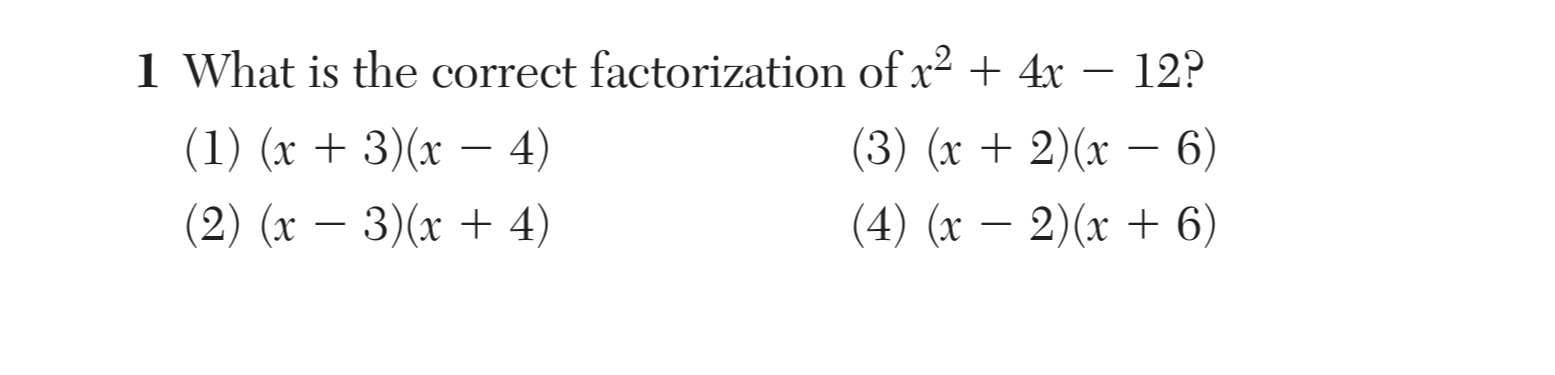
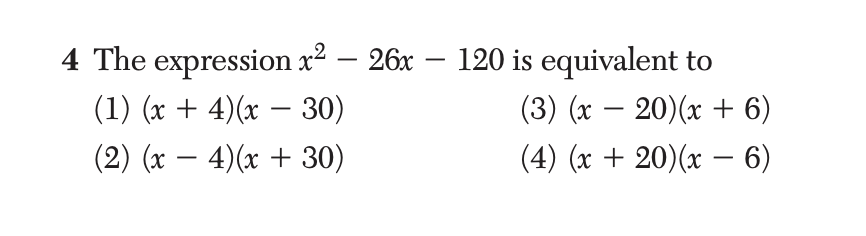
For example, suppose we wish to write x2−11x+24 in factored form.
Let’s start by creating a diagram and writing in the terms x2 and 24.
We need to think of two numbers that multiply to make 24 and add up to -11.
| x | ||
|---|---|---|
| x | x2 | |
| 24 |
After some thinking, we see that -8 and -3 meet these conditions. The product of -8 and -3 is 24. The sum of -8 and -3 is -11.
So, x2−11x+24 written in factored form is (x−8)(x−3).
| x | -8 | |
|---|---|---|
| x | x2 | -8x |
| -3 | -3x | 24 |
Visual / Anchor Chart

Standards
6.G.1
Find area of triangles, trapezoids, and other polygons by composing into rectangles or decomposing into triangles and quadrilaterals. Apply these techniques in the context of solving real-world and mathematical problems.
A-SSE.29 questions
Recognize and use the structure of an expression to identify ways to rewrite it.



A-REI.4.b
Solve quadratic equations in one variable.
A-SSE.29 questions
Recognize and use the structure of an expression to identify ways to rewrite it.
A-SSE.3.a
Choose and produce an equivalent form of an expression to reveal and explain properties of the quantity represented by the expression.